Strategic Background
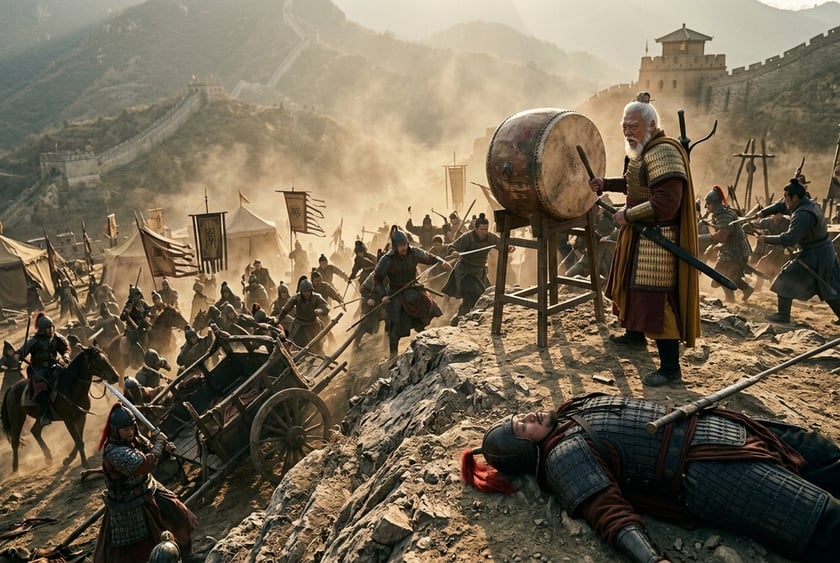
The Battle of Ruxukou in the Romance of the Three Kingdoms takes place in the eighteenth year of Jian'an (213) and is the first large-scale southern campaign Cao Cao organized after the Battle of Chibi (208). The previous year, the Sun-Liu alliance had shown signs of fracture — Sun Furen had been recalled to Wu by Sun Quan, and Zhang Fei and Zhao Yun had intercepted the young Liu Shan on the river, leaving Wu-Shu relations tense. Cao Cao chose this moment to march south, hoping to exploit the internal strains between Sun and Liu and swallow Jiangdong in one stroke. In the Romance's narrative, the stated pretext for Cao Cao's mobilization was "avenging the disgrace of Chibi," while the deeper logic was this: after the Chibi setback he had spent five years consolidating the north — pacifying Ma Chao, settling Liangzhou, securing the Guanzhong region — and now the time had come to march south again. The reported force of four hundred thousand also confirmed Cao Cao's resolve: this was the second southern campaign, second only to Chibi in scale.
Deployments on Both Sides
On Cao Cao's side: Cao Cao commanded in person; Cao Hong led thirty thousand iron-armored vanguard troops to reconnoiter to the river's edge, with the main force pressing up behind toward Ruxukou. The later Romance also describes a five-pronged deployment: Cao Cao's central army; Zhang Liao and Li Dian on the left; Xu Huang and Pang De on the right; each prong with ten thousand troops driving toward the riverbank. On Wu's side: Sun Quan personally led the naval forces in a standoff on the river. Lv Meng's key pre-battle recommendation was "to build a fort at the mouth of the Ruxu waterway to keep them at bay" — this became the celebrated Ruxu fort. The logic behind fortifying was this: relying solely on mobile naval action, infantry and cavalry could not board ships quickly enough when the enemy came suddenly; with the fort, water and land forces could switch rapidly. The other commanders initially dismissed the idea ("go ashore to attack, then wade onto the ships barefoot — what need to build a city?"), but Sun Quan adopted Lv Meng's suggestion and had it completed overnight. This fortification proved decisive in multiple subsequent engagements and became the signature installation of Wu's Yangtze defensive system.
Key Decision Points
The standout decisions in this battle do not lie in tactical clashes but in the "strategic restraint" both sides exercised. Cao Cao ascended a height to observe the Wu fleet in formation: seeing Sun Quan beneath a green silk parasol flanked by attendants civil and military, he exclaimed in admiration, "To beget a son, one should beget a Sun Zhongmou! The sons of Liu Jingsheng are no better than pigs and dogs". This moment was in fact an updating of Cao Cao's assessment of the Jiangnan power — he recognized that Sun Quan was in an entirely different category from Liu Biao's sons, and that Jiangdong was not the "unresolved territory" he had imagined before Chibi. On Sun Quan's side, restraint was equally in evidence. He did not push for a decisive engagement, relying instead on the Ruxu fort and his naval advantage to wear down Cao Cao's forces. There was only one proactive counter-raid — Sun Quan personally led a cavalry force to strike at Cao Cao's camp, with Han Dang and Zhou Tai crashing into the main position and nearly capturing Cao Cao, who escaped only through Xu Chu's desperate rearguard action. But this was a local counter-strike, not a pitched battle. For over a month the two armies "faced each other on the river, fighting several engagements, with neither side consistently winning". The underlying reality of this prolonged standoff was that neither side was willing to bet everything on a single throw — Cao Cao had learned the bitter lesson of fire attacks, and Sun Quan knew that four hundred thousand troops could not be resolved in a single naval engagement.
Outcome and Reverberations
The turning point was seasonal. The following spring, unrelenting rain flooded every waterway and port and left the troops mired in mud, sharply increasing logistical pressure on Cao Cao's forces. Cao Cao was inclined to withdraw but feared being mocked by Eastern Wu, caught between advancing and retreating. At this point Sun Quan sent a letter, courteous yet firm: "You and I are both ministers of the Han — you should be working to repay the dynasty and bring peace to the people, yet you recklessly raise arms... Today spring waters are rising; you should withdraw promptly. Otherwise you will suffer another catastrophe like Chibi." On the back of the letter two lines were brushed: "If you do not die, my heart will not be at ease". Cao Cao read it and laughed aloud: "Sun Zhongmou does not deceive me." He rewarded the messenger richly, ordered the army to withdraw, instructed the Governor of Lujiang, Zhu Guang, to garrison Wancheng, and himself led the great army back to Xu Chang. Sun Quan also recalled his forces to Moling. What was unique about this battle was the absence of a Chibi-style decisive engagement, yet its strategic significance was great — it confirmed the "north-south separation" pattern that had taken shape after Chibi, and proved that Sun Quan could independently resist Cao Cao's full-scale southern offensive. From this point on, Cao Cao's posture toward Jiangnan became predominantly defensive; he redirected his military attention to Hanzhong and Guanzhong. Another long-running consequence was Lv Meng's rise. The Ruxu fortification proposal elevated Lv Meng's standing substantially in military and political terms, paving the way for him to succeed Lu Su as the supreme commander in the Jingzhou direction a few years later. The Romance's later chapter sixty-eight also expands the Ruxu battlefield into a series of connected engagements — Ganningbaiqijieweiying, Zhang Liao and Li Dian attacking in separate columns — further enriching the narrative of the Ruxu battlefield.
Counterfactual Analysis
What if Cao Cao had forced a decisive battle before the spring rains arrived? With four hundred thousand against Sun Quan's full Jiangdong strength (perhaps over one hundred thousand water and land troops), Cao Cao held the numerical advantage — but the lesson of Chibi was too deeply learned. Northerners were disadvantaged in water combat; forcing a decisive engagement would most likely have repeated the fire-attack disaster. Cao Cao's choice to maintain the standoff was pragmatic; the problem was only that this "war of attrition" also imposed no small political and economic pressure on the north. What if Sun Quan had launched an active counter-offensive while Cao Cao's forces were mired in the spring rains? Short-term local victories might have been achievable, but the risks of pursuing Cao Cao's main force in full were extreme — Cao Cao's retreating army still numbered in the hundreds of thousands, with layered defensive positions along the Huai and Ru rivers; once Wu forces crossed deeply onto the north bank, their naval superiority would vanish and their cavalry disadvantage would be exposed. Sun Quan's choice to "send Cao Cao off politely with a letter" maximized the political value of the victory — without losing troops, Wu won the international reputation of "Jiangdong is not to be taken lightly." Seen over a longer time horizon, the Battle of Ruxukou in the eighteenth year of Jian'an is less a battle in the conventional sense and more an important confirmation of the "north-south separation" system that had emerged from Chibi. It produced no dramatic decisive outcome, but it established the basic framework of the three-way standoff — after this, Cao Cao never again launched a southern campaign of such scale, and Sun Quan harbored no ambition to advance into the central plains; both sides entered a period of relative stable confrontation along the Yangtze line that lasted well over a decade.