Strategic Background
The Battle of Ruxukou in the eighteenth year of Jian'an (213) was the first large-scale standoff along the river between Cao Cao and Sun Quan after Chibi. Cao Cao personally led four hundred thousand troops southward, intending to pressure Sun Quan's Ruxukou stronghold on the northern bank of the Yangtze and thereby threaten Jianye. Sun Quan had constructed fort-works at Ruxu and established a combined land-naval defense system, transferring the Yangtze middle-reaches naval advantage to the line of Hefei–Ruxu–Chaohu. Overall, this standoff differed from the Battle of Hefei in that it did not center on contest over a city but rather on the two sides wearing down each other's endurance at the Yangtze–Chaohu waterway node through positional warfare [c:17375]. In this kind of prolonged standoff, what Sunwu needed was not merely solid defense but also proactive small-scale "challenge-style" actions to break the psychological advantage Cao forces held — this was the strategic context in which the hundred-cavalry raid on the Wei camp was adopted.
Disposition of Forces
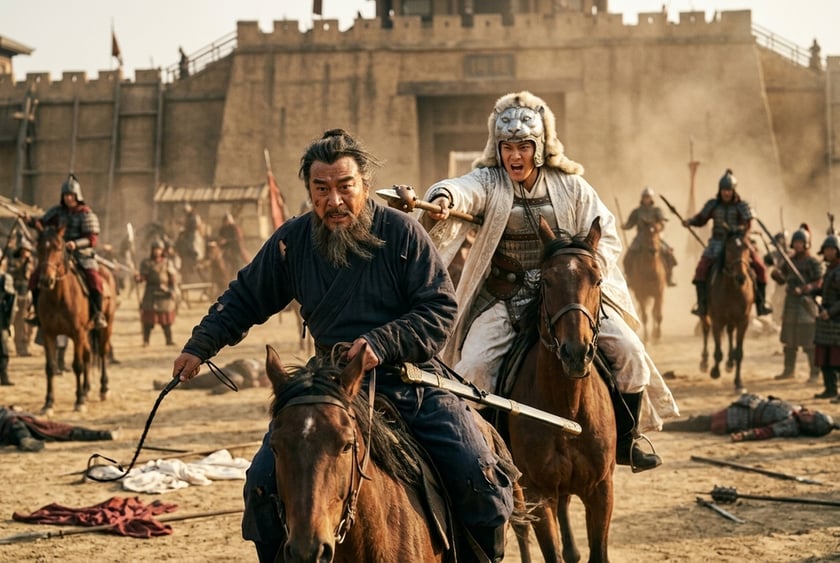
Gan Ning's deployment followed the standard pattern of Sunwu's elite-force night raids: one hundred elite cavalry, communal drinking and oath-taking, setting out at the second watch, white egret feathers stuck in helmets for mutual identification [c:17375]. Cao Cao's deployment reflected the mature defensive system the Cao central army had developed against night raids: carts positioned as roadblocks, encircling like an iron barrel — a mark that the Cao forces had developed systematic countermeasures against surprise attacks. It should be noted that this passage in the novel's Chapter 68 is almost identical to event 325 (the hundred-cavalry raid in the Battle of Hefei) [c:17374] [c:17375], reflecting the novel's reuse of the same narrative across different battles. From a historiographical standpoint, the more probable true attribution of this tactic is the Battle of Ruxukou — the context of the Gan Ning biography in San Guozhi in which "Gan Ning led a hundred men to break Cao's camp" aligns more closely with Ruxukou; the novel placed this episode at both Hefei and Ruxukou, which is a literary treatment's multi-event expansion of a real incident.
Critical Decision Points
The key of this engagement lay not in "how many people were killed" but in rehearsing and demonstrating a new type of small-scale psychological warfare. After Gan Ning led his hundred cavalry into the linked-cart central formation, they did not become trapped inside the perimeter but maneuvered repeatedly among Cao Cao's roadblocks and carts, charging left and right, making noise and raising fire, causing Cao forces to be unable to determine the actual size of the enemy force and throwing themselves into disorder [c:17375]. This tactic of "frighten if you cannot pierce through" produced additional disruption against Cao Cao's forces who were methodically advancing through positional warfare: the Cao forces were compelled to maintain high alert and strengthen night-defense, invisibly consuming the physical energy and morale of the main army troops. Gan Ning's choice to withdraw through the south gate, with Sun Quan timely ordering Zhou Tai to receive them, allowed this disruption operation to conclude with zero losses — a manifestation of the operational maturity of Sunwu's strike tactics in execution detail.
Outcome and Reverberations
In terms of tactical results, Sunwu left a conspicuous disruption incident in the Cao central camp at extremely low cost; in terms of strategic results, this disruption provided partial justification for Cao Cao's "spring waters are rising" northward withdrawal — the Battle of Ruxukou ultimately concluded with Cao Cao returning north and Sun Quan holding the defense. Looking at the narrative of commanders' reputations, the hundred-cavalry raid on the Wei camp is one of the core episodes of Gan Ning's celebrated-general image; combined with the similar narrative in the Battle of Hefei, it made the story of "Gan Ning dared to enter ten thousand troops with one hundred cavalry" a general spiritual resource in the Wu military; the novel's reuse of the same narrative across two battles in turn reinforced the stability of this image in the reader's mind.
Counterfactual Analysis
Had Sunwu launched no similar small-scale sharp-force actions during the Battle of Ruxukou and let the standoff degrade entirely into water-land passive defense, Cao Cao might have remained stationed at Ruxu for longer and attempted new lines of attack, with the entire battle outcome perhaps not concluding until the following year. Conversely, had the Cao central camp adjusted its defensive line and launched active counter-attacks after the hundred-cavalry surprise, the Wu forces would have found it very difficult to repeat the same method effectively a second time — which is why "the hundred-cavalry raid" in San Guo battle examples was employed effectively at most one or two times: once the enemy learned its lesson, the marginal returns of this form of psychological warfare declined sharply. From a broader macro perspective, the hundred-cavalry raid on the Wei camp and the Ganningbaiqijieying at the Battle of Hefei form a pair of narratives that in actuality represent the standard operational template Sunwu developed to respond to Caowei's main army: the naval main force holds the Yangtze, while sharp-force units repeatedly disrupt the Chaohu–Ruxu–Hefei line, making it difficult for Cao forces to stabilize their supply and psychological tempo. This was a key tactical element enabling Sunwu to maintain its Yangtze defense line for half a century after Chibi.
Additionally, from the perspective of documentary organization, event 325 (the Battle of Hefei in the twentieth year of Jian'an) and the present event (the Battle of Ruxukou in the eighteenth year of Jian'an) share the same narrative passage from the novel's Chapter 68 — this is a case of "event attribution drift" that needs to be annotated in the knowledge base; when subsequently displaying both on the map, it should be noted that the two narratives differ in year, geography, and literary reuse, rather than being treated as two entirely independent military actions.