Background
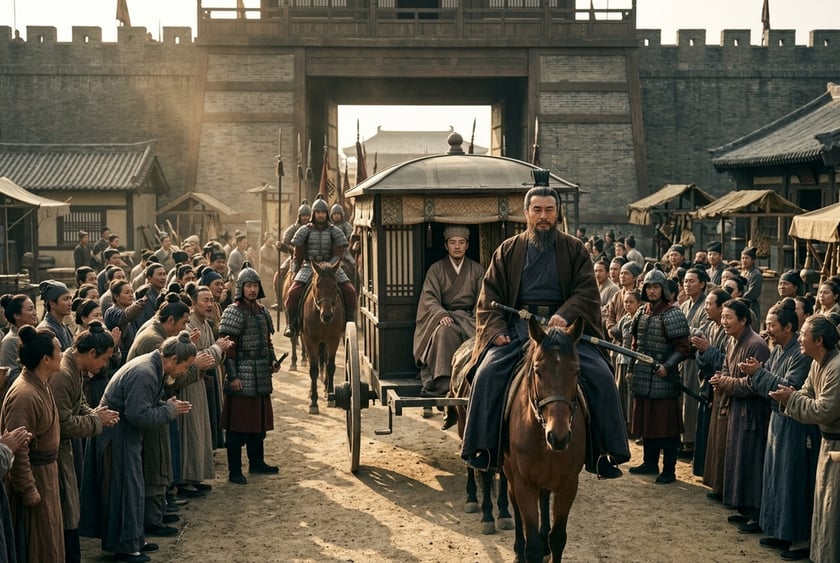
The twenty-fourth year of Jian'an was the most sensitive year of Cao Cao's later reign. Hanzhong had just been lost, Guanyubeifa was underway in the north, and the succession remained unresolved — several political threads simultaneously entering a zone of high intensity. It was precisely at this juncture that Yang Xiu, Chief of Staff to the Chancellor, was executed on the charges of "divulging edicts and instructions and forming associations with the lords." According to Pei Songzhi's annotations to the San Guozhi biography, Cao Cao had already noted the damaging precedent set by Cao Zhi's unauthorized use of the Sima Gate, and had begun redrafting the "regulations governing the princes," with the favor shown to the Prince of Linzi steadily declining; it was at this moment that Yang Xiu, as a core figure in Cao Zhi's faction, was placed on the list for reckoning [c:17121]. Unlike the novel's dramatization of "chicken ribs" as a theatrical trigger, in the historical record this blow was in substance a clearing of the field in the succession dispute.
Principal Figures
Yang Xiu came from the Hongnong Yang clan; his father Yang Biao had risen to Grand Commandant. He was also a nephew of Yuan Shu — this dual identity added a layer of political calculation to Cao Cao's decision. Pei Songzhi's annotation, citing the Dianlüe, explicitly records that Yang Xiu was "modest, deferential, and widely accomplished," and that everyone from the Heir to Wei downward competed to cultivate his friendship; Cao Zhi, "quick-witted and much favored," exchanged frequent letters with Yang Xiu, binding him into the role of his chief strategist [c:17121]. Cao Cao, driven by anxiety about "the beginning and end of the succession," resolved to first cut away the most essential pillar. After Yang Xiu's death, Cao Zhi "grew increasingly uneasy within," an emotional trajectory clearly visible throughout the biography.
Core Issues
This case has three layers worth unpacking. First, it was formally an execution for crime, but substantively a preemptive purge — while Cao Cao could still maintain control, he severed the core of the Cao Zhi camp to prevent a confrontation between two courts after his death. Second, it involves the delicate boundary between the aristocracy and the imperial clan. Yang Xiu, as the son of a prominent household, intervened in the struggle over who would be designated heir — treading precisely on the red line that Cao Cao found most sensitive, concerning "private partisans of the lords." Third, the Yuan bloodline was an anxiety deliberately invoked: after Guandu, any association with the old Yuan network was enough to constitute political contamination, which is why Pei Songzhi's annotation specifically singles out "he was also a nephew of Yuan Shu" [c:17121].
Political Consequences
After Yang Xiu's death, the Cao Zhi faction lost its most strategically capable and organizationally effective advisor; the remaining pillars, Ding Yi and Ding Yi (Ding Piao), were progressively purged after Cao Pi took the throne. Cao Pi prevailed completely on the succession's scales and enshrined "no private associations among the lords" as a founding law of the new dynasty. For the aristocracy, this case sent a clear signal: even birth in a top-tier lineage made intervention in imperial succession a wager with very high odds of death. For the Yang Biao line, the Hongnong Yang clan thereafter maintained a prolonged low profile; Yang Biao himself refused to resume office at the Han-Wei transition, absorbing through his family's posture the trauma this case had inflicted.
Counterfactual Analysis
Had Cao Cao chosen to demote rather than execute Yang Xiu, Yang Xiu would in all likelihood still have been purged after Cao Pi took the throne — but that would have become a political burden on the new ruler, creating for the early Caowei the reputational liability of "a talented clan scholar executed by the crown." Had Yang Xiu sought a transfer to an outer commandery a year earlier, leaving the vortex of the succession, his high efficiency in administrative matters might have let him survive; but Cao Zhi's disadvantage in Cao Cao's eyes was already established, and Yang Xiu's unilateral withdrawal could not have reversed the overall logic of the reckoning. Had Cao Zhi conceded defeat in the succession early and of his own accord pulled back from his social networks, Yang Xiu might have avoided being pinned as the specimen of a "private partisan of the lords" — this line of reasoning confirms a common pattern: in an imperial succession struggle, the first to be sacrificed are always the advisors who committed most deeply to a side, not the princes who did the taking of sides themselves.