Background
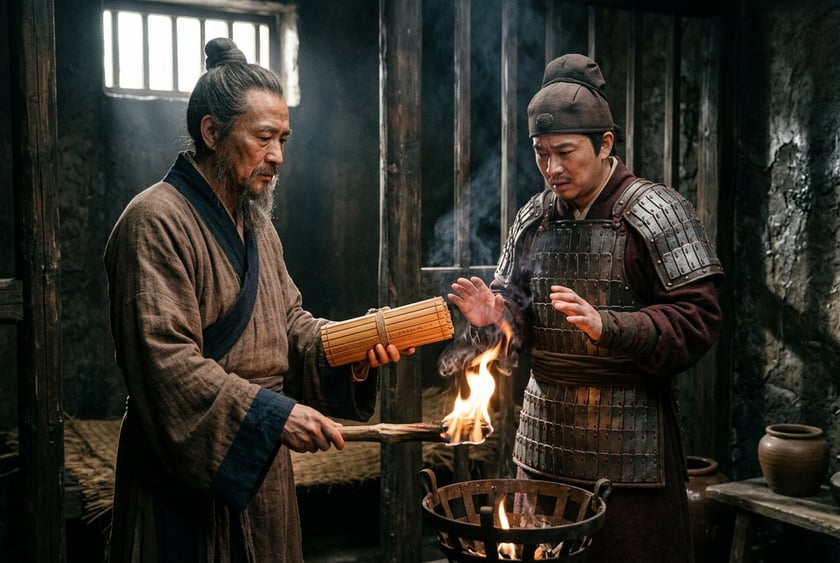
This event and "Liyanfeichu" (event 270) are two narrative cross-sections of the same historical process — the former focuses on the outcome (reduction to commoner status) while this entry focuses on the cause (Li Yan's failure to deliver supplies on time and the false memorial that triggered the recall). In the ninth year of Jianxing (231), Zhuge Liang launched the Disicibeifa, again targeting the Qishan direction and engaging Sima Yi's main force. Shuhan's army achieved significant tactical victories on the front — routing Wei forces in the battle of Lucheng, seizing Wei's grain harvest at Shangyi, and scattering the Yong-Liang relief column, leaving bodies strewn across the field. Yet Shuhan's underlying national strength meant that any extended deployment in the field depended on a fragile supply chain — the mountain road relay from Hanzhong to Qishan. That autumn brought heavy rains; the mountain roads were muddy and impassable, and Li Yan's supervisory capacity was already insufficient, causing a supply crisis at the front. The core political problem in this event was not the technical question of "whether the grain road could be fixed," but the question of character: "how does the man in charge of supply handle his own dereliction?"
Principal Figures
Li Yan is the core responsible party, then serving as Protector-General and Military Governor of Yongan, responsible for Shuhan's eastern military administration and rear-area logistics. The political calculation and self-interest embedded in his character were fully exposed when confronted with his own failure: rather than confess and seek improvement, he chose the riskier path of "falsifying military intelligence." Zhuge Liang, as front-line commander, fell into a strategic dilemma upon receiving Li Yan's urgent dispatch — he had to choose between "the possibility of an Eastern Wu incursion" and "abandoning battlefield advantages already secured". Jiang Wan, then serving in the rear as a staff officer to the Chancellor, was the key interceding figure in the subsequent handling; Fei Yi, moving as a liaison between Hanzhong and Chengdu, laid the full picture of events before the emperor and was the executor who exposed the truth. Dong Yun, as Palace Attendant and the palace's eyes and ears, had indirect knowledge of how the affair was progressing and was an invisible participant in the political balancing during the handling phase.
Core Issues
The true issue in this event is "how Zhuge Liang handled a urgent dispatch that was clearly possibly forged." Looking at the novel's text, Li Yan's letter was extremely sophisticated — it invoked a concrete threat (Eastern Wu joining forces with Wei) while also offering a clear political recommendation (make sound plans promptly). It reads less like a simple distress call and more like a carefully designed strategic report. Zhuge Liang's reaction — "greatly astonished and suspicious upon reading it" — indicates that he did not fully believe it, yet he still chose the conservative path of "better to believe it true," ordering the withdrawal from the Qishan main encampment back to Xichuan. This was an acutely ironic moment: Zhuge Liang was famous for caution, yet precisely this caution was exploited by Li Yan to surrender every strategic advantage already gained on the front. In the course of the withdrawal, Zhuge Liang again demonstrated tactical brilliance — anticipating that Sima Yi "would certainly not dare pursue," he ordered Wang Ping, Zhang Yi, Wu Ban, and Wu Yi to withdraw in two columns at a measured pace back into Xichuan, avoiding the worst outcome of "a withdrawal becoming a rout." Yet upon returning to Hanzhong the truth rapidly surfaced — Li Yan falsely memorialized the emperor that "the Chancellor withdrew the army without cause," pushing responsibility back onto Zhuge Liang. This act of deceiving the throne utterly broke every bound of political tolerance.
Political Consequences
After the affair was exposed, the handling process is detailed in the preceding entry on "Liyanfeichu" (event 270): Zhuge Liang summoned Li Yan to arraignment and wished to execute him; Fei Yi interceded on the grounds of a regent minister's commission; after memorializing the emperor, the emperor in great fury wished to execute Li Yan; Jiang Wan interceded on the grounds of a regent minister's commission; and the final resolution was reduction to commoner status and banishment to Zitong. In terms of institutional consequences, this event produced three effects. First, Shuhan established the political precedent of "front-line dereliction — post-hoc accountability," strengthening wartime discipline. Second, Zhuge Liang's chancellorial position henceforth faced no constraint, and the dual-track regency system ended simultaneously in name and in substance. Third, after this reorganization Shuhan's supply-supervision apparatus was taken over by generals from the pro-Zhuge Liang circle such as Jiang Wan, Fei Yi, and Jiang Wei, achieving some improvement in overall efficiency — but strategic initiative also gave way to the steady defensive line of "using defense as offense."
Counterfactual Analysis
If Li Yan's urgent dispatch had been genuine — if Eastern Wu had truly joined forces with Wei — Zhuge Liang's decision to withdraw would have been absolutely correct, and he would have earned the reputation of "prudent foresight" in historical evaluation. But Li Yan chose to fabricate, and this transformed Zhuge Liang's withdrawal decision into "the humiliation of having been deceived." From a political science perspective, the deepest lesson of this affair is not "how to prevent subordinates from falsifying reports" but rather "how to distinguish the reliability of intelligence from the soundness of a decision." With no time to verify the intelligence, Zhuge Liang's conservative decision to withdraw was blameless from a risk-management standpoint; the problem lay in his longstanding failure to accurately assess the political character of Li Yan, a core deputy — Li Yan's early encroachments (the demands for his own chancellery and for the nine-commandery Bazhou) could have served as warning signs, but Zhuge Liang had chosen to endure them. Had he perceived Li Yan's political inclinations earlier, the crisis of the ninth year of Jianxing might have been avoidable. But from another angle, it was precisely this crisis that allowed Zhuge Liang to clearly see the fragility of Shuhan's power structure, and it accelerated his final adjustments to the northern campaign strategy — the standoff at Wuzhangyuan, the cultivation of farmland to stockpile grain, the secret plot of the fire attack at Shangfanggu, all of these were premised on "never again being able to rely on a rear position like Li Yan's." In that sense, Li Yan's false dispatch, however humiliating, was also the catalyst that brought Zhuge Liang's strategic thinking to its final form.