Background
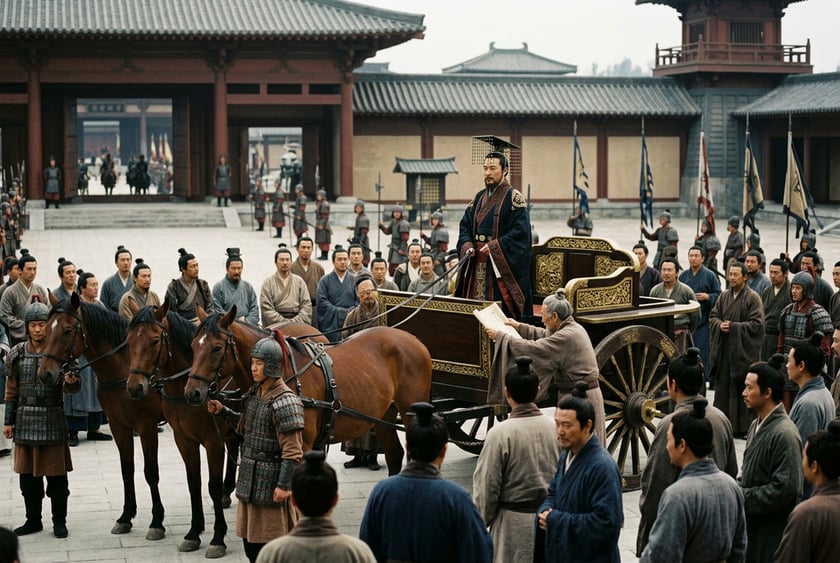
Cao Cao Created King of Wei was not simply a promotion in rank, but an important turning point in the late Han power structure, as it shifted further from “governing in the name of the Han dynasty” toward “establishing a Cao family kingdom.” According to Romance of the Three Kingdoms, Volume 68 places the investiture in the fifth month of the twenty-first year of Jian’an (216): the officials submitted a memorial praising Cao Cao’s merit and virtue, Emperor Xian of Han ordered Zhong Yao to draft an edict, and Cao Cao was installed as King of Wei. The ceremony still took the form of an imperial edict, but the forces driving the proposal, assessing his achievements, and effecting the investiture clearly came from the political faction under Cao Cao’s control.
Volume 66, meanwhile, offers an earlier episode in which the proposal to make Cao Cao king met resistance. Wang Can, Du Xi, Wei Kai, He Qia, and others proposed honoring Cao Cao as King of Wei. Xun You objected on the grounds that Cao Cao was already Duke of Wei, had received the Nine Bestowments, and had “reached the utmost rank.” Cao Cao was angered, and the proposal to make him king was temporarily dropped. Volume 68 then describes the officials submitting another memorial two years later and the Han emperor issuing an edict, showing that this was not a straightforward ceremonial promotion, but a political arrangement shaped by resistance, suspension, and renewed advocacy. The change in the narrative between the two volumes highlights the political weight of when to claim kingship, who should propose it, and how it should be presented.
It is important to note that the material at hand consists of narrative passages from Romance of the Three Kingdoms, not multiple independent historical sources sufficient to verify the details. It can be used to analyze how the novel presents the relationship between power and legitimacy, but its dialogue, specific motives, and causal explanations of events should not therefore be treated as established historical fact. The following interpretation thus focuses on how the text presents events and remains cautious in making historical claims.
Major Figures
Cao Cao is at the center of the investiture process and is also the actual organizer of power in the narrative. Volume 66 says that he was “angered” when he heard of Xun You’s opposition, and links Xun You’s attitude to Xun Yu. Volume 68, by contrast, says that Cao Cao submitted three memorials declining the honor before accepting the investiture. The former passage shows a political leader sensitive to dissent within his ranks; the latter depicts a public ceremony in which he maintains a posture of deference through formal refusals. Taken together, the two passages show that the novel’s Cao Cao needs both to retain the initiative in decision-making and to use Han court procedures to make his expansion of power appear properly sanctioned.
In Volume 68, Emperor Xian of Han is the issuer of the edict installing Cao Cao, while Zhong Yao performs the procedural task of drafting it. The text does not describe Emperor Xian’s true attitude toward the investiture, nor does it say whether Zhong Yao had any independent scope for decision-making. Rather than simply describing the two as active supporters, it is more accurate to say that they represent imperial authorization and the court’s documentary procedure, respectively. The investiture still had to be carried out in the Han emperor’s name, which itself shows that, although constrained by powerful ministers, the Han dynasty’s name retained political value that could be invoked.
Xun You is a significant internal opponent. Citing Cao Cao’s position as Duke of Wei and receipt of the Nine Bestowments, he argues that promotion to kingship might exceed the proper limits. Volume 66 also links his opposition to Cao Cao’s anger and Xun You’s subsequent death from illness, but narrative proximity does not suffice to prove that Cao Cao caused his death. Cao Pi appears in the succession arrangements following the investiture: Cao Cao “discussed appointing an heir apparent,” the sons born to Lady Bian are listed, and Lady Bian is installed as Queen of Wei. Cui Yan is also listed among the related figures, but the passages provided do not recount the circumstances of his death; his actions or cause of death cannot be supplied merely on the basis of the event summary.
Key Issues
The first issue is the expansion of power and the limits of status. Xun You’s objection does not deny that Cao Cao already holds a high position; rather, he argues that the title of Duke of Wei and the Nine Bestowments have already brought him close to the upper limit of political rank. This turns the dispute from one about personal merit into one about institutional boundaries. Kingship would further elevate Cao Cao’s title, ceremonial standing, and political status, while making the disparity in power between Cao Cao’s faction and the Han emperor more overt. The phrase “reached the utmost rank” points to a political risk: every promotion in rank can affirm existing power, but also invite questions about whether the proper limits have been exceeded.
The second issue is how legitimacy is produced. The officials’ memorial portrays Cao Cao as a figure of outstanding merit and virtue, worthy of comparison with Yi Yin and the Duke of Zhou. Emperor Xian’s edict then recasts the political initiative as authorization by the court. The ceremony of three refusals and three imperial commands transforms acceptance of the title into an act of submission to an unavoidable command. In the structure of the text, these steps together complete the transition from a proposal by Cao Cao’s faction, to imperial investiture, and finally to Cao Cao’s acceptance. They may not eliminate the imbalance of power, but they give the change in power a recognizable ritual and legal form.
The third issue is succession and court order. After the investiture, the narrative turns immediately to the choice of heir apparent, Cao Cao’s sons, and the status of the consorts, indicating that kingship changed not only Cao Cao’s own title but also made the continuity of the kingdom an urgent concern. Lady Ding’s having no sons, Cao Ang’s death, and the enumeration of Lady Bian’s sons provide the family context for the succession discussion. Lady Bian’s installation as Queen of Wei links the status of the inner court with the new royal order. But the passage provided does not record the final decision on the heir apparent, so it cannot be said on this basis that the dispute had already been resolved.
Political Consequences
As presented in the novel, after Cao Cao’s investiture he received the title of King of Wei and used a twelve-strand crown, a golden-root chariot, six horses, and ceremonial regalia associated with the Son of Heaven. He also built a royal palace at Ye Commandery. Such ritual and spatial symbols gave concrete, everyday visibility to the hierarchy of power, turning the Prince of Wei’s court from a personal honor into an institution suggestive of an independent political center. At the same time, the text retains the formal act of investiture by the Han emperor, presenting a state of coexistence: the Han dynasty’s name remained in use, while Cao Cao’s power was further embodied in his royal title, palace, and ceremonial retinue.
Within the court, the account of the investiture draws attention to both the scope for dissent and its possible cost. Xun You’s opposition in Volume 66 displeased Cao Cao, and the proposal was promptly suspended. When the proposal later advanced, the public path was formed by the officials’ memorial and the emperor’s edict. This arrangement makes political disagreement more than a dispute over policy: it also concerns who may define what constitutes an “appropriate” rank and who has the power to advance an agenda. As for Death of Cui Yan, although the event summary lists it as a related episode, the two original passages provided do not give details. One can therefore only note that the political atmosphere around the investiture may have involved pressure on dissent, not assign a specific cause of death or responsibility to any party.
In the longer term, the investiture brought the question of the transfer of power to the fore. After Cao Cao gained the royal title, the narrative turns to the appointment of an heir apparent and the arrangements for the consorts, showing that the stability of the regime depended no longer solely on Cao Cao’s personal prestige, but also on whether agreement could be reached on the rules of succession. Cao Pi is not explicitly identified as heir apparent in this material, but his status as Lady Bian’s eldest son has already entered the succession narrative. The investiture thus had two effects at once: it strengthened the incumbent ruler’s rank and resources, while increasing the political importance of future succession struggles.
Counterfactual Scenarios
Had Cao Cao accepted Xun You’s advice and remained Duke of Wei instead of advancing to King of Wei, his faction could still have governed on the basis of its existing rank and political strength, and in the short term this might have reduced controversy over an overt breach of the limits of proper status. However, Volume 66 shows only that the opposition was enough to suspend the proposal temporarily; it does not prove that it could have prevented Cao Cao from becoming king in the long term. Without the royal title, palace, and corresponding ceremonial retinue, the institutional expression of the Cao family’s center of power might also have been weaker. This is a possibility inferred from the symbols listed in the text, not an outcome established by the material.
If the officials had not submitted a memorial and Emperor Xian had not issued an edict, but Cao Cao had simply proclaimed himself king, the fact of his power might have been more direct, but the process would have lacked the elements the novel emphasizes as lending legitimacy: the emperor’s edict, the officials’ praise of his achievements, and the ritual of three refusals and three appeals. Conversely, even when the formal procedures were complete, the available material does not allow us to conclude that all participants genuinely approved. The text presents a narrative framework that gives the elevation of power the appearance of ritual propriety; it does not prove the actual degree of acceptance among officials, the emperor, or local forces. This distinction helps avoid mistaking ritual compliance for political consensus.
If the appointment of an heir apparent and arrangements for the consorts had been postponed after the investiture, this might have reduced the risk of competition forming too early within the court around the succession, but it would also have left an institutional gap over who would inherit the kingdom. If an heir had been designated promptly, the succession might have become more predictable, while the political space available to other members of the ruling family might have narrowed. The material provided says only that there was “discussion of appointing an heir apparent,” lists the sons, and records Lady Bian’s installation; it does not identify the final choice or the outcome of the dispute. Both paths can therefore be considered only as conditional scenarios. Overall, the deeper significance of Cao Cao Created King of Wei lies not in the title alone, but in the way it brought the questions of legitimizing power, institutionalizing it, and ensuring its succession to the fore all at once.