Final Circumstances
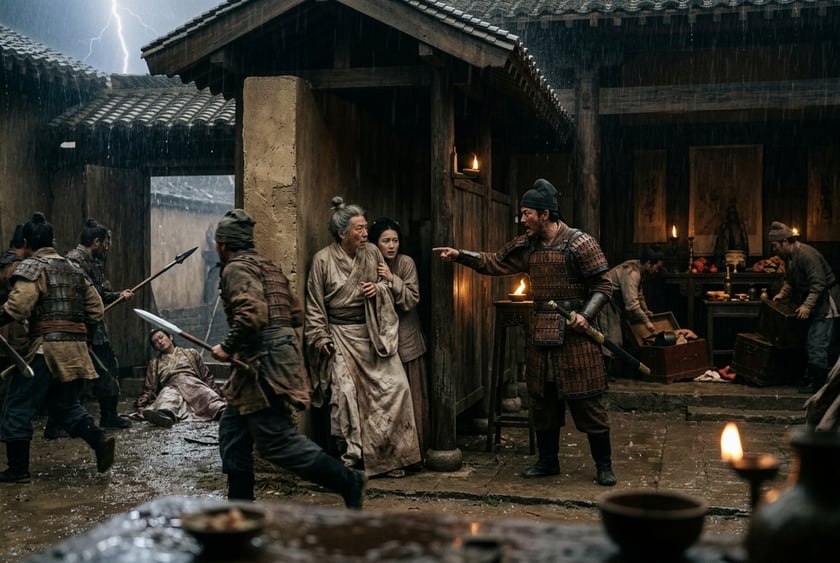
In the historical sources, the death of Hua Tuo was not a dramatic single instant but the conclusion of a months-long political and doctor-patient impasse. In Cao Cao's later years his headaches grew increasingly frequent; he summoned Hua Tuo for specialist treatment, and Hua Tuo judged that "this is nearly impossible to cure — it can only be managed with sustained treatment to prolong his years," meaning that only ongoing therapy could maintain his condition and eliminate it entirely was beyond reach. This medical judgment was already a source of dissatisfaction for Cao Cao, and thereafter Hua Tuo repeatedly requested leave of absence citing correspondence from home and his wife's illness, while Cao Cao repeatedly summoned him in writing and ordered the commandery to dispatch him — yet Hua Tuo, "relying on his skill and disdaining menial service, still would not set out," and was ultimately arrested and sent to prison in Xu for interrogation under torture, where he died. The novel places the final scene forward to a diagnostic consultation: Hua Tuo proposed to open the skull with "anesthetic powder and an axe" to extract the wind-phlegm; Cao Cao suspected an assassination plot, immediately had him seized and subjected to urgent examination under torture, and Hua Tuo died under torture in prison. The two versions of his final circumstances differ greatly, but both share the same main thread: "collapse of doctor-patient trust — imprisonment and torture — death in prison."
Final Words or Dying Instructions
The historical record preserves the key scene before Hua Tuo's death: from prison he produced a scroll of writings and handed it to the jailer, saying, "This can save lives." The jailer, fearing the law, dared not accept it; Hua Tuo did not press the matter, asked for a fire, and burned the writings. This scene holds landmark significance in the history of Chinese medicine: it placed "medical transmission" and "administrative system" in direct opposition — a physician inside the machinery of the state, at the final moment of his life, still attempting to pass his medical knowledge to the most ordinary of jailers, but the system caused this transmission to fail at the last step. The specific content of that scroll is irrecoverable today, but given the highly refined surgical techniques described in Hua Tuo's own biography in the San Guozhi — the anesthetic powder, excision surgery, bone-scraping, and intestinal suturing — that scroll was most likely the most systematic clinical compendium of ancient Chinese surgery ever assembled. Its burning caused the Chinese surgical tradition to lose its most vital branch of independent development after Hua Tuo, for more than a thousand years.
Aftermath
After Hua Tuo's death, Cao Cao did not truly "let it go." His headaches remained uncured, and he stubbornly declared, "Hua Tuo could have cured this. That wretch was keeping me sick so he could make himself indispensable — but even if I had not killed him, he ultimately would never have cut out the root of this condition," rationalizing the killing as prevention of a physician leveraging illness for personal gain. But reality soon struck back: when his beloved son Cao Chong (Cangzhu) fell critically ill, Cao Cao finally lamented, "I regret having killed Hua Tuo — it has condemned this child to die young". This record of regret is one of the rare glimpses of Cao Cao's private emotions in the historical sources, and the only explicit self-reflection on his own decision by the man himself. In the novel's version, after Hua Tuo's death Cao Cao's headaches "grew even heavier," and he ultimately died of complications related to his wind ailment, casting "killing Hua Tuo" as a pivotal node in the self-inflicted destruction of Cao Cao's later years. Hua Tuo's two disciples, Wu Pu and Fan A, later transmitted the Five Animal Frolics and acupuncture respectively, but the complete surgical system was never passed on.
Historical Assessment
The assessments of this event offered by the historical sources and the novel provide two entirely different ethical coordinates. Chen Shou recorded the event in San Guozhi with relatively restrained brushwork, but through details such as Xun Yu's failed plea for Hua Tuo's life and Cao Cao's subsequent remorse, he laid bare Cao Cao's instrumentalizing attitude toward talent. The novel pushes this to an extreme, using it as a defining piece of evidence for "Cao Cao's suspicious and cruel nature," combining it with the contrast of Hua Tuo's proposal to scrape the bone-poison from Guan Yu's wound to create a counter-portrait of Cao Cao. From the perspective of medical history, Hua Tuo's death meant that the systematic development of Chinese surgery lost its most pioneering branch; the clinical transmission of the anesthetic powder and surgical excision techniques was interrupted — a loss far exceeding the fate of any individual. From the perspective of political history, the event reflects the deep-seated contradiction in the relationship between "talent and authority" under the rule of a late-Han strongman: when the ruler holds the power of life and death, the only two paths left to a master practitioner are absolute submission or dying to preserve one's integrity. Hua Tuo chose the latter, but the price was the obliteration of an entire technical lineage.