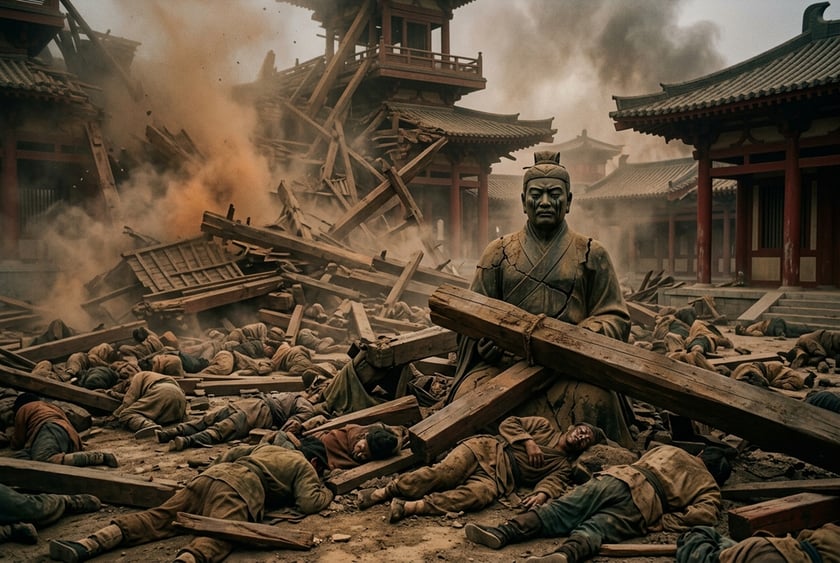
Historical Background
Around the fifteenth year of Jian'an (210), Cao Cao had pacified the northern regions of the Yellow River for several years, and Yecheng's status as the center of Caowei power was increasingly established. Geographically, Yecheng was backed to the north by the Zhang River and adjoined the old Yellow River course to the east, forming a nexus at which the northern plain met the great thoroughfares of the Central Plains. Politically, after bringing the Emperor to Xu, Cao Cao built his Chancellor's compound and military base at Yecheng, making Yecheng in practical terms the true seat of power beyond any nominal arrangements. The construction of the Bronze Sparrow Tower occurred precisely at this spatial and temporal juncture: Cao Cao needed a symbolic structure to transform the fruits of military victory into a form of cultural capital that could be permanently displayed. In the novel's narrative, the unearthing of the bronze sparrow was interpreted by Xun You as an auspicious omen — the ancient story of the sage-king Shun's mother dreaming of a jade sparrow entering her bosom — elevating the construction project from a mere engineering undertaking to a piece of the mandate-of-Heaven narrative [c:17049].
The Construction Process
The construction of the Bronze Sparrow Tower is compressed in the novel into the summary description of "breaking ground, felling timber, firing tiles, and grinding bricks — finished in approximately one year," but Cao Zhi's proposal for the terrace design is given special prominence: three terraces standing together — the Bronze Sparrow in the center, the Jade Dragon to the left, the Golden Phoenix to the right; two flying bridges spanning empty space between them, linking the three independent structures into a connected whole overhead [c:17049]. This plan was rare in the history of Han-Wei garden architecture, combining in one complex a sacrificial terrace, an observation terrace, and a banqueting terrace, weaving the spatial arrangement of "high terraces, flying bridges, and open waters" into a single ceremonial stage. From a ritual perspective, the Bronze Sparrow Tower was not an ordinary palace-garden building but a composite venue capable of accommodating large-scale assemblies, troop reviews, banquets, and poetry-composing gatherings — the subsequent series of "Bronze Sparrow Tower grand banquet" events used precisely this stage.
Cultural Symbolism
The symbolic significance carried by the Bronze Sparrow Tower has three layers. The first is heavenly mandate: Xun You's binding of the bronze sparrow's unearthing to the birth mythology of the ancient sage-king Shun was intended to present Cao Cao's political rise as a "legitimate narrative foretold by a celestial sign," a logic consistent with the political rallying cry of "honoring the Son of Heaven in order to command the lords" during the same period [c:17049]. The second is literary lineage: the Bronze Sparrow Tower later became the core stage of the "Jian'an literary spirit," where Cao Pi, Cao Zhi, Kong Rong, Wang Can, Chen Lin, Ruan Yu, Ying Chang, Liu Zhen, and other members of the "Seven Masters of Jian'an" joined the father-and-sons trio of the Cao family in communal verse composition, elevating a military-political bloc into a literary collective and leaving the key platform for the mature transition of late-Han poetic style from yuefu toward the five-character form. The third is the question of succession among the sons: Cao Zhi's proposal for the terrace's design projected an image of "quick-minded and talented in literature," and in the novel Cao Cao specifically praised him — "well said, my son" — a partiality that later sparked the succession struggle between Cao Pi and Cao Zhi; the building of the Bronze Sparrow Tower thus inadvertently became an early foreshadowing of the heir rivalry [c:17049].
Transmission and Evolution
At the historical level, the Bronze Sparrow Tower was built in the winter of the fifteenth year of Jian'an; in the eighteenth year (213) the Gold Tiger Terrace was added to its south, and in the nineteenth year (214) the Ice Well Terrace was added to its north — together called the "Three Terraces." This differs slightly from the novel's version (in which Cao Zhi simultaneously incorporates the Jade Dragon and Golden Phoenix into the design, while historically they were built in stages). The terrace foundations suffered repeated damage and reconstruction after the Wei and Jin dynasties, and by the Tang and Song periods had become a literary allusion rather than a physical structure. Du Mu's Chibi poem — "Had the east wind not favored Zhou Yu, the bronze sparrow's deep spring would have locked up the Two Qiaos" — wove the Bronze Sparrow Tower together with the Battle of Chibi and the legend of the Two Qiaos, giving it an enduring resonance in the history of Chinese verse. The present site is located at Santai Village, Linzhang County, Handan City, Hebei Province; the ruins park preserves the terrace foundations and artifacts and has become an important archaeological coordinate for the study of the culture of Yecheng. The Bronze Sparrow Tower's transformation from an engineering project into a cluster of cultural symbols is one of the most poetically charged political legacies that the late Han and San Guo period bequeathed to later ages.