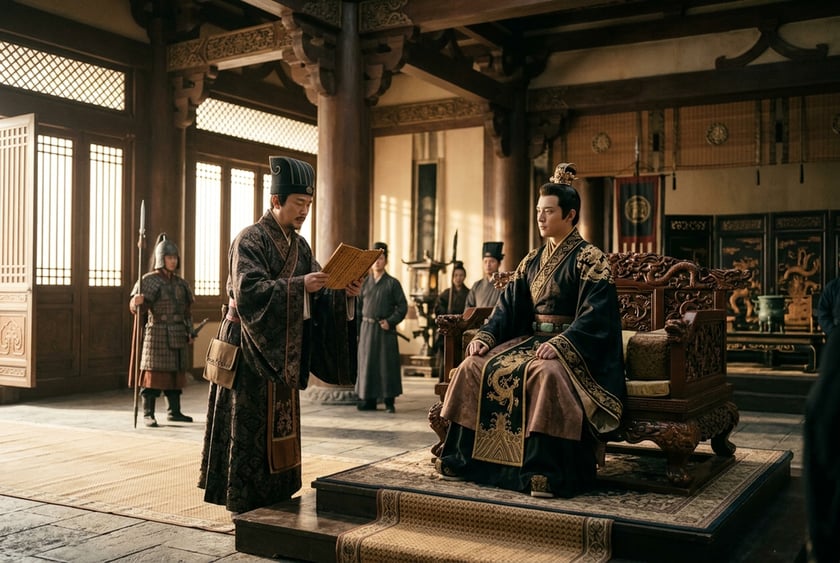
Background of the Proclamation
The edict of the sixth month of the thirteenth year of Jian'an — abolishing the Three Excellencies and assuming the office of Chancellor — was a major reform by Cao Cao at the level of political institutions. The Han system of Three Excellencies — the Grand Commandant commanding the military, the Minister of Works overseeing the people, the Minister of Works overseeing public construction — had persisted for more than one hundred and eighty years since Emperor Guangwu's restoration of the Han, forming the top-level structure of the Han bureaucratic system. The Three Excellencies were institutionally independent from the emperor and mutually checking, the concrete embodiment of the Confucian concept of "joint rule by ruler and ministers." But this institution had long since become a name without substance in the late Han: from Dong Zhuo's deposition of the young emperor onward, the actual power of the Three Excellencies had been hollowed out in turn by consort clans, eunuchs, and powerful ministers; by the era of Emperor Xian it had only ceremonial functions left. Cao Cao chose to formally abolish the Three Excellencies at this juncture; the timing was highly synchronized with the military mobilization for the southward campaign against Jingzhou — he needed a command position unconstrained by any institutional limits in order to rapidly mobilize troops and resources across provinces.
Principal Content
The edict itself was brief and direct: abolish the three offices of Grand Commandant, Minister of Works, and Minister of Works, with one Chancellor holding all of them concurrently. The Chancellor was the highest civil official position of the early Western Han; since Emperor Wu of Han had replaced the Chancellor with the Three Excellencies system, it had not been used for two hundred years. Cao Cao's choice to restore this ancient institution was clearly using the name of antiquity to concentrate power in fact. Alongside the Chancellor position, Cao Cao established the three aides of the Eastern Aide, Western Aide, and Literary Aide as the core of the chancellor's residence — the Eastern Aide controlled the personnel appointments and removals of officials at the two-thousand-shi level and above; the Western Aide controlled the assessment of officials within the residence; the Literary Aide controlled the canonical texts, writings, and confidential documents. These three aides together formed a "Chancellor's Residence" independent of the Han court's Three Excellencies and Nine Ministries system, in practice transferring the administrative functions of the Han court into the Chancellor's Residence. In terms of personnel arrangements, Mao Jie was known for honest and forthright remonstrance; Cui Yan carried authority as the leader of the aristocratic clans; Sima Yi represented the newly emerging clans of Henei — the combination of the three covered the dimensions of moral reputation, prestige among the literati, and emerging forces, while mutually checking each other, preventing any one person from growing too powerful.
Implementation
The edict took immediate effect upon promulgation, meeting no substantive resistance from the court or the literati — in sharp contrast with the situation years later when Xun Yu opposed the elevation to Duke of Wei and Xun You opposed the elevation to King of Wei. The reason was that abolishing the Three Excellencies on the surface was merely "restoring an ancient institution" rather than usurpation; the Chancellor was already a legitimate official position of early Han, and Cao Cao's restoration of this office as Han Chancellor could be fully explained as "returning to fundamentals." At the same time, the Three Excellencies had long been empty titles without substance; abolishing them caused no concrete harm to any specific faction's actual interests, and the cost of opposition far exceeded any benefit. Sima Yi was by means of this appointment first entering Cao Cao's core chancellery — the Romance deliberately notes his lineage "grandson of Yingchuan Prefect Sima Jun, son of Metropolitan Prefect Sima Fang, younger brother of Chief Clerk Sima Lang," hinting that the Henei Simashi clan's political deployment had from this point formally commenced. This is the Romance planting the seeds for the later Simashi replacement of Wei.
Political Impact
The immediate impact of abolishing the Three Excellencies comprised three layers. The first was the level of administrative efficiency: all military and political commands no longer required the countersignature of the Three Excellencies; the Chancellor's Residence could issue documents directly, and the rapid mobilization of the southward campaign against Jingzhou (five hundred thousand troops assembled within a few months) was precisely the dividend of this reform. The second was the level of power structure: the Chancellor's Residence as a core political institution independent of the Han court was established, and from that point forward all of Cao Cao's major decisions were made in the Chancellor's Residence rather than at the Han court; the Han court's Secretariat, Nine Ministries, and other institutions gradually declined to the status of ceremonial departments. The third — and the most far-reaching — was the level of institutional paradigm: Cao Cao's abolition of the Three Excellencies to establish a single Chancellor opened the tradition in the late Han of "powerful ministers exercising imperial power through the Chancellor position"; thereafter Sima Yi, Sima Shi, and Sima Zhao all exercised Wei's government through the Chancellor position. After the Western Jin, this model was used repeatedly until it was displaced by the Three Secretariats and Six Ministries system of the Sui and Tang. Viewed over the long span, Cao Cao's reform in effect ended the era of the Three Excellencies from Eastern Han, opening the transitional channel from "power divided among the Three Excellencies" to "supremacy of the Chancellor."
From another angle, the abolition of the Three Excellencies to assume the Chancellorship also exposed Cao Cao's "centralization instinct" in institutional design — he consistently tended to concentrate power in himself personally and in the small staff team under his direct control, rather than stabilizing the regime through institutionalized arrangements for the distribution of power. During his lifetime this inclination was an advantage (efficient, fast decision-making), but it also sowed the seeds of fragility for the Caowei regime: when Cao Cao was gone and the ability of his successor fell short, concentrated power could very easily be taken over in the same way by a new powerful minister (Sima Yi). The greatest irony of abolishing the Three Excellencies lies precisely in the fact that it ultimately provided the institutional template for the Simashi replacement of Wei — Sima Yi and Sima Zhao, exercising Wei's government through the Chancellor position, were following precisely the path that Cao Cao had once walked.