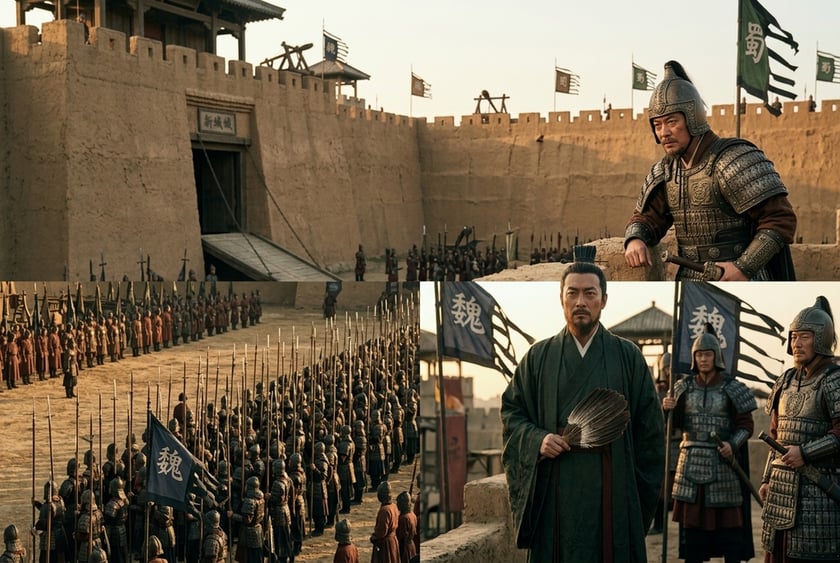
Background
The enfeoffment as Duke in the eighteenth year of Jian'an was, for Cao Cao, the critical transitional ceremony on the path from "Han Chancellor" to "replacing Han." Since moving the capital to Xu Chang in the first year of Jian'an and securing the political legitimacy of "holding the Son of Heaven," Cao Cao had spent nearly seventeen years progressively completing the annexation of the north — successively pacifying Lv Bu, Yuan Shu, the Yuan Shao brothers, the Wuhuan, Ma Chao, Han Sui, and Zhang Lu. Yet even though his actual power had long since exceeded that of any Han Chancellor, his rank had remained fixed at "Chancellor, concurrently Governor of Jizhou." To further advance the project of replacing Han, he needed a transitional title that "broke through the Han system while remaining within it" — "Duke" was neither a mere ranking marquis nor directly a "King" (since by Han convention only those of the Liu surname could be kings), but rather a grey-zone step intermediate between subject and emperor. The year before, Xun Yu had died in depression and resentment after opposing Cao Cao's elevation to Duke of Wei, and the forces of opposition had been absorbed. The enfeoffment could thus proceed smoothly through the court.
Principal Figures
The core actor in the enfeoffment was undoubtedly Cao Cao himself — he was both the recipient of the title and the actual designer of the process of reception. Emperor Xian Liu Xie was throughout this process merely a passive ritual instrument; every edict draft, ceremonial procedure, and investiture exchange was rehearsed in advance by Cao Cao's staff, and Liu Xie's role was to issue, at the appropriate moment, an edict conforming to Cao Cao's wishes. Xi Lv, as Imperial Counselor, was the specific driver of this investiture on the court level; he and Hua Xin and others, after Xun Yu's death, bore the task of eliminating dissenting voices and advancing the agenda. Behind the scenes, strategists such as Xun You and Jia Xu played important roles in designing the ritual — they had to make the enfeoffment appear consistent with the ancient precedent of the Duke of Zhou assisting King Cheng, while also endowing the Kingdom of Wei with the actual operational capacity of an independent regime. This dual demand for "classical exterior and modern interior" required extraordinary institutional design.
Core Issues
The enfeoffment's substantive content comprised three layers. The first was the ritual breakthrough of the title itself: in Han political tradition, "no one of a different surname shall be a Duke" — for Cao Cao, not of the Liu surname, to be enfeoffed as a Duke was already a breach of the Han taboo at the level of bloodline. The second was the nine regalia — the carriage and horses, robes and garments, musical instruments, vermilion-painted gate, raised steps, tiger-and-leopard bodyguard, battle-axes, bows and arrows, and black millet wine. These nine ritual instruments symbolized the imperial status in Han times; to receive the nine regalia meant that Cao Cao had ritually ascended to a level commensurate with the Son of Heaven. The third, and most crucial, was "establishing the Kingdom of Wei": with ten commanderies of Jizhou as the enfeoffed territory, independently setting up all officials from Chancellor and Imperial Counselor downward within the Wei kingdom's borders, independently establishing ancestral temples and altars of soil and grain — this was a complete governmental system, not merely a magnified version of a marquisate. From this point forward, Cao Cao's commands within the Kingdom of Wei carried the force of "national law," standing in parallel with the edicts of the Han court, effectively hollowing out the Han government into a nominal institution.
Political Consequences
After the enfeoffment, the Caowei faction entered a "dual-track operation" phase: the Han court's ritual authority and the Wei kingdom's substantive regime coexisted; the court's edicts had to pass through the Wei kingdom system for relay and execution; the court's personnel appointments required review by the ducal chancellery. This framework went one step further than "holding the Son of Heaven to issue commands to the lords" — holding the Son of Heaven still meant acting in the name of the Han dynasty, whereas being enfeoffed as Duke of Wei meant establishing a "backup regime" that could stand alongside the Han dynasty and ultimately replace it. Cao Cao's elevation to King of Wei in the twenty-first year of Jian'an was a further upgrade of this framework; Cao Pi's acceptance of the Han abdication in the twenty-fifth year of Jian'an was its ultimate realization. It can be said that the enfeoffment as Duke of Wei accomplished not a personal elevation in rank but a pre-emptive construction of a governmental framework — all the offices, ritual structures, personnel, and territory required to replace Han were progressively put in place after the eighteenth year of Jian'an, leaving Cao Pi with nothing more to do than complete the abdication ceremony.
Counterfactual Analysis
If Xun Yu had not died the year before and had continued to oppose the enfeoffment within the court, whether the enfeoffment could have been completed on schedule is a genuine question — Xun Yu's political prestige and his power to rally the aristocratic clans were sufficient to delay this process; at minimum he would have forced Cao Cao to make greater concessions on ceremonial details, and the territory of the Wei kingdom might have been reduced from ten commanderies to five, with some items of the nine regalia potentially canceled. If the enfeoffment had been delayed by two or three years, Cao Cao might not have had time during his lifetime to advance even to the level of King of Wei — he died in early Jian'an twenty-five, leaving an extremely narrow time window. In other words, the speed of this enfeoffment in the eighteenth year of Jian'an, rather than reflecting Han voluntary consent, was Cao Cao's precise insertion into a strict biological timetable. From a broader perspective, the enfeoffment as Duke of Wei was an important paradigm innovation in the pattern of dynastic succession since the Han: from this point forward, the standard path for a powerful minister to replace the Han was the five-step process of "enfeoffment as Duke — conferral of the nine regalia — establishment of the kingdom — elevation to King — acceptance of abdication," a template followed by the Simashi replacing Wei, the Yuwen clan replacing Western Wei, and numerous abdications before the Sui and Tang dynasties. Cao Cao's enfeoffment as Duke of Wei thus became the foundational paradigmatic event in the history of medieval political succession.