Strategic Background
In the twenty-third year of Jian'an (218), the Cao Cao bloc was committing its full effort to holding against Liu Bei in Hanzhong — western-front pressure was at an unprecedented level. At precisely this moment, the Wuhuan of Daijun, who had nominally been incorporated into Caowei's loose-rein system, rose in rebellion again, opening a crack in the northern defensive line. Failure to pacify them swiftly would very likely embolden the watching Xianbei chieftain Ke Bineng and others to push south, potentially coordinating strategically with Liu Bei on the western front and placing Cao Cao in a two-front war of attrition. In terms of the personnel decision, Cao Cao did not draw on his main generals in the Guanzhong and eastern regions — he chose instead to deploy his second son Cao Zhang. On one hand, Daijun was relatively close to Yecheng, keeping mobilization costs low; on the other, it was an opportunity to give an imperial-clan son a chance to establish prestige through real combat, laying the groundwork for future imperial-clan control of regional commands. This reflects the classic thinking of "use imperial-clan members to train in a small-scale border crisis."
Opposing Deployments
Cao Zhang's forces were extremely limited at this stage: on entering the territory of Zhuojun he had only about a thousand infantry and a few hundred cavalry, clearly arriving as the lead element before the main force had assembled. His opponents numbered several thousand cavalry — far more mobile than Cao Zhang's troops, already in the tactical initiative, and appearing suddenly. The critical figure on the Caowei side was Tian Yu — a veteran border official who had followed Liu Bei early in his career and then transferred his allegiance to Cao Cao, with extremely thorough knowledge of Wuhuan and Xianbei combat habits. His proposed approach was "hold the key passes firmly" — use terrain to cancel the cavalry's mobility advantage and compel the enemy to deploy in unfavorable ground. This is the classic transitional deployment of using small forces against larger ones, converting defense into an eventual offensive. In the background lurked an invisible force: Ke Bineng the Xianbei chieftain, with tens of thousands of cavalry encamped nearby. His purpose was to observe Caowei's strength, and he had not yet joined the battle — but his choice would determine the configuration of the northern frontier for the next several years.
Critical Decision Points
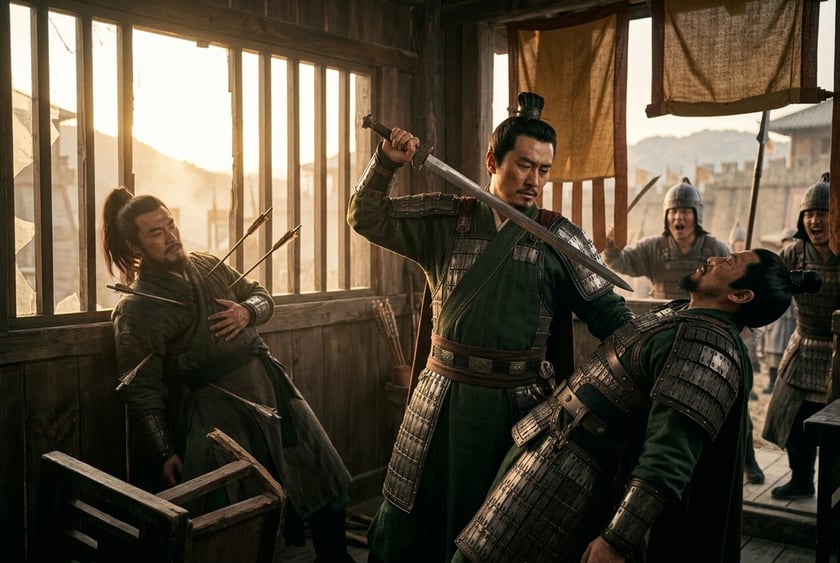
The entire battle had three critical junctures. The first was adopting Tian Yu's plan at the outset — holding firm and not venturing out, avoiding open battle with the mobile cavalry when at a numerical disadvantage. This forced the rebel Hu to exhaust their assault against prepared positions until they "dispersed and withdrew." The second was Cao Zhang personally entering the fight and shooting at the enemy, "having been struck several times through his armor, his spirit only fiercer" — a classic early model of charismatic command: by leading from the front in a small unit, he rapidly established authority among his men, enabling subsequent pursuit orders to be executed without question. The third — and most contentious — was Cao Zhang's decision to order a deep pursuit to the Sanggan River, overriding the objections of his staff officers and exceeding Cao Cao's original instructions. His reasoning was "when leading troops on campaign, one acts wherever advantage lies — what does the order say?" This is the archetypal border-commander mentality of placing battlefield judgment above the text of orders. As it turned out, he gambled correctly: pursuing through day and night, he overtook the enemy force, killing or capturing more than a thousand, turning a rout into a decisive annihilation. In Cao Cao's system of strict military discipline, "disobeying orders to win merit" was a double-edged sword that could easily invite disaster if handled carelessly.
Outcomes and Echoes
The battle's direct military achievement was killing and capturing enemy troops in the thousands and completely scattering the main Wuhuan force of Daijun. But the true strategic dividend came from Ke Bineng: the Xianbei chieftain, who had entered the scene to "observe which side was stronger," saw Cao Zhang achieve victory against the odds and pursue to the end, and immediately "submitted and asked for allegiance" — drawing the Xianbei forces of the northern frontier voluntarily into the Caowei loose-rein system, and "the north was entirely pacified." This gain was in practice more significant than the defeat of the rebel Hu — strategically it bought Caowei security on the northern front for the entire duration of the Hanzhong campaign, freeing Cao Cao to concentrate on the western front. After the battle, Cao Zhang, following Cao Pi's earlier counsel, "attributed the merit to his generals" and avoided boasting in front of Cao Cao — political advance protection by his elder brother: at the moment when the succession struggle was still undecided, letting the second son win merit without overreaching and arousing their father's suspicion that "martial prowess is a threat." Cao Cao stroked his beard and laughed: "My yellow-bearded boy has truly done something remarkable" — a rare and positive endorsement of a martial son.
Counterfactual Analysis
Had Cao Zhang obeyed his orders and not pursued beyond Daijun's boundaries, the rebel Hu main force would have escaped intact, and Ke Bineng would very likely have continued to observe or even chosen to merge with the rebels. In that case, Cao Cao would have had to split forces northward and might also have been compelled to withdraw early from the Hanzhong front — and we know that the Hanzhong campaign already ended in Cao Cao's "chicken-rib"-style withdrawal. Had this withdrawal been triggered early by northern-frontier pressure, Liu Bei's capture of Hanzhong would have gone more smoothly; but Caowei's control of the north would have developed greater cracks, potentially planting a longer-lasting border threat. A second counterfactual concerns Cao Zhang himself: had he been killed in this battle (stray arrows had already penetrated his armor multiple times), the "martial imperial-clan king" option beyond Cao Pi and Cao Zhi would have vanished at that point, and Caowei's later arrangement of imperial-clan military authority might have concentrated more quickly in the Cao Zhen and Cao Xiu lineage — with subtle consequences for the trajectory of "imperial-clan and great-clan co-governance" after the Jiupinguanrenfa.