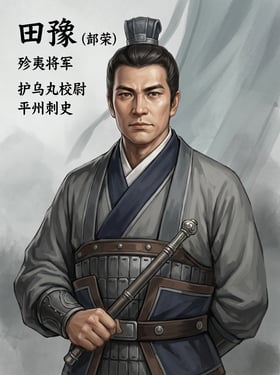
Historical Record
Tian Yu, styled Guorang, was a native of Yongnu in Yuyang. In his youth, when Liu Bei took refuge with Gongsun Zan, Tian Yu followed Liu Bei and was deeply valued by him. When Liu Bei was appointed Inspector of Yu Province, Tian Yu requested to return home because his mother was old; Liu Bei wept as he parted with him, lamenting that he could not accomplish the great cause together with him c:2869.
Gongsun Zan once sent Tian Yu to garrison Dongzhou. When Gongsun Zan's general Wang Men revolted and led more than ten thousand of Yuan Shao's troops to attack the city, the people in the city were terrified and wished to surrender, but Tian Yu mounted the wall and said to Wang Men: "You once received Gongsun Zan's generous treatment and yet left—you must have had some compelling reason; now you return to make trouble, and I know you are a disorderly man. Since I have received the charge to defend the city, how could I lightly give it up? Why do you not hasten to attack?" Hearing this, Wang Men withdrew in shame. Although Gongsun Zan knew Tian Yu had strategy, he failed to make full use of him c:2870.
After Gongsun Zan's downfall, Xianyu Fu was chosen by the people as Grand Administrator; long on good terms with Tian Yu, he appointed him Chief Clerk. At the time, with heroes rising on all sides, Xianyu Fu did not know where to turn. Tian Yu said to Xianyu Fu: "In the end, the one who will pacify the realm is surely the house of Cao. You ought to submit as soon as possible, to avoid inviting disaster later." Xianyu Fu adopted his advice and was therefore rewarded and favored by Cao Cao. Cao Cao summoned Tian Yu as Aide of Military Plans to the Chancellor, and he later served as Magistrate of Yingyin and Langling, and was further promoted to Grand Administrator of Yiyang, governing well wherever he went c:2870.
When Cao Zhang campaigned against Dai Commandery, he appointed Tian Yu as his chancellor. As the army reached Yibei, it was ambushed by hidden Hu cavalry, and the army fell into disorder. Tian Yu used the terrain, turning the carts into a circular formation, with crossbowmen at the ready within and decoy troops set to block the gaps in the enemy. The Hu could not advance and had to scatter and retreat. Tian Yu then pursued and crushed them, going on to pacify Dai Commandery—all from Tian Yu's planning c:2871. When Cao Zhang pursued the Hu, he too adopted Tian Yu's plan, firmly holding the key points, so that the Hu scattered and retreated c:5990.
In the early years of Emperor Wen of Wei, the northern Hu and Di were strong and harassed the frontier. Emperor Wen appointed Tian Yu, bearing the imperial credentials, as Protector-Colonel of the Wuhuan, together with Qian Zhao and Xie Jun to oversee the Xianbei. From Gaoliu eastward, from the Huimo westward, there were dozens of Xianbei tribes, with Kebineng, Mijia, Suli, and others holding separate territories, each with their own borders, who had jointly sworn an oath not to trade horses to the central lands. Tian Yu held that a Hu alliance would be harmful to the central lands, and so first sowed discord among them, making them enemies who attacked one another. When Suli broke the oath and presented a thousand horses to the court, he was attacked by Kebineng and appealed to Tian Yu for rescue. Fearing that the Hu would grow by annexation and become a deeper harm, Tian Yu held that he ought to rescue the good and chastise the wicked, to show good faith to all the Hu. He led elite troops deep into Hu territory; the Hu, being numerous, plundered front and rear and cut off his return route. Tian Yu then advanced and encamped some ten li from the enemy, gathered much ox and horse dung and burned it, then withdrew by another road. Seeing the smoke and fire unbroken, the Hu assumed Tian Yu was still there, and only after marching dozens of li did they discover the truth. They pursued Tian Yu to Macheng and besieged him ten layers deep. Tian Yu secretly mustered his army, ordered his marshal to raise banners, beat drums and blow horns, and led infantry and cavalry out the south gate; the Hu all turned their attention there. Tian Yu meanwhile led his elite out the north gate, raising a clamor, and the two columns struck together. Caught off guard, the Hu host fell into great disorder and all abandoned their bows and horses to flee on foot; he pursued them more than twenty li, leaving corpses strewn over the field c:2871.
The Wuhuan king Gujin was unruly and arrogant. Taking the chance of an inspection beyond the frontier, Tian Yu entered Gujin's tribe with only a hundred or so of his own riders. When Gujin came to pay his respects, Tian Yu at once ordered his attendants to behead Gujin and proclaimed his crimes as a warning to the rest. All were terrified and dared not stir, and Tian Yu then replaced Gujin with his younger brother. From then on the Hu were struck with dread, and his prestige shook the desert. The mountain bandit Gao Ai, with a host of several thousand, plundered and harmed You and Ji Provinces. Tian Yu induced the Xianbei Suli tribe to behead Gao Ai and sent his head to the capital. Tian Yu was therefore enfeoffed as Marquis of Changle Precinct. During his nine years as colonel, he constantly suppressed annexation and broke up the powerful. Whenever fugitive villains schemed on the Hu's behalf against the court, Tian Yu sowed discord and confusion among them, so that wicked plots could not succeed and gathered tribes could not find peace. However, before his work was complete, the partisans of You Province Inspector Wang Xiong wished to have Wang Xiong concurrently hold the Wuhuan colonelcy, and falsely accused Tian Yu of disturbing the frontier and stirring up trouble for the state. Tian Yu was thus transferred to Grand Administrator of Runan, with the additional title General Who Exterminates the Yi c:2871.
At the end of the Taihe era, Gongsun Yuan rebelled in Liaodong, and Emperor Ming of Wei wished to campaign against him but was hard-pressed for a suitable man. The Central Leader of the Army, Yang Ji, recommended Tian Yu for the selection. Emperor Ming therefore ordered Tian Yu, in his current office, to command the various armies of Qing Province with the imperial credentials, and to go to the attack. It happened that Wu sent envoys to collude with Gongsun Yuan; considering that the Wu troops were numerous and had already crossed the sea, Emperor Ming ordered Tian Yu to disband his forces. Tian Yu judged that the Wu ships would soon turn back, and that as it was the end of the year with fierce winds, they would surely fear drifting; with no shore to land on to the east, they would certainly head for Chengshan. Chengshan had no place to hide ships, so he surveyed the terrain along the coast, as well as the various mountains and islands, blocked the key passes, and stationed troops in garrison. He himself entered Chengshan and ascended Emperor Wu of Han's viewing terrace. When the Wu fleet turned back, it indeed met a foul wind, and the ships all struck the mountains and sank, washed ashore by the waves with nowhere to hide, and all were captured. At first the generals all laughed that Tian Yu was waiting for the enemy on empty ground, but once the enemy was broken they vied to claim merit, demanding to go out to sea to salvage the sunken ships. Fearing that the cornered enemy would fight to the death, Tian Yu paid them no heed c:2872.
Earlier, when Tian Yu commanded the Qing Province armies as Grand Administrator, the Inspector of Qing Province, Cheng Xi, was inwardly resentful and often obstructed military operations. Knowing that Emperor Ming prized bright pearls, Cheng Xi secretly memorialized: "Tian Yu, though he has military merit, is lax in his prohibitions; the implements, pearls, and gold he obtained were many, yet he scattered them all and did not turn them over to the government." For this reason, Tian Yu's merit went unrecorded c:2872.
Later, when Sun Quan attacked Hefei's New City with a hundred thousand troops, the General Who Conquers the East, Man Chong, wished to lead the various armies to the rescue. Tian Yu said: "The enemy has come out in full force, not merely for small gain, but wishing to use New City as bait to draw out our main force. Better to let them attack the city to blunt their edge, and not engage them head-on. If the city cannot be taken, the enemy will surely grow weary; attack them once weary, and we may win a great victory. If the enemy sees through our plan, they will not attack the city and will surely withdraw of their own accord. If we advance at once, we fall right into their scheme. Moreover, when great armies face off, one should keep the enemy unable to fathom one's intent, and not let them easily judge our designs." Tian Yu thereupon memorialized, and the Son of Heaven adopted his advice. The Wu troops indeed fled. Later the Wu troops came again, and Tian Yu went to resist them, whereupon the Wu troops withdrew. The various armies were alarmed in the night, with rumors that "the enemy has come again!" Tian Yu lay abed and would not rise, ordering: "Any who dare stir rashly will be beheaded!" In a short while, there were indeed no enemy c:12863.
At the end of the Jingchu era, Tian Yu's fief was increased by three hundred households, making five hundred in all with the earlier grant. In the early years of the Zhengshi era, he was promoted to Central Gentleman-General Who Protects the Xiongnu, bearing the imperial credentials, with the additional title General Who Rouses Awe, and concurrently held the post of Inspector of Bing Province. The foreign Hu, hearing of his prestige, came in succession to present tribute. The province's borders were peaceful and orderly, and the people gave their allegiance. Later he was summoned to be Commandant of the Guards. He repeatedly requested to resign his office, but the Grand Tutor Sima Yi held that Tian Yu was in his prime and wrote to urge him not to resign. Tian Yu replied: "To remain in office past the age of seventy is like the bell-tones already spent, the clepsydra already emptied, yet still pressing on by night—this is to be a criminal." He thus firmly claimed to be gravely ill. The court appointed him Grand Palace Grandee, with the emolument of a minister. He died at the age of eighty-two. His son Tian Pengzu inherited his fief c:12865.
The *Weilüe* records that after Tian Yu resigned office and returned home, he lived in Wei County. A swift courier of Runan Commandery, on his way to the General Who Conquers the North, recalling Tian Yu's old kindness, made a special visit to call on him. Tian Yu killed a chicken and cooked a meal to entertain him, and saw him off at the crossroads, saying to him: "This old man is aged, troubling you to come and visit. I am now powerless to do anything—what can I do?" The courier, pitying his poverty and frailty, departed in tears, and on his return told the matter to the old officials and people. Runan Commandery raised several thousand bolts of cloth as goods and sent men to give them to Tian Yu, but Tian Yu refused them all. When gravely ill, he left a charge admonishing his wife and children: "You must bury me beside Ximen Bao." His wife and children found this difficult, saying: "Ximen Bao was a divine man of antiquity—how can you be buried beside him?" Tian Yu said: "Ximen Bao's conduct matches mine; if there are spirits after death, he will surely be on good terms with me." His wife and children heeded his words. On learning of his death, Runan Commandery grieved deeply, both painting his portrait and erecting a stele with an inscription for him c:12865.
In the Novel
In *Romance of the Three Kingdoms*, Tian Yu's image appears mainly during Cao Zhang's campaign against Dai Commandery, where he serves as Cao Zhang's strategist. The novel's depiction of Tian Yu is basically consistent with the historical record, emphasizing his military strategy and his loyalty to Cao Wei. In Chapter 103, Tian Yu has five lines of dialogue, though their specific content is not detailed in the materials provided. The novel does not greatly embellish his early experience following Liu Bei, nor describe in detail his deeds under Gongsun Zan, but directly portrays him as a resourceful and valiant frontier general in the Cao Wei camp c:5990. In the novel, Tian Yu's character traits of "dwelling in pure integrity, with clear and practiced strategy; keeping to himself in poverty and want, distributing all rewards to his officers and soldiers" accord with the histories' record, but the unfolding of specific episodes is more literary. For example, during Cao Zhang's northern campaign, the novel may focus more on how Tian Yu used stratagems to help Cao Zhang crush the Hu, highlighting his "clear and practiced strategy" c:5990.
Key Relationships
* Liu Bei: In his youth Tian Yu took refuge with Liu Bei and was deeply valued by him. Liu Bei once wept at Tian Yu's departure, lamenting that he could not accomplish the great cause together with him c:2869.
* Gongsun Zan's faction: Tian Yu once served Gongsun Zan and was appointed Magistrate of Dongzhou. He once cleverly drove off the rebel general Wang Men, but Gongsun Zan failed to make full use of him c:2870.
* Xianyu Fu: After Gongsun Zan's downfall, Tian Yu persuaded Xianyu Fu to submit to Cao Cao, and was appointed Chief Clerk by Xianyu Fu c:2870.
* Cao Wei: After submitting to Cao Cao, Tian Yu successively held posts such as Aide of Military Plans to the Chancellor, county magistrate, and grand administrator, and later served as Protector-Colonel of the Wuhuan, Grand Administrator of Runan, Central Gentleman-General Who Protects the Xiongnu, Inspector of Bing Province, and Commandant of the Guards—an important frontier general and strategist of Cao Wei c:2870, c:2871, c:2872, c:12865.
* Cao Zhang: Tian Yu once served as Cao Zhang's chancellor, devising plans for him to pacify Dai Commandery c:2871. On Cao Zhang's northern campaign, he adopted Tian Yu's plan and crushed the Hu c:5990.
* Kebineng, Suli, Mijia, Budugen: As Protector-Colonel of the Wuhuan, Tian Yu was responsible for managing relations with the various Xianbei tribes; he once sowed discord among the Hu to make them attack one another, and struck at the power of tribes such as Kebineng's c:2871, c:5994.
* Cheng Xi: The Inspector of Qing Province, Cheng Xi, out of jealousy of Tian Yu's merit, once falsely accused him c:2872.
* Man Chong: When Sun Quan attacked New City, Tian Yu discussed with Man Chong the strategy for repelling the enemy and offered an original view c:12863.
* Sima Yi: Sima Yi once urged Tian Yu to remain in office, but Tian Yu firmly resigned on the grounds of old age c:12865.
Signature Scenes
* Liu Bei's Tearful Farewell: Tian Yu requested to return home because his mother was old, and Liu Bei wept as he saw him off, lamenting that he could not accomplish the great cause together with him—displaying Liu Bei's esteem for Tian Yu and his reluctance to part c:2869.
* Driving Off Wang Men by Wit: When Gongsun Zan's general Wang Men revolted and attacked the city, Tian Yu mounted the wall and with a few words made Wang Men withdraw in shame, embodying Tian Yu's resourcefulness and eloquence c:2870.
* Persuading Xianyu Fu to Submit to Cao: In an age of chaos with heroes rising everywhere, Tian Yu accurately judged that the house of Cao would pacify the realm and persuaded Xianyu Fu to submit, winning an important force for Cao Wei c:2870.
* Helping Cao Zhang Pacify Dai Commandery: During Cao Zhang's northern campaign, Tian Yu offered the plan of firmly holding the key points, crushed the Hu, and pacified Dai Commandery, displaying his outstanding military talent c:2871, c:5990.
* Sowing Discord Among the Hu, Awing the Desert: During his term as Protector-Colonel of the Wuhuan, Tian Yu used schemes of discord to make the various Xianbei tribes attack one another, and rode alone into the Hu tribe to behead the unruly Gujin, striking the Hu with dread and shaking the desert with his prestige c:2871.
* Crushing the Wu Army at Chengshan: During Gongsun Yuan's rebellion, Tian Yu accurately predicted the Wu army's retreat route, set an ambush at Chengshan, and crushed the Wu army, displaying his superb strategic vision and familiarity with geography c:2872.
* Repelling Sun Quan at New City: When Sun Quan attacked New City with a great army, Tian Yu proposed the strategy of "letting them attack the city to blunt their edge," ultimately making Sun Quan withdraw without battle and avoiding head-on conflict, embodying his far-reaching military insight c:12863.
* Resigning to Retirement, Keeping to Pure Poverty: Past the age of seventy, Tian Yu firmly resigned office and refused the support of the old officials and people of Runan, leaving a dying wish to be buried beside Ximen Bao—manifesting his lofty character of dwelling in pure integrity and keeping to himself in poverty and want c:12865.
Portrait file
Character profile
- Character
- Pure and unstained in his conduct, clear and seasoned in strategy; poor and self-sufficient, he distributed all his rewards among his officers and men.
- Life
- A man of Yongnu in Yuyang, styled Guorang. In his youth he joined Liu Bei, later followed Gongsun Zan, and upon Zan's defeat submitted to the house of Cao. He administered and pacified the northern frontier, holding off the Xianbei and Wuhuan for several decades; he died at the age of eighty-two.
- Anecdotes
- He held such posts as General Who Exterminates the Yi, Inspector of Ping Province, Colonel of the Wuhuan, Protector-Colonel of the Wuhuan, Grand Administrator of Runan, Inspector of Bing Province, and Commandant of the Guards, and once served as Chief Clerk / adviser accompanying Cao Zhang on his northern campaign against the Wuhuan of Daijun. In Emperor Wen's time he was Colonel of the Wuhuan bearing the staff of authority to protect the Xianbei, and was once besieged by Bi Neng at Macheng for seven days.
Relationships
4 relationships
Lord & vassal1
Other3
Quotes
5 recorded lines · 3 featured
「終能定天下者,必曹氏也。宜速歸命,無後禍期。」
Predicting that Cao Wei would unify the realm, it displays his outstanding strategic vision.
「賊悉衆大舉,非徒投射小利,欲質新城以致大軍耳。宜聽使攻城,挫其銳氣,不當與爭鋒也。城不可拔,衆必罷怠;罷怠然後擊之,可大克也。若賊見計,必不攻城,勢將自走。若便進兵,適入其計。又大軍相向,當使難知,不當使自畫也。」
Proposing the military strategy of 'wearing down the enemy to win,' it embodies his deep military wisdom.
「年過七十而以居位,譬猶鍾鳴漏盡而夜行不休,是罪人也。」
Likening himself to 'a tolling bell and a spent water-clock,' he expresses the magnanimity and self-reflection of retiring once his work is accomplished.
Chapters3 回 ▸
- 史ch.19ch.26ch.30
Relationship timeline4 条 ▸
史 ch.26
- Liu Bei§13
serves
刘备奔公孙瓒时,豫年少自托于备,备甚奇之
- Xianyu Fu§14
advises_in
鲜于辅素善豫,以为长史;豫劝其归曹氏
- Cao Zhang§15
advises_in
鄢陵侯彰征代郡,以豫为相;回车结圜阵破胡皆豫策
- Gongsun Yuan§18
commands_in
帝以豫督青州诸军假节往讨之;后预贼船触山尽虏其众
Inner monologues · AI-generated3 段 ▸
- Now that I am past seventy and hold a place among the court officials, whenever I think of it, I feel that I cannot trea
- My name is Tian Yu, and my courtesy name is Guorang. On the frontier, what I saw was not the borders debated in court, b
- My name is Tian Yu, and my courtesy name is Guorang. I come from Yongnu in Yuyang. When I was young, turmoil broke out,
Life events3 ▸
- 0218-01-01 · Sanggan RiverCao Zhang's Northern Campaign Against the Wuhuan of Daijun· Advisor
- 0228-01-01 · MayiQian Zhao Rescues Tian Yu from the Siege of Mayi· Commander
- 0247-01-01 · MayiCao Wei's Management of the Northern Frontier· Commander