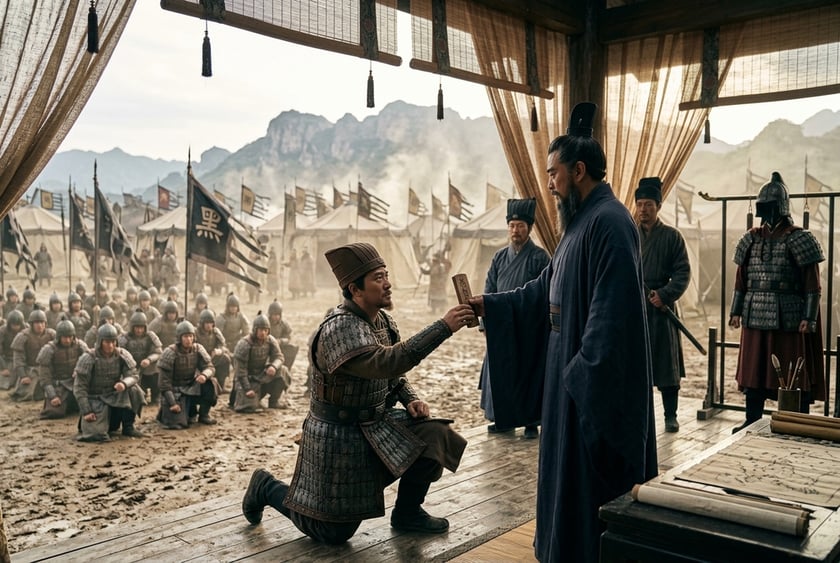
Background
Toward the end of the second year of Jingchu, Emperor Ming of Wei, Cao Rui, suddenly fell gravely ill; by the first month of the third year of Jingchu (239) he was on the point of death. At this point only nineteen years had elapsed since Caopidaihan, and the institutional arrangements for imperial succession in Caowei had not yet been stabilized: no previous emperor had died while the imperial son was still a child, and there was no precedent for a clearly defined regency system. Cao Rui himself had throughout his reign been acutely sensitive to the balance between the imperial clan and outside surnames — over more than a decade on the throne he had consistently kept the Cao princes in check, while also being unwilling to rely excessively on any single powerful outside-surname minister. At this moment, Gongsun Yuan of Liaodong had just been suppressed by Sima Yi (in the second year of Jingchu), bringing Sima Yi's military reputation and prestige to a new peak; Cao Zhen had already died and his son Cao Shuang had taken over the role of clan leader, and this structure of "military power residing in an outsider, clan prestige nominal" had to be definitively settled at the moment of entrusting the orphan [c:16964].
Key Figures
Cao Rui is the central figure. Shortly before his death he first opted for a clan-centered solution — appointing his uncle Prince of Yan, Cao Yu, as Grand General to assist the heir apparent, a procedure conforming to the ritual principle of "elevating close clan members." But Cao Yu "was deferential, frugal, and temperate, and absolutely refused this great responsibility, insisting on resigning" [c:16965], returning the decision to Cao Rui. The Palace Attendants Liu Fang and Sun Zi were the two who truly transformed the shape of the regency — they had for many years controlled the secretariat, had old ties of obligation with the Cao Zhen clan, and moved partly out of personal friendship and partly out of fear of clan domination of the center to sponsor Cao Shuang instead, and forcefully requested that the Prince of Yan be "commanded home to his princely state and prohibited from entering the court without an edict," thereby cutting off any possibility of clan subversion of the center [c:16965]. Sima Yi was present and invested with the role of "military pillar": in the official history Cao Rui took his hand and had the Prince Qi embrace his neck, performing the ritual of "father-son entrustment" to its utmost — the highest possible political endorsement Caowei imperial power could give him [c:16964]. Cao Shuang was the nominal head of the regency, but had not yet truly built an independent political following at the time — this gap was the key to the Gaopinglingzhibian ten years later. The eight-year-old Cao Fang was the object of the entrustment; throughout the event he was nothing more than a ritual object of political ceremony.
Core Issue
The first issue is the distribution of power between the imperial clan and outside surnames. From the founding of Caowei, the imperial clan princes had been suppressed (drawing the lesson from the early Han), but this overcorrection left the imperial house with no one it could lean on. When the imperial son was young and an outside-surname regency was unavoidable, the Cao house was forced to choose between "trust the clan" and "trust outside military meritocrats." Cao Rui's first choice of Prince of Yan and subsequent switch to Cao Shuang amounted to a filtering between "close clan" and "distant clan" — placing Cao Shuang, a person of more distant bloodline from the imperial succession and not of princely origin, at the head preserved the clan name while minimizing the threat to imperial power. The second issue is the political right of intervention by personal attendants near the throne. Liu Fang and Sun Zi intervened in the choice of regent in their capacity as drafters of imperial edicts, opening the harmful precedent of "attendant participation in establishing heirs and regents" that persisted through Wei and Jin [c:16965]. The third issue is the politicization of the outer army commander. The military-political experience Sima Yi had accumulated in Guanxi and Liaodong was at this moment endorsed by the dying emperor through the highest ceremony of "clasping hands at the bedside," formally elevating him from "frontier commander" to "central politician."
Political Consequences
First, the dual-regency structure of Cao Shuang and Sima Yi immediately showed imbalance after Cao Rui's death. Cao Shuang first used the gesture of deferential courtesy to elevate Sima Yi to Grand Tutor — an "honorary empty position" — in effect stripping him of real military and political power; Sima Yi feigned illness and bided his time for ten years, finally in the first year of Jiaping (249) launching the Gaopinglingzhibian, in one stroke deposing Cao Shuang and exterminating his clan. The promise Sima Yi made on the day of the entrustment with tears and prostrations was completely reversed at that moment [c:16964]. Second, Cao Fang, as the entrusted child emperor, never truly controlled his own court — from Cao Shuang to Sima Yi and then to Sima Shi, he was deposed in the sixth year of Jiaping (254), and the entire political succession of the Emperor Ming line ended in failure. Third, Liu Fang and Sun Zi obtained short-term political gains through sponsoring Cao Shuang and excluding the Prince of Yan, but the "attendants interfering in government" model they embedded continued to ferment through the late Western Jin, becoming one of the remote causes of the War of the Eight Princes. Fourth, the entrustment case was repeatedly written up in both the official histories and the novel as "the political moment of the Simashi's rise," becoming the most representative negative case for later discussions of "a ruler's judgment at the moment of death."
Counterfactual Analysis
Had Prince of Yan Cao Yu accepted the entrustment and jointly assisted the young emperor with Cao Shuang, replacing the "clan plus outside surname" structure with a "dual clan pillar" structure, Sima Yi at most would have held ceremonial positions like Grand Tutor or Grand Commandant with no real power, and his political footing in Luoyang would have been significantly weakened. In the novel's account, Cao Yu was deferential, frugal, and unambitious — he could in principle have been a steady trustee in the style of Zhou Bo under Han Wendi; but his voluntary resignation precisely illustrates that over more than twenty years of high-pressure suppression, the Caowei imperial clan had already lost the talent reserves capable of bearing central responsibility. Another counterfactual is Cao Rui living three to five more years until Cao Fang came of age: Sima Yi's political window would have closed, and Caowei imperial power might have smoothly completed its second generational transition — but the palace construction and occult arts of the Jingchu years had exhausted Cao Rui's body, and he had blocked that path himself. The day of the entrustment determined not only the choice of regent but the trajectory of the entire remaining thirty years of the Caowei empire.