Background
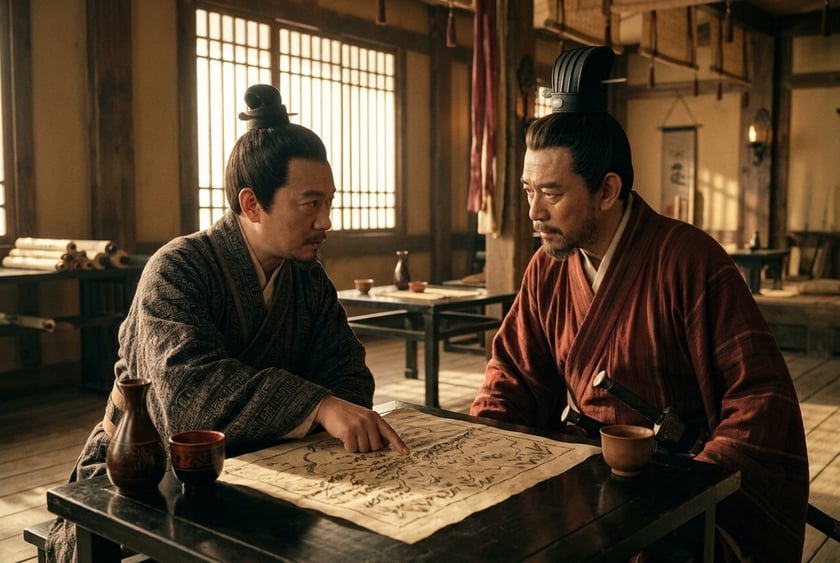
During the Qinglong years of Emperor Ming of Wei (233–237), the western front lulled after Zhuge Liang died at Wuzhangyuan, Gongsun Yuan had not yet publicly proclaimed the state of Yan, and Sun Quan's repeated military forays had yielded nothing. Cao Rui thus obtained the first relatively unconstrained strategic window of his reign. He directed the financial resources and labor that had been building up for years into a single massive burst of palace construction at the two capitals of Xu Chang and Luoyang: the Chaoyang Hall, Taiji Hall, Chonghua Hall, Qingxiao Pavilion, Fenghuang Tower, Jiulong Pool were built, and the General Chapters Observatory was raised to a height of ten zhang, deploying thirty thousand skilled craftsmen and more than three hundred thousand laborers. Before this, Caopidaihan had been just twenty years past, and the Wei court was still performing the posture of "legitimate successor to and upholder of Han law"; Cao Rui's politicized construction was precisely meant to transform the Wei emperor from "the successor to a regent's power" into "a Son of Heaven possessed of his own palace city and celestial aura" — a clear act of legitimacy upgrading.
Key Figures
Cao Rui is the initiator of the event; he not only personally supervised construction but also seized the occasion to seek long life: he summoned Ma Jun to go to Changan to dismantle the bronze figures from the Boliang Terrace, wishing to collect "heavenly sweet dew" to mix with jade filings and drink in search of immortality. Ma Jun is the core engineer of this period — famous in history as a mechanical scientist, here assigned a composite role somewhere between craftsman and practitioner of occult arts. Grand Excellency Dong Xun was the first to openly remonstrate at court, citing the hardship of construction and the exhaustion of the people's strength; Cao Rui labeled him "not afraid of death" but merely demoted him to commoner status, indicating Cao Rui at this time still exercised some self-restraint. Palace Attendant of the Heir Zhang Mao followed Dong Xun's memorial immediately and was executed that very day — this jump from lenience to severity in consecutive enforcement communicated Cao Rui's zero tolerance for "repeated remonstrance." Senior statesmen like Chen Qun, Yang Fu, Xin Pi, and Gao Tanglong, who used ritual and propriety as the foundation of their service, submitted memorials of remonstrance repeatedly during this period; the tension between them and imperial power constitutes one of the most important political landscapes of Emperor Ming's reign.
Core Issue
One issue is the sustainability of state finances and the people's labor. At the time, Wei was locked in standoff with Shuhan on the western front and maneuvering against Sun Quan at Hefei; on top of years of continuous warfare, an immense palace construction project was now layered on top, maxing out both labor levies and taxation simultaneously — the description of "unending resentment" among the common people at the local level is not exaggerated. A second issue is the boundary of the ruler-minister relationship: in a Caowei founded on classical learning and ritual, remonstrance was the legitimate mode of political participation for the scholar-official class, but Cao Rui's handling of it began to drain this channel of blood. A third issue is the image politics of imperial power: Chaoyang, Taiji, Chonghua, Qingxiao, Fenghuang, Jiulong — this dense succession of names all point toward the mandate of heaven and cosmic order; it was a key step in the evolution of Caowei's legitimacy from "succession by Han abdication" to "self-creation of the heavenly mandate." The obvious intertextual reference to Han Wudi's quest for immortality (moving the bronze figures from Boliang Terrace, erecting dew-collecting plates) is particularly worth noting: what Cao Rui admired was not Gaozu or Guangwu but Wudi — an emperor whom historians have long viewed as one who "attended to construction at home and managed the four barbarians abroad."
Political Consequences
First, a lasting tension developed between the court's Confucian-official group, represented by Gao Tanglong, and imperial power; the disaster-omen memorials and debates over changing the dynastic colors during the Jingchu years were extensions of this fissure. Second, the years of construction severely depleted the tax base of the Guandong heartland, meaning that what the regency council inherited after Cao Rui's death was not a powerful empire but a regime of extreme upper-level political concentration with a taut and strained populace at the lower levels — this is one of the remote causes of why the Gaopinglingzhibian could succeed in Luoyang in a single day. Third, for Ma Jun personally, this event was both a stage for his engineering talent and the beginning of his partial posthumous stigmatization in later historiography: his achievements as a mechanical scientist were overshadowed by the political absurdity of the "dew-collecting plate in search of immortality." Fourth, Wei lost on the diplomatic-discourse front the moral high ground of "genuine successor to Han," providing a crack in public opinion through which the Simashi, after their coup, could absorb the rhetoric of "ruling through Confucianism."
Counterfactual Analysis
Had Cao Rui redirected the construction budget of these dozen-plus years into the western front, the strategic suppression of Shuhan would have been far more thorough — in terms of the novel's account, Shuhan under Jiang Wan and Fei Yi had already stopped launching active northern expeditions after Zhuge Liang's death; had Wei matched an equivalent outlay in military farming and frontier works, sustained routine suppression along the Guanlong–Hanzhong front was not an impossible dream, and Sima Yi's "indispensability" would have been diminished. Another counterfactual is Cao Rui accepting the remonstrance of Dong Xun and Zhang Mao and halting the construction: his court would have preserved stronger Confucian-official voice, the Wei legitimacy narrative would have been closer to "the worthy successor of Han," and the space for negotiation between imperial power and the bureaucracy would have been larger; even had the Simashi still plotted to seize power, the difficulty would have been significantly greater. History chose the other path — Cao Rui used the brief strategic window on palace halls and occult arts, simultaneously shortening his own lifespan and the lifespan of his dynasty.