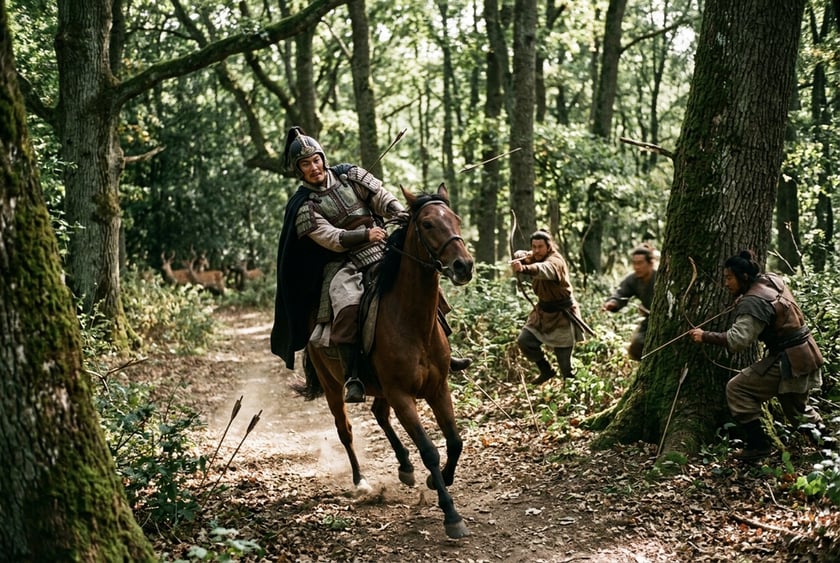
Background
The state of the realm around the fifteenth year of Jian'an (210) was a brief "intermission": the Battle of Chibi had just ended, the Sun-Liu alliance had not yet fractured, and Cao Cao had retreated north to regroup. On Liu Bei's side, he had secured the four commanderies of Jingzhou and was beginning to shift his center of gravity from Jiangxia toward Gongan, with seizing an entry into Yizhou to the west as his next core strategic goal. Yet at the counselor level he had only Zhuge Liang as a top-tier strategist, a critical shortage of strategic depth. On the Sun Wu side, Zhou Yu had died of illness at Baqiu, and his plan to "first take Yizhou, then vie for all under heaven" was shelved with him; Lu Su took over and pivoted toward the compromise line of "lend Jingzhou to Liu Bei, jointly resist Cao Cao." Pang Tong, as a former subordinate of Zhou Yu, briefly returned to center stage at Zhou Yu's funeral — and his next move became a pivotal moment of talent redistribution within the Sun-Liu alliance.
Key Figures
Pang Tong was around thirty-two at the time, belonging to the same circle of young Jingzhou scholars as Zhuge Liang and Xu Shu; the elder Sima Hui had paired them as "Sleeping Dragon and Young Phoenix." Pang Tong had traveled earlier in the Wu territories and befriended Lu Su, Lu Ji, and others, and was assessed by the Wu scholarly community as possessing "talent for a king's advisor." Yet he had never been truly valued in Eastern Wu — Sun Quan disliked his appearance and assigned him only a minor post, sowing the seeds of his departure. Zhuge Liang happened to make direct contact with him on the occasion of Zhou Yu's funeral, and drawing on their shared Jingzhou connections, immediately promised on the spot: if Eastern Wu cannot accommodate you, come to Jingzhou [c:16879]. Lu Su provided a second channel of recommendation, writing to Liu Bei to urge that Pang Tong was "not a talent for a hundred-li district." On Liu Bei's side, when they first met, Liu Bei was misled by Pang Tong's drunken, dissolute manner at Leiyang — a county magistracy — and assigned him only a county magistracy; it was only when Zhuge Liang returned to Jingzhou and Zhang Fei was urgently dispatched to retrieve Pang Tong, with Liu Bei descending the steps to make amends, that proper treatment was belatedly rendered [c:16880].
Core Issue
The political science question of this event is: under what conditions will a top-tier strategist belonging to the other camp cross over of his own accord? The answer has three layers. First, his original camp used him poorly (Sun Quan showed him little regard and gave him a position fit for a talent of a hundred-li domain). Second, the new camp offered greater scope for advancement (Liu Bei at this time was short of strategists and urgently needed a planner for the westward campaign). Third, credible recommenders served as trust guarantors (the double endorsement of Zhuge Liang plus Lu Su was what made Liu Bei's gesture of "descending the steps to make amends" credible as a personnel-relations overture). Pang Tong's crossing was not a one-sided "Young Phoenix choosing a worthy perch" but the natural outcome of all three conditions converging. From the detail of Zhuge Liang's letter — "Liang once had a letter of recommendation with Scholar Yuan [Pang Tong]; has it reached the Lord?" [c:16880] — this personnel transfer was a carefully premeditated arrangement on both sides of the Sun-Liu alliance, not a coincidence.
Political Consequences
Pang Tong was appointed Deputy Chancellor-Commandant, jointly deliberating strategies and training troops with Zhuge Liang. This title carried political significance on two levels. First, Liu Bei now at last possessed a "dual-axis" configuration at the level of strategic advisers — Zhuge Liang overseeing overall strategy and rear-area governance, Pang Tong specializing in campaign-level planning. Second, the phrase "Sleeping Dragon and Young Phoenix together" — long circulating as a widely-known prediction — was given concrete reality, adding an important piece of rhetorical capital to the legitimacy narrative of Liubeijituan. In terms of direct consequences, Pang Tong was the actual planner of Liu Bei's Yizhou entry in the sixteenth year of Jian'an (211): his "presentation of the upper, middle, and lower strategies" laid out the specific routes of the Yizhou campaign. Without Pang Tong's joining the Shu cause, there would have been no such pace in Liu Bei's entry into Yizhou — Zhuge Liang's original thinking had been to first consolidate Jingzhou and pursue Yizhou gradually; Pang Tong's arrival pushed that timetable forward by at least two to three years.
Counterfactual Analysis
Suppose Pang Tong had not come into contact with Zhuge Liang at Zhou Yu's funeral, or Zhuge Liang had not left the letter of recommendation on the spot — the probability of Pang Tong remaining in Eastern Wu was still relatively high. Given Sun Quan's low regard for him, he might have been assigned to an ordinary staff post and eventually faded into the Wu civil service — such unremarkable careers for frustrated talents in Eastern Wu were not uncommon in history. In that scenario, the strategic planning for Liu Bei's entry into Yizhou would have had to be carried entirely by Zhuge Liang alone; the Yizhou campaign would very likely have been delayed until after the eighteenth year of Jian'an (213), missing the window when Zhang Song and Fa Zheng proactively came over; and Cao Cao's push toward Liangzhou and Hanzhong would have reached Yizhou's doorstep first — the feasibility of Liu Bei "straddling Jing and Yi" would have dropped sharply. Suppose further that Pang Tong, after joining Liu Bei, had not died at Luocheng — had the "dual-strategist" configuration continued through to before the Battle of Yiling, Pang Tong, given his style of on-the-spot judgment, would not necessarily have agreed to Liu Bei's campaign against Wu; even if the campaign had gone forward, it might not have ended in the great eastern defeat it became. Pangtongguishubaijiang is thus simultaneously a "fortunate moment" in Shuhan's history and the foil to "lost at Luocheng" five years later: a successful talent integration, reversed and recontextualized by a single stray arrow.