Background
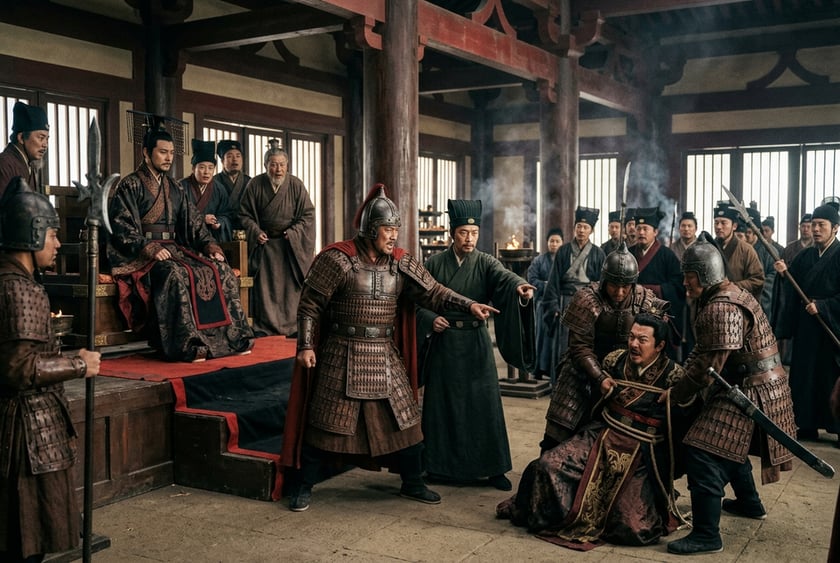
The true backdrop of Sunquanjiwei was the "trial of three generations" facing the Sun clan's Jiangdong power in the fifth year of Jian'an. Sun Jian had died in battle at Xiangyang in 191; Sun Ce took command of his brothers' old forces and fought for eight years to bring the six Jiangdong commanderies into rough unification — and just as Sun Ce was on the verge of elevating himself from regional warlord to independent lord, he was suddenly assassinated on Xishanin Dantu at the age of twenty-six. For a regime that had unified Jiangdong less than three years earlier, this kind of "founding sovereign dying in middle age" was nearly fatal — internally, the Shanyue were not yet pacified and the gentry families not yet tamed; externally, Cao Cao was consolidating the north and Liu Biao in Jingzhou was watching hungrily. Jiangdong could have fractured at any moment in the power vacuum. On his deathbed, Sun Ce entrusted his younger brother Sun Quan to Zhang Zhao and conferred the seal upon him, with the explicit admonition: "In marshaling the strength of Jiangdong to contend with the realm, you are not my equal; in selecting the wise and employing the able, allowing each to give his utmost in protecting Jiangdong, I am not your equal." This parting charge set the tone for Sun Quan's succession: not an empire-building founding sovereign, but an integrating sovereign who preserves and appoints the talented.
Key Figures
Sun Quan at this moment was only nineteen, with "a square jaw and a wide mouth, blue-green eyes and a reddish-purple beard" — a striking appearance but insufficient personal authority [c:16732]; among the officials of Jiangdong he had no independent reputation and depended almost entirely on the regency of Zhang Zhao and Zhou Yu. Zhang Zhao in Sun Ce's era had been the center of civil affairs; when Sun Ce died, he immediately stopped Sun Quan from weeping aloud and led him out to receive the salutations of the officials, converting Sun Quan from the role of "chief mourner" to "new ruler" — this procedural act was the decisive element in Sun Quan's stable succession [c:16732]. Zhou Yu in Sun Ce's era had been the center of military affairs; he rushed overnight from Baqiu to mourn and, before the bier, swore a death-oath of loyalty before Wu Taifuren, formally transferring the loyalty of the armed forces into Sun Quan's name [c:16733]; he was then appointed by Sun Quan as Grand Commander with supreme authority over Wu's land and naval forces [c:16735], establishing the stable dual structure of "imperial authority plus military authority." Sun Jing, as Sun Jian's younger brother and elder of the clan, presided over Sun Ce's funeral rites, providing the weight of family authority. Lu Su in the novel's narrative had not yet appeared directly at this moment but had entered the Jiangdong bloc through Zhou Yu's recommendation and became an important early strategist for Sun Quan's independent diplomatic policy.
Core Issues
This succession concentrated three core issues. The first is "constructing the legitimacy of a young lord's accession." Sun Quan was barely nineteen, without independent military achievements, and had to rely on a combination of "receiving the salutations of all officials, the Grand Commander conferring the military seal, and broadly gathering talented people" to rapidly build authority — not on personal charisma. The second is "the stability of a dual-regent system." The arrangement of Zhang Zhao handling civil affairs and Zhou Yu handling military affairs was the precise execution of Sun Ce's deathbed charge, but this dual structure had an internal tension — Zhang Zhao leaned toward prudence and conservatism, Zhou Yu toward initiative and forward action. That Sun Quan was able in his early years to balance the two owed much to his own political talent; it was only when he refused Cao Cao's demand for a hostage in 202 (see event #149) and made the decision to resist Cao Cao in 208 (see event #144) that he genuinely learned to forge an independent course between his two regent ministers. The third is "how to rapidly build up a talent reserve." After succeeding, Sun Quan immediately opened a guest lodge in Wuhui and directed Gu Yong and Zhang Gang to receive visitors from all directions, within a short period recruiting civil officials such as Han Ze, Yan Jun, Xue Zong, Cheng Bing, Zhu Huan, Lu Ji, Zhang Wen, Ling Tong, and Wu Can, as well as military commanders such as Lv Meng, Lu Xun, Xu Sheng, Pan Zhang, and Ding Feng [c:16734]. This cohort over the following fifty years successively bore the weight of Jiangdong's military and political apparatus, forming the talent base that enabled Sun Quan to win at Chibi and Yiling and to proclaim himself emperor in 229.
Political Consequences
The most immediate consequence was that the Jiangdong regime completed a smooth transition from the "Sun Ce era" to the "Sun Quan era" without the prolonged integration period of eight years that had followed Sun Jian's death. Second, Zhou Yu was appointed Grand Commander, and Jiangdong for the first time had an institutionalized supreme military post [c:16735]; this position was subsequently passed down in succession to Lu Su, Lv Meng, Lu Xun, and Lu Kang, becoming the core nexus of Eastern Wu's military-political system across fifty years. Third, the establishment of Sun Quan's "broad recruitment of talent" model — practiced continuously from 200 through 234 — meant that the talent supply was never interrupted even during wartime, and this was the fundamental reason that Eastern Wu always had qualified commanders in multi-front operations at Chibi, Hefei, Yiling, Shiting, and Hefeixincheng.
Counterfactual Analysis
Had Sun Quan at the time of Sun Ce's assassination chosen succession "by son" — that is, following Western Han convention with a young child inheriting — Jiangdong would inevitably have fallen into the common trap of a young lord with regents monopolizing power, and could well have been picked off one by one during Cao Cao's unification of the north between 200 and 208. Sun Ce's deathbed choice of his nineteen-year-old brother rather than a young child was itself a clear-eyed judgment that Jiangdong "must have an adult successor." Conversely, had Sun Quan after his succession not immediately received Zhou Yu's support returning from Baqiu, the Jiangdong military might have fractured for lack of a commanding figure, and the Shanyue might even have seized the opportunity for a mass uprising; Zhou Yu's death-oath before the bier [c:16733] and his subsequent appointment as Grand Commander [c:16735] were the decisive nodes in the successful transfer of Jiangdong's military authority. Looking at these two counterfactual branches, Sun Quan's ability to stabilize Jiangdong at age nineteen owed equally to Sun Ce's precise choice of heir on his deathbed, the highly professional performance of his two regents Zhang Zhao and Zhou Yu, and Sun Quan's own rapid learning in the dimensions of both procedure and personnel.