Circumstances of Death
As a biographer looking back at Dantu in the fifth year of Jian'an, the death of Sun Ce is the most theatrically charged non-combat death in the early San Guo period. The chain of events began with Wu Commandery Administrator Xu Gong — a former official who, after Sun Ce swept through Jiangdong, attempted in secret to send counsel to Cao Cao. The covert letter he wrote was intercepted by troops guarding the river, and Sun Ce confronted him directly and had him strangled. Xu Gong's household scattered, and three of his personal retainers swore to avenge their master. One day Sun Ce was hunting in the western hills of Dantu, chasing a deer deep into the forest, when he suddenly encountered the three retainers carrying spears and bows; they claimed to be soldiers of Han Dang's army. Sun Ce grew suspicious and tried to withdraw, whereupon one man drove a spear into his left thigh and another shot an arrow into his cheek. Sun Ce pulled out the arrow and returned fire, fighting off the assassins hand-to-hand; he took several spear wounds and his mount was also injured before his personal guard rescued him. This ambush was a close-range, sudden, and professionally executed act of revenge — one that inflicted not only devastating physical injury on a young military genius accustomed to leading from the front, but a profound psychological shock as well.
Final Words and Dying Instructions
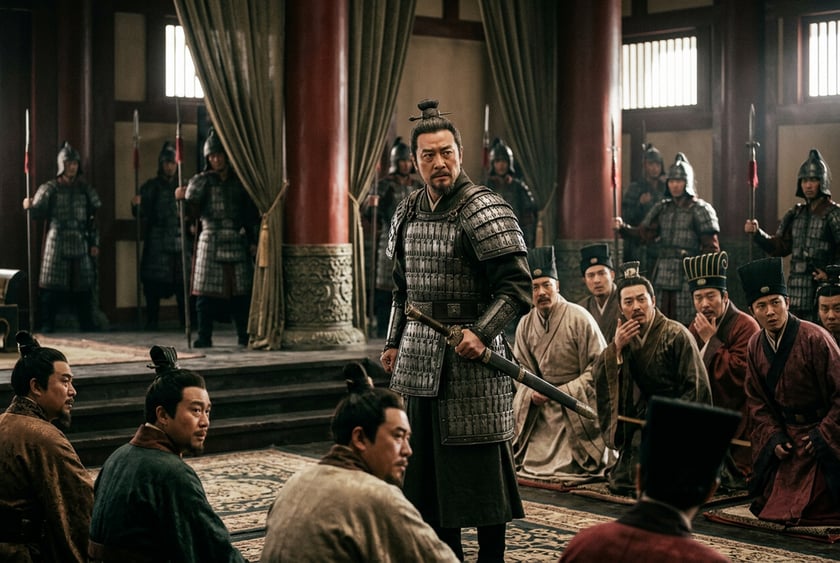
Sun Ce's deathbed arrangements unfold fully only toward the end of chapter twenty-nine of the Yanyi — but in biographical terms, his "dying instructions" actually accumulated in stages. In the initial period of being confined to bed, his physician warned him that "he must rest quietly for a hundred days before there would be no danger; if his wounds were agitated by anger they would not heal". For a man who had never in his life been good at suppressing his emotions, this medical warning was virtually a death sentence. When a messenger returned from Xu Chang bearing Guo Jia's prediction that Sun Ce "was reckless and unprepared, impulsive and unstrategic, and would surely die at the hands of a petty man," Sun Ce erupted in fury on the spot, demanding to lead a campaign against Xu Chang, only to be dissuaded by Zhang Zhao with the words "do not risk your precious person for a moment's anger". But the emotional blow had already struck, and the wound would not close. In the days that followed, he had Yu Ji executed and then saw Yu Ji's ghost appear to him; rage and spiritual anguish tormented his body simultaneously; at the Yuqing Abbey, burning incense, he even mistakenly struck down an old retainer in a daze. This sequence of events constitutes a pattern of "self-refutation" in the final phase of his life — the harder he tried to use rage to prove he was still the Little Conqueror he had been, the more irretrievably his wounds progressed. In the end, he summoned Zhang Zhao and Sun Quan to his sickbed in Dantu and entrusted Jiangdong to his younger brother (see Event 161 for details).
Aftermath
The course of events in Jiangdong after Sun Ce's death proved the soundness of his dying transfer of authority. The young Sun Quan, with the support of Zhang Zhao and Zhou Yu, stabilized Jiangdong; the remnants of Xu Gong's household and other local opposition forces were swiftly suppressed. Cao Cao initially considered advancing south to swallow Jiangdong, but his advisors counseled alliance with the Sun clan to divide Yuan Shao's support base; he accordingly arranged for a daughter of Cao Ren to marry Sun Ce's youngest brother Sun Kuang, turning news of Sun Ce's death into a diplomatic opportunity rather than a military one. In the following twenty years, Eastern Wu gradually established a stable regime anchored by the Yangtze River, and at the Battle of Chibi defeated Cao Cao, forming the tripartite balance with Liu Bei. From the perspective of dynastic continuity, Sun Ce's death, though a personal tragedy, happened to catalyze a "second-generation" political system that placed far greater emphasis on talent cultivation and institutional development.
Historical Assessment
Historians and literary works through the ages have consistently regarded Sun Ce's early death as one of the most regrettable untimely deaths of the late Han period. In temperament he combined boldness with impulsiveness; militarily he swept across Jiangdong and laid the foundations of a state before the age of twenty-six; but his weaknesses were equally pronounced — excessive reliance on his own martial prowess, impatience with the nuances of civil-military administration, and an overreaction to criticism from public opinion. Guo Jia's prediction that he "would surely die at the hands of a petty man" was not fatalistic prophecy but a probabilistic inference grounded in character analysis. Viewed from a wider angle, the reason Sun Ce's death has been recounted and re-examined across the centuries is precisely because it illuminates a universal proposition: the upper limits of a political leader's capacity are determined not only on the battlefield but equally by emotional management and institutional design. Sun Ce could conquer Jiangdong, yet nearly destroyed it through loss of emotional control; he could, in the very moment of dying, recognize and employ the right person and entrust Jiangdong to the most suitable brother, thereby salvaging his own life's work — the complexity of "greatest failure and highest success intertwined in the same person" is the fundamental reason Sun Ce's death has endured as a landmark event of the early San Guo era.