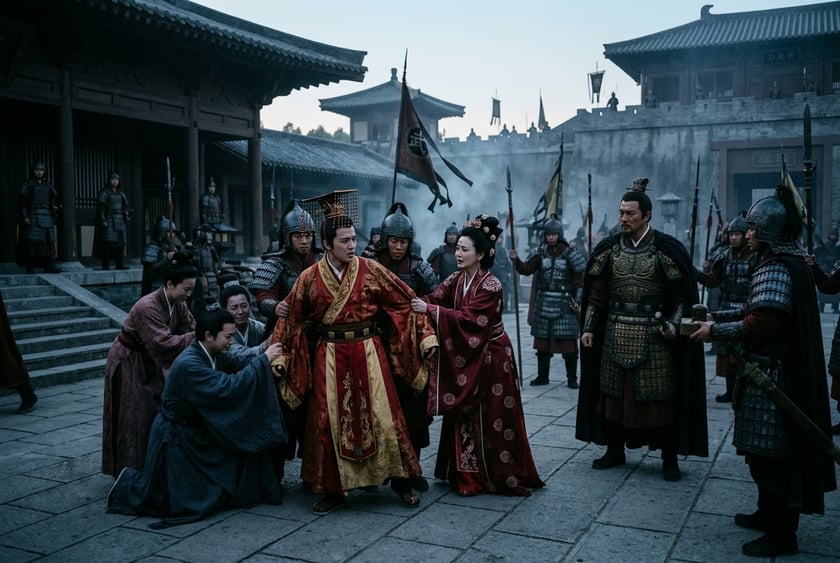
Strategic Background
The 234 assault on Hefeixincheng was the high-water mark of strategic coordination between Wu and Shu, and also its final real-world test. Zhuge Liang moved out in late spring to Wuzhangyuan, intending a prolonged standoff of farming and attrition against Sima Yi, forcing Wei's main force into the open; Sun Quan bore the task of "relieving pressure on the eastern front," personally leading the Eastern Wu main force north through Chaohu Lake to press Hefeixincheng, while Lu Xun and Zhuge Jin advanced into the Mienshui region from Jiangxia and Sun Shao pressed into the Guangling region, forming a three-pronged simultaneous advance designed to pin down Wei forces across the board. This was the most clearly delineated and largest-scale simultaneous operation the Wu-Shu alliance had mounted since its formalization in 229. Geographically, Hefeixincheng had been recommended by Man Chong and relocated to a site roughly thirty li northwest of the old Hefei city, specifically to avoid the weakness of the old city, which Wu's navy could reach directly by water; the new city was farther from Chaohu Lake, forcing Wu troops to disembark and attack on foot, which shifted the battlefield from the water combat at which Wu excelled to the infantry-and-cavalry fighting at which Wei excelled.
Deployments on Both Sides
On the Wu side, Sun Quan personally commanded the main force surrounding Hefeixincheng, approximately one hundred thousand men; Lu Xun and Zhuge Jin led roughly ten thousand men from Jiangxia into the Mienshui, targeting a feint toward Xiangyang; Sun Shao led another ten thousand or so into Guangling, targeting raids toward Xuzhou. All three prongs advanced north simultaneously — in sheer momentum, it was the largest offensive against Wei since Chibi. On the Wei side, Zheng Dong General Man Chong was the core defender of the Huainan front; he initially judged that since the new city was distant from Chaohu Lake and Wu's supply lines were long, it was possible to mount a countermove by "abandoning the new city and luring the enemy deep," but Emperor Cao Rui insisted on holding firm, citing Eastern Han Guangwu's campaign at Lueyang and Cao Cao's old dictum that "there are positions that must be contested," and ordering all commanders to hold their ground. Cao Rui then personally boarded a dragon boat to campaign eastward, advancing to Shouchun to oversee the battle — the gesture of an emperor personally taking the field struck directly at Wu army morale.
Key Decision Points
The outcome of this battle turned on three points. The first was whether Cao Rui would hold to "defend and not withdraw." Man Chong had proposed withdrawing from the new city to Shouchun with the aim of shortening lines and concentrating force, but this would have conceded the depth from Hefei to Huainan; Cao Rui's hold-firm order blocked this concession, forcing Wu to bleed time and manpower against the fortified walls of the new city. The second was whether Lu Xun's secret plan to "lift the siege of the new city and cut off Wei's line of retreat" could be kept from the enemy. Lu Xun intended to let Sun Quan pin down Man Chong on the main front while he led the Mienshui force around to strike Wei's rear and flanks, creating a pincer — but his secret memorial was intercepted by Wei's roadside scouts and presented to Cao Rui, rendering the surprise-attack plan completely ineffective. The third was whether Sun Quan would choose to "hold on and fight once Cao Rui's personal expedition arrived." The Wei emperor's personal campaign meant that Wei could mobilize the entire mobile force of the north; Wu could only be ground down by holding on under those conditions, and Sun Quan promptly withdrew, avoiding the catastrophe of being counterattacked and intercepted in the manner of Xiaoyaojin in 215.
Outcome and Aftermath
The battle ended with all three Wu prongs withdrawing in succession. Cao Rui remarked, "Lu Xun's generalship is not inferior to that of Sunwu; the southeast cannot be pacified" — a statement that simultaneously reflected Wei's high assessment of Lu Xun and announced that Wei's strategic posture toward Wu was settling into a stable mode of "primarily defensive, no active southward campaigns." Zhuge Liang, receiving no eastern front support, continued his long standoff with Sima Yi at Wuzhangyuan, dying in camp in the eighth month; the window for large-scale Wu-Shu joint action thus closed permanently. This battle was also the last time Sun Quan personally led a major campaign in the Hefei direction — though Wu's pressure on Hefei did not cease afterward, subsequent efforts were always led by subordinate commanders and none matched the scale or ambition of this 234 campaign. Hefeixincheng became a threshold that Eastern Wu could never cross, locking the Wu-Wei boundary for the entire second half of San Guo.
Counterfactual Analysis
Had Lu Xun's secret memorial not been intercepted by Wei's roadside scouts and the surprise-attack plan been successfully executed, Wei's forces might have faced a genuine dilemma — pinned frontally by Sun Quan and cut off from the rear by Lu Xun — and Hefeixincheng might have fallen to Wu before Cao Rui's reinforcements arrived. Under those circumstances, the Wu-Shu alliance would have achieved its greatest strategic victory: a breakthrough on the eastern front at Hefei would have given Wu access to the Huai River via the Fei River, opening up Wei's entire southern defensive line; Zhuge Liang on the western front, responding to the broader strategic shift, would also have gained a chance for strategic reversal, and Sima Yi's "attrition tactic" at Wuzhangyuan would have been untenable. The San Guo order might have been broken in 234 or 235. Conversely, had Sun Quan chosen to continue battering the new city even after Cao Rui's personal expedition arrived, Wei could have seized the opportunity to concentrate its mobile forces for a counterattack, potentially encircling Wu's main force beneath Hefei's walls; a severe blow to Eastern Wu's main army would have immediately plunged Jiangnan into crisis. Seen from this angle, the interception of Lu Xun's secret memorial was the true "branch point" of this campaign — it converted what might have been the greatest possible victory into the most ordinary of withdrawals, and ended the highest strategic ambition the Wu-Shu alliance ever entertained.