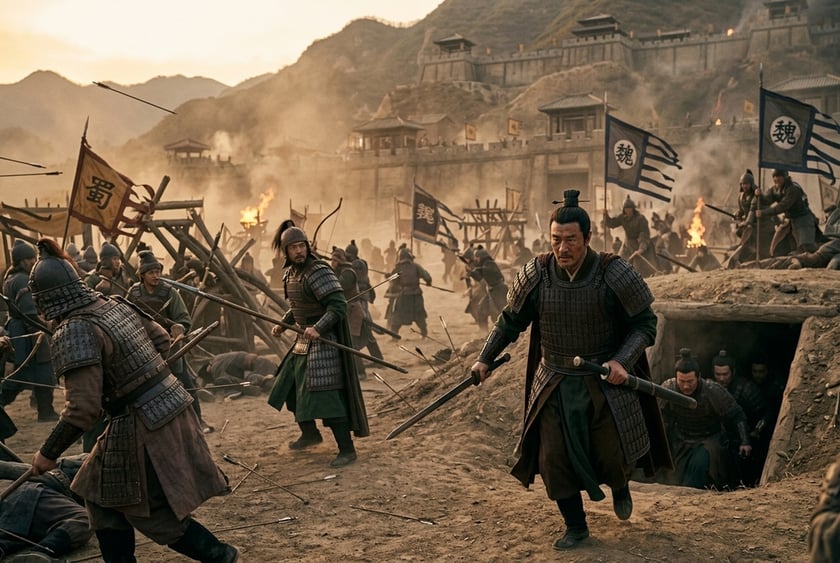
Background
Sunquanjuecekangcao is the deepest taproot of the Battle of Chibi's strategic tree. At the political level, Sun Quan was barely twenty-six and had inherited Jiangdong for only eight years; the mountain peoples were not yet fully pacified internally, and Cao Cao had just demonstrated his awesome power by driving Liu Bei to Dangyang with light cavalry. Cao Cao then sent Sun Quan a letter in the name of Inspector of Jingzhou, explicitly declaring he would "hunt at Jiangdong" — posturing for submission, not negotiation. At the strategic level, the real question Sun Quan faced was not "can we defeat Cao Cao in battle?" but "even if we cannot, we must fight" — because should he yield without a fight, the scores of thousands of the Jiangdong clans along with three generations of political capital accumulated since Sun Ce and Sun Jian would be instantly absorbed into Cao Cao's bureaucratic system, leaving the Sun family with no independent political existence whatsoever.
Principal Figures
Lu Su was the true driving force behind this decision. After the Changban defeat he personally traveled to Dangyang to meet Liu Bei, proposed the basic framework of a Liu-Sun alliance against Cao, and against all opposition brought Zhuge Liang into the Wu court, transforming an "idea" into an "event." Zhuge Liang used a goading technique that struck directly at Sun Quan's self-regard, prompting him to declare his position — in the novel Sun Quan "sees the light at once" upon hearing Zhuge Liang's analysis [c:16722], which is a literary rendering but is psychologically true to the actual decision: a young sovereign surrounded by senior officials advocating submission needed an outside voice to bolster his resolve. Zhang Zhao represented the cautious faction of Jiangdong's senior officials; his argument was that "Cao Cao has pacified the north and his momentum cannot be resisted, especially now that he leads a million men southward" — reducing the strategic question to a simple comparison of raw strength [c:16723]. Gu Yong seconded Zhang Zhao, advocating from the standpoint of the literati clans' collective interests that they avoid war and seek security. Lady Wu Guotai is depicted in the novel as a crucial family arbiter who, invoking the ancestral maxim "for internal affairs consult Zhang Zhao, for external affairs consult Zhou Yu," steers Sun Quan toward following Zhou Yu's counsel — though this is literary embellishment, it reflects the real role of the maternal line in the Sun family's political dynamic.
Core Issues
The core issues of this decision are three. The first is "the ledger of strength for resistance versus submission." Zhang Zhao's faction calculated that "submission preserves Jiangdong's wealth and rank," but they overlooked the precedent Cao Cao had just set in dealing with the Yuan family — his treatment of surrendered provinces' great clans had never been one of patronage but of assimilation; Jiangdong's literati would lose their independent political structure upon yielding to Cao. The second is "how to play the Liu Bei card." Lu Su insisted on the Liu alliance not because he overestimated Liu Bei's troop strength but because he understood the geopolitical value of the coalition: letting Liu Bei bear the land-front face while Eastern Wu bore the water-front face, together forming depth along the Yangtze line, would leave Cao Cao hobbled by supply lines and plague. The third is "how a young sovereign reaches a decision amidst competing senior-official opinions." Sun Quan employed a deft procedure — he first heard Zhang Zhao's view and appeared to waver; then let Lu Su and Zhuge Liang present their case privately; then summoned Zhou Yu back to the capital to declare his position; finally, in the novel's rendering, "saw the light at once" [c:16722], converting the decision from external pressure into internal conviction — a procedure that guaranteed unity of execution in wartime.
Political Consequences
Once the decision was made, Lu Su was immediately ordered to "convey this intention to all civil and military officials" [c:16722], aligning Jiangdong top to bottom on a war footing; the pro-submission faction was temporarily suppressed. Zhou Yu was then appointed Grand Commander, overseeing Wu's land and naval forces; Lu Su remained in the capital coordinating provisions and diplomacy; Zhuge Liang was sent back to Xiakou to join Liu Bei, formalizing the alliance. The longer-term political consequence was Sun Quan's transformation from "inheritor" of his father's and brother's legacy into an independent strategic decision-maker in his own right. Previously he had mostly balanced between Zhang Zhao and Zhou Yu; the decision to resist Cao on the eve of Chibi was the first time he overrode Zhang Zhao's cautious faction on a major strategic question, and it laid the psychological groundwork for his 229 proclamation as emperor. At the same time, this decision furnished the original template for the Wu-Shu alliance: "Liu and Sun jointly resisting a stronger enemy" became the default premise of Eastern Wu's diplomacy for the next fifty years, and even after its brief rupture at Yiling it was rebuilt in 229.
Counterfactual Analysis
Had Sun Quan accepted Zhang Zhao's advice to submit, Jiangdong would have been incorporated into Cao Cao's bureaucratic system in the winter of 208; Sun Quan would most likely have been given a sinecure and relocated to Xu, while Jiangdong's literati were gradually conscripted northward and the military independence of the south permanently erased. After resolving the south Cao Cao would have concentrated on Guanzhong and Hanzhong; Liu Bei might not have reached Sichuan before being pushed to the margins, and the three-way San Guo balance could never have taken shape. Conversely, had Sun Quan trusted Zhou Yu's optimistic assessment completely and rushed to battle before Lu Su's diplomatic groundwork was finished, he would have been forced to face Cao's main army alone without Liu Bei pinning Cao's land forces on the other flank, leaving the Yangtze line undermanned — an outcome far more perilous. From this angle, Sun Quan's true wisdom in deciding to resist Cao was not "the choice to resist" itself but "first confirming the alliance was established, then making the decision to resist" — that procedural design was the political starting-point of the Chibi victory.