Background
After the Battle of Chibi, Liu Bei "borrowed" several commanderies south of the Yangtze from Sun Quan as a forward staging ground for the alliance, but the alliance's nature was always that of temporary cooperation under the threat of Cao Cao, not a long-term boundary agreement. As Liu Bei captured Yizhou and his territory expanded, the original "borrowed Jingzhou" arrangement began to put increasing pressure on Wu — Sun Quan could not accept that Changsha, Lingling, and Guiyang, three commanderies pressed against the heartland south of the Yangtze, remained indefinitely under Liu Bei's control. In the Romance's narrative, this episode falls between chapters sixty-six and sixty-seven, positioned squarely between two major events — "Liu Bei's consolidation of Shu becoming a fait accompli" and "Cao Cao's western campaign against Hanzhong" — making it a classic "geopolitical rebalancing."
Key Figures
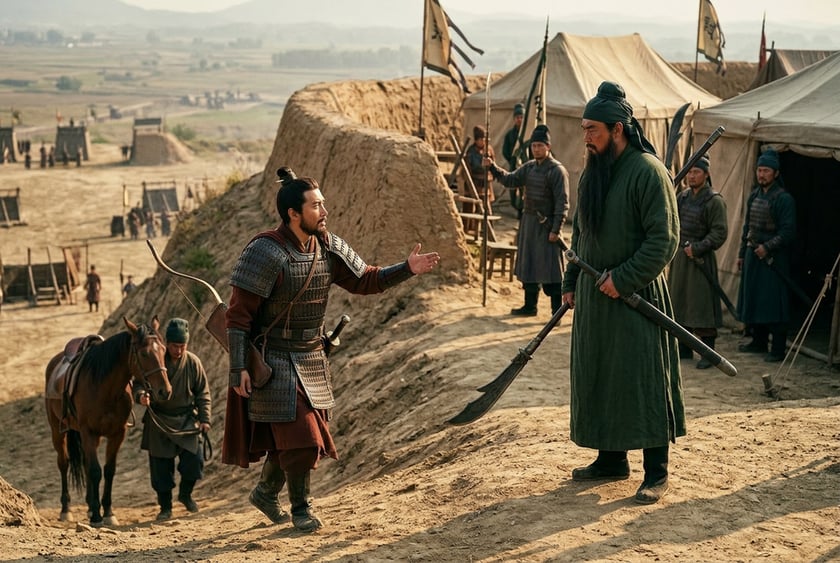
In the Romance, Sun Quan forces the issue of "returning the three commanderies" onto the negotiating table by leveraging Zhuge Jin's family connections to detain relatives as a form of moral pressure. This move simultaneously activates Zhuge Liang's fraternal loyalty and avoids the charge of openly violating the alliance. Zhuge Jin's role is thus placed in the dual position of "envoy plus kinship hostage," his two fruitless missions converting diplomatic failure into justification for military intervention. Guan Yu, in chapter sixty-six, is portrayed as a quintessentially "stubbornly uncooperative" frontier commander — neither honouring Liu Bei's promised concessions nor accepting the administrative officers Wu dispatched to take possession. This on-the-ground defiance conveniently provided Sun Quan with the pretext to later deploy Lv Meng and seize the three commanderies by force. Lu Su, though absent from the specific details of this episode (that material is reserved for the sub-event "Single Blade Meeting at Yiyang"), remains present throughout as a diplomatic mediator.
Core Issues
The core issue of this episode is "how to manage territorial disputes within an alliance." Sun Quan's approach unfolds in three steps. Step one: use the detention of relatives as a moral lever to pressure the other side into making the first concession. Step two: when that concession fails to materialise on the ground, immediately send troops to take over and appoint administrative officials, converting "agreement implementation" into "accomplished fact." Step three: exploit a larger geopolitical event (Cao Cao attacking eastern Shu) to get the other side to raise its own offer — at which point Liu Bei was even willing to add Jiangxia, asking Sun Quan to send forces to Hefei to divert Cao Cao's attention. These three steps illustrate Sun Quan's consistent diplomatic style: extracting the maximum political gain at the minimum military cost.
Political Consequences
The final outcome was a division of territory along the Xiang River: Sun Quan took Changsha and Guiyang, while Liu Bei retained Lingling (the Romance handles this detail in the sub-event "Single Blade Meeting"). At the same time Sun Quan received Liu Bei's verbal pledge that "as soon as eastern Shu is taken, all of Jingzhou will be returned" — a pledge that was never honoured, and that later became the pretext for Guan Yu's isolation during his northern campaign and for Sun Quan's seizure of Jingzhou. The short-term impact was that Wu's southward expansion received formal legitimation; the medium-term impact was that the Sun-Liu alliance shifted from "unconditional alliance" to "transactional alliance"; the long-term impact was that the concessions and mutual distrust of this year led directly, four years later, to the chain of disasters culminating in Lv Meng's white-robed crossing of the river and Guan Yu's defeat and death.
Counterfactual Analysis
Had Liu Bei flatly refused when Zhuge Jin came seeking the territory back — willing to let his brother-in-law suffer rather than cede any land — Sun Quan would likely have been compelled to tear up the alliance outright and launch a military campaign against Jingzhou ahead of schedule; this would have meant Cao Cao could have simultaneously intensified pressure on both Wu and Shu, potentially sending the San Guo balance into disequilibrium far earlier. Conversely, had Liu Bei on the very first concession delivered all three commanderies intact, Guan Yu's long-standing image as a "stubbornly uncooperative" frontier lord would never have been confirmed, and the moral cost of Lv Meng's later seizure of Jingzhou would have been substantially higher. Either way, this episode tells us that "alliances" in the San Guo period were always fragile — they required constant renegotiation and successive concessions to sustain, and every concession bred the next crisis. Sunwu's taking of the three commanderies was the first concentrated exposure of the Chibi alliance's fragile nature.