Background of the Meeting
The true starting point of Yiyangdandaohui was not Yiyang but an unwritten "loan agreement" that followed the Battle of Chibi. After Chibi in the thirteenth year of Jian'an (208), Sun Quan "lent" the territory around Nanjun to Liu Bei for his garrison — the underlying logic being twofold: on one hand acknowledging that Liu Bei had genuinely contributed at the Battle of Chibi and needed a foothold to maintain the alliance; on the other hand hoping that Liu Bei would shield the western front against Cao Cao and reduce the direct pressure on Sunwu. This was a classic "vague strategic agreement," with neither side making explicit what was being lent, the conditions for return, or the timeline. The virtue of a vague agreement is that it is easy to reach; its flaw is that the moment the balance of power between either party shifts, the entire agreement instantly flips. By the twentieth year of Jian'an (215), Liu Bei had already taken Yizhou, his western territory having expanded by more than double; Sun Quan's judgment was straightforward: the premise under which the land had been lent — that Liu Bei was "defeated and come from afar, with no resources" — had disappeared, and the three commanderies (Changsha, Lingling, and Guiyang) had to be returned. Viewed from this angle, what the Yiyangdandaohui was truly negotiating was not "whether it was a loan" but "whether the loan's validity had expired."
The Exchange
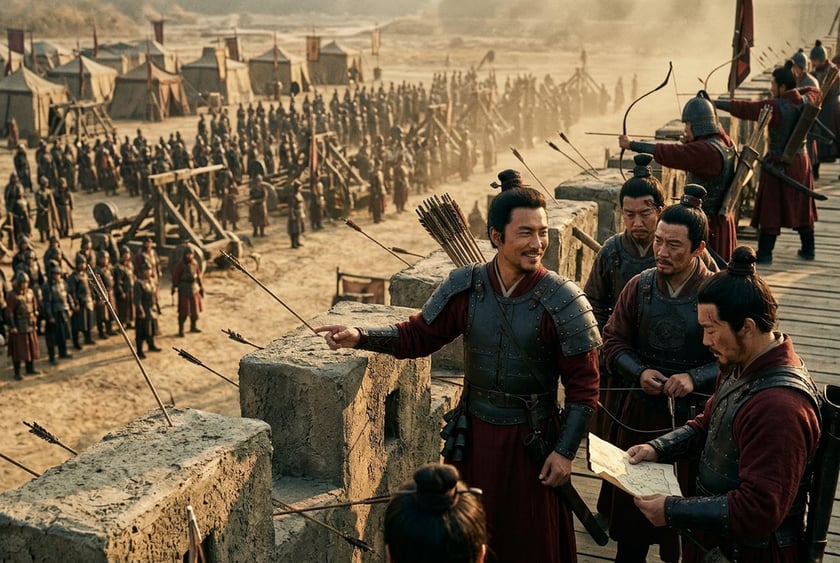
This was a carefully designed "low-intensity confrontation" meeting. Each side's troops were stationed a hundred paces away; only the commanders would attend with single swords at their sides — an arrangement with three purposes: first, preventing the assembled armies from firing on each other directly; second, preserving negotiating space and leaving a dignified exit for both parties; third, lifting the dialogue between the two sides' commanders from the military plane to the diplomatic plane. At the meeting, Lu Su opened by placing the word "the state" at the forefront — elevating this conflict of interests to a question about the integrity of the Sun-Liu alliance as a whole, and avoiding having it reduced to a performance of Guan Yu's personal posture. Lu Su's argumentative structure was clean: we gave (grace); now that you have Yizhou (conditions changed), you still refuse to return (breach of agreement) — this is a failure of virtue. Guan Yu's response avoided the "loan" topic and instead emphasized the personal military contribution of Liu Bei himself at Chibi — this shifted the frame from contractual ethics to "attribution of credit," essentially changing the subject. Lu Su immediately pulled the argument back, pointing out that Sun Quan, seeing Liu Bei desperate and defeated at Changbanpo, had extended the land and the strength of his officials without reservation — making him Liu Bei's benefactor — and that it was now Liu Bei who was trying to swallow Jingzhou entirely that truly constituted a failure of virtue. At this Guan Yu was in fact out-argued, which is why the exchange ended with "this is an affair of state; what does this person know about it" — a gesture of dismissing the subordinate and closing out the conversation.
Decision and Outcome
From the meeting itself, neither party reached any written agreement, and neither truly backed down. Yet the actual effect of Yiyangdandaohui was enormous — it froze a border confrontation that could have erupted into armed conflict at any moment into an oral standoff that could be sustained for months. This "freezing" left a time window for external variables to intervene: shortly afterward Cao Cao moved to take Hanzhong, Liu Bei's main force was tied down on the western front, and the Liu Bei side recognized it could not sustain the eastern front and had to accept a compromise. Eventually both Sunwu and the Liu Bei side agreed to the Xiang River as the border, with Changsha and Guiyang going to Sunwu and Nanjun, Lingling, and Wuling staying with Liu Bei. In terms of outcome, Sunwu reclaimed two commanderies, but because this was achieved through negotiation rather than war, the Sun-Liu alliance was formally maintained in form. Lu Su's role throughout this process was "using a posture of confrontation to maintain the pace of negotiation" — his firmness at the front line was precisely what created the bargaining space for returning to the negotiating table afterward.
Historical Significance
The position of Yiyangdandaohui in the long arc of historical perspective far exceeds that of an ordinary meeting — for three reasons. First, it was the inflection point at which the nature of the Sun-Liu alliance changed: from this point forward, Sunwu's attitude toward Liu Bei shifted clearly from "allied force" to "creditor," permanently undermining the internal trust structure of the alliance. Second, it planted the distant cause of Guan Yu's later killing at the hands of Sunwu: while Lu Su was alive he could still constrain force through negotiation; after Lu Su's death, Lv Meng succeeded him and adopted a far more aggressive strategy, and when Guan Yu next confronted Sunwu there was no longer a "Yiyangdandaohui-style" buffer mechanism available to him. Third, Yiyangdandaohui shaped posterity's perception of Lu Su as a historical figure: he was not the hapless pushover repeatedly outmaneuvered by Zhuge Liang as depicted in the Romance but rather a tough diplomat willing to confront Guan Yu face to face at the front line and press him with argument — an image that is quite clear in the original text of San Guozhi, and it is Yiyangdandaohui itself that has preserved it. Viewed over a longer arc, what Yiyangdandaohui truly demonstrated was a distinctive model in Chinese classical diplomacy: "using a posture of force as a prelude to negotiation" — place military force on the table first, then use language to create bargaining space. This model appears repeatedly in Chinese court diplomacy from the Tang and Song dynasties onward, and the Yiyang meeting of that single afternoon is almost its earliest and purest exemplar.