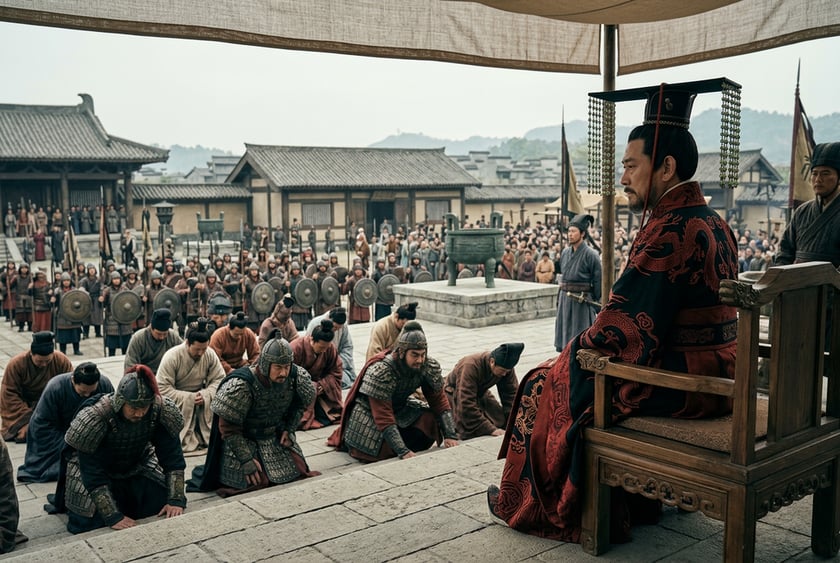
Strategic Background
The Battle of Nanjun was the "second half" of the Chibi campaign, yet in certain respects its strategic significance exceeded even Chibi itself. The fire at Chibi was a defensive victory that stopped Cao Cao from swallowing Jiangdong; seizing Nanjun by assault was the critical step by which the Sun-Liu alliance converted that victory into a durable strategic asset. After withdrawing north, Cao Cao did not abandon Jingzhou—he left first-line commanders such as Cao Ren, Xu Huang, and Le Jin to defend Jiangling, Xiangyang, and Hefei, the "Jing-Xiang-He Triangle" that formed his forward base for the next southern push [c:16430]. If Eastern Wu could not remove the nail of Jiangling, Chibi's victory would only have delayed rather than altered the strategic picture. Zhou Yu personally led his main forces north into Nanjun precisely in order to drive Caowei's power entirely out of central Jingzhou and push the Wu-Shu boundary north to the Hanshui line. In the longer view, who held Nanjun determined the shape of the tripartite Jingzhou arrangement that would govern the following decade—Zhou Yu wanted Nanjun as a base for attacking Shu; Lu Su wanted it as a strategic buffer to lend to Liu Bei.
Disposition of Forces
On the Wu side, Zhou Yu commanded and Cheng Pu served as deputy; historical sources suggest a force of roughly twenty to thirty thousand. In the forward deployment, Gan Ning was ordered to seize Yiling first—this advance occupation both cut off Cao Ren's western line of retreat and threatened the right flank of Cao Cao's Jiangling position [c:16429]. In the decisive-battle phase, Lv Meng proposed leaving Ling Tong to guard the Yiling rear while he and Zhou Yu went in person to relieve the position—a transition reflecting the shift in Eastern Wu's military command from the old-guard dominance of Cheng Pu toward the younger generation of Zhou Yu and Lv Meng. On the Cao side, Cao Ren held Jiangling as the main defender; Cao Hong, Cao Chun, and Niu Jin held the outlying positions; Xu Huang coordinated from the Xiangyang direction; Cao Cao before withdrawing north had left secret plans with Cao Ren intended to delay the Wu advance through local counterattacks [c:16430]. The Romance's supplementary details of Cao Ren deploying garrisons at Yiling with Xiangyang in support, though touched up by novelistic craft, are compatible with the historical record of "Cao Ren dispatching cavalry separately to attack and encircle Ning" [c:16429].
Critical Decision Points
The first critical decision was Gan Ning's advance to hold Yiling being surrounded, prompting Lv Meng to propose relief. This engagement tested Eastern Wu's capacity for combined operations: relieving Yiling meant dividing forces and weakening the main body; not relieving meant losing a strategic anchor. Lv Meng's solution—"divide inner and outer, each bearing its own duty"—with Ling Tong holding the rear while Zhou and Lv went personally in relief—rescued Gan Ning without degrading the main force; a textbook instance of coordinated decision-making [c:16429]. The second decision was Zhou Yu choosing to cross the river and encamp on the north bank to fix a date for a decisive engagement with Cao Ren. This surrendered the defensive advantage of "using the river as a barrier," but eliminated the risk of being caught between two fires; it concentrated the entire campaign into a single frontal engagement. The third decision point was Zhou Yu going on inspection tour while wounded. After being hit by an arrow and wounded, Wu army morale briefly faltered; Cao Ren sharply sensed this vulnerability and sallied out to challenge. Zhou Yu's response—personally rising despite his wound to "go in person and inspect the camp formation" and inspire the troops—is the most dramatic and at the same time most historically grounded moment of the battle: a commander's physical presence, in ancient warfare, carries psychological value that no troop reinforcement can replace [c:16429]. The fourth decision was Cao Cao's post-battle enfeoffment of Zhou Yu as administrator of Nanjun and Cheng Pu as administrator of Jiangxia—Cheng Yu's stratagem of "letting Sun and Liu consume one another" [c:16437], converting battlefield contest into diplomatic maneuvering.
Outcome and Resonance
Tactical result: Nanjun passed to Wu; Cao Ren withdrew to defend Xiangyang; Cao Cao's presence in Jingzhou was compressed to north of the Hanshui. Three strategic impacts followed. First, the Sun-Liu alliance transitioned from "wartime coalition" to "long-term standoff"—Zhou Yu intended Nanjun as a springboard for attacking Shu, but after his death Lu Su's policy of lending Nanjun to Liu Bei transformed it into a stable "unite Liu to resist Cao" strategy. Second, Liu Bei was able to establish himself at Gong'an and gradually extend his reach to the four Jingnan commanderies, forming the material and manpower base for his subsequent entry into Shu. Third, Cao Cao's offensive capacity in Jingzhou was severely diminished, compelling him to shift his strategic center of gravity from the southern front to the western front (against Ma Chao and Guanzhong), thereby laying the groundwork for the shape of the Battle of Hanzhong [c:16437]. From the Romance's perspective, the Battle of Nanjun also stands as the starting point of the "three provocations of Zhou Yu" narrative chain—though "Zhuge Liang getting there first" is a novelistic fiction, it does capture a genuine deep anxiety: Wu's forces paid the greatest cost, yet Liu Bei reaped the greatest benefit. That anxiety was real; Lu Su's subsequent Jiejingzhou decision was precisely designed to resolve that structural resentment.
Counterfactual Analysis
First counterfactual: had Zhou Yu not been hit by an arrow, he might have immediately advanced after the battle with his plan to "conquer Shu by sailing west along the river"—this was his explicit strategy in his memorial to Sun Quan before his death. Had this path been taken, the Sun-Liu alliance would have broken apart ahead of schedule; Liu Bei might well have been squeezed out of Jingzhou by a combined Sun-Cao pincer, and the San Guo order would have evolved into a binary confrontation rather than a three-cornered standoff. Second counterfactual: had Cao Ren held the city longer (as Chengdu held out during Liu Zhang's time, into the following year), Zhou Yu's wound might have dragged on until he could no longer command; Wu army logistics might not have sustained the campaign; the Nanjun assault might have been abandoned—Caowei would have retained Jiangling as a southern-advance base, greatly diminishing the value of the Chibi victory. Third counterfactual: had Zhou Yu not died young (he passed away in 210 at thirty-six), Lu Su's scheme of lending Nanjun to Liu Bei might never have been proposed at all; the fruits of the Battle of Nanjun would have been monopolized by Eastern Wu along the Zhou Yu line. Seen from this angle, the true historical significance of the Battle of Nanjun lies not only in changing Caowei's southern front but in the fact that two contingencies—"Zhou Yu struck by an arrow" and "Zhou Yu dying young"—determined that the decade after Chibi evolved toward "unite Liu to resist Cao" rather than "a single Wu hegemony."