Strategic Background
Ganningyilingrushou was the most decisive mid-scale engagement in the middle section of the Battle of Nanjun, occurring in the fourteenth year of Jian'an (209). Although the Chibi fire attack destroyed the core of Cao Cao's naval forces, it did not resolve the problem of fortified cities on the Jiang-Han Pingyuan. Cao Ren held Jiangling with heavy troops and Cao Hong occupied Yiling to form a flanking position, making it difficult for Zhou Yu to assault a single point [c:17369]. In this situation the Wu army was compelled to shift from "fire attack for quick decision" to the new mode of "attriting the adversary through prolonged siege operations" — precisely the combined tactical style of rapid assault and long-term defense of key terrain at which Gan Ning excelled. Looking at the broader strategic picture, the Battle of Nanjun determined the attribution of the middle section of Jingzhou: whether Sunwu could independently control Nanjun, whether Liu Bei could obtain a political justification for the Jiejingzhou arrangement, and whether the Cao forces could hold the strategic depth of the Nanyang–Xiangfan line all hinged on whether Sunwu could absorb the pair of cities of Jiangling and Yiling.
Disposition of Forces
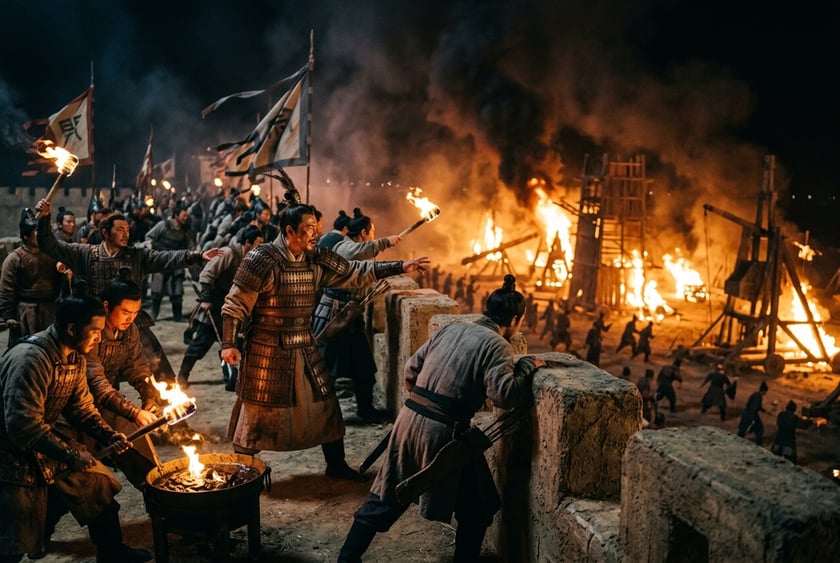
Gan Ning's force numbered no more than several hundred at the time of the surprise strike; after entering Yiling city and absorbing newly won troops, they numbered "barely a full thousand, combining the newly acquired" [c:17369]. Cao Ren's response was classic siege-warfare tactics: dispatching five to six thousand men to encircle and assault the city while erecting tall towers to rain arrows into the city, intending to break the garrison's morale through both psychological and physical pressure [c:17369]. On the Wu side, Zhou Yu's main force was still on the Jiangling front, with limited relief troops available for dispatch — this was the most dangerous aspect of Ganningyilingrushou: he was not simply an isolated city holding firm but an isolated city holding firm at a position relatively far from the main force and relatively deep in enemy territory.
Critical Decision Points
This battle had three critical decision points. The first was Gan Ning himself maintaining composure — "talking and laughing as usual" — over the course of several days of encirclement as his soldiers were all gripped by fear [c:17369]; this was the standard method by which commanders of the time shaped military morale, and Gan Ning's ability to maintain order within the city and prevent mutiny preserved the relief window for Zhou Yu. The second was Zhou Yu's adoption of Lv Meng's plan in the face of internal Wu debate about "whether dividing forces for relief might itself be intercepted": leave Ling Tong to hold the camp while personally leading his generals to relieve the siege, and lay timber barriers on the road of Cao forces' likely retreat to impede cavalry movement. The essence of this plan lay not in "rescuing the men" but in "converting the rescue into a counter-attack against Wei's main force" — turning the straightforward relief into a battle of encirclement reversal [c:17369]. The third was Cao Ren's judgment when Wu's main force arrived — he chose to proactively abandon the siege of Yiling and withdraw to Jiangling; while this was the conservative choice, it also meant that the Wu forces had successfully used "striking the encircling force" to consume Cao Ren's capacity for open-field operations.
The novel's Chapter 51 fictionally credits the key merit of the relief operation to a scene of Zhou Tai breaking through the encirclement alone on horseback to receive Gan Ning [c:17370], entirely backgrounding Lv Meng's planning and Zhou Yu's command. This is a typical instance of the novel's narrative technique of "heroizing a single-point audacious act" — Zhou Tai was indeed a fierce Wu general, but according to the Gan Ning biography in San Guozhi, the true planner of the rescue was Lv Meng and the commander was Zhou Yu; Zhou Tai does not independently appear in that particular operation [c:17369].
Outcome and Reverberations
After Ganningyilingrushou succeeded, Cao forces at Jiangling experienced a sharp reversal of fortune: losing the upstream flanking position and suffering the destruction of a large body of relief troops and horses, Cao Ren was caught in the double attrition of being "unable to hold long from within, unable to counter-attack from without." In the twelfth month of the fourteenth year of Jian'an, Cao Cao finally decided to abandon Jiangling and withdraw north to Xiangfan, with Sunwu formally taking Nanjun. In recognition of his merits Gan Ning was appointed Administrator of Xiling, holding jurisdiction over Yangxin and Xiayi counties — the first time Wu had granted an independently administered commandery-level post of real authority to a general who was "neither of Sun clan blood nor a veteran subordinate," reflecting Sun Quan's high valuation of Gan Ning's tactical worth [c:17369]. From the perspective of the Sun-Liu alliance, after Nanjun was taken Zhou Yu originally intended to continue west to take Bashu, but died of illness at Baqiu; Nanjun was subsequently "loaned" to Liu Bei, on the basis of which Liu Bei laid the foundation for entering Shu. Without the success of Ganningyilingrushou, Jiangling would quite likely have dragged into the fifteenth year of Jian'an still not taken; the Sun-Liu alliance's internal settlement would have collapsed early, and the San Guo configuration might have been completely different.
Counterfactual Analysis
Suppose Gan Ning had been somewhat late in sending word to Zhou Yu after taking Yiling and morale had collapsed first, with Cao forces breaking the city after several days of encirclement — then the Battle of Jiangling would immediately have become a situation of "Wu forces losing troops on two lines while Cao Ren holds Jiangling stably"; Cao Cao might not have proactively abandoned Jiangling to withdraw north, Sunwu would not have been able to rapidly take over Nanjun, and Liu Bei's entry-into-Shu strategy would have been delayed by at least several years. Further suppose Lv Meng had not proposed the "hold the camp and lay timber for the relief" stratagem but had instead adopted the conventional approach of splitting forces for relief — Wu's main force, once divided, would very likely have been defeated piecemeal between Jiangling and Yiling by Cao forces. The true value of Ganningyilingrushou lies in how it drew the Battle of Nanjun into an attrition model whose tempo was controlled by the Wu side, and through Lv Meng's tactical creativity solidified the situation of "encirclement becoming opportunity." This was one of the most textbook-worthy offense-defense coordination battles the Wu army produced in the early period of San Guo, and also the foundational battle example that enabled Lv Meng later to rise to the supreme military commander for the Jingzhou direction.