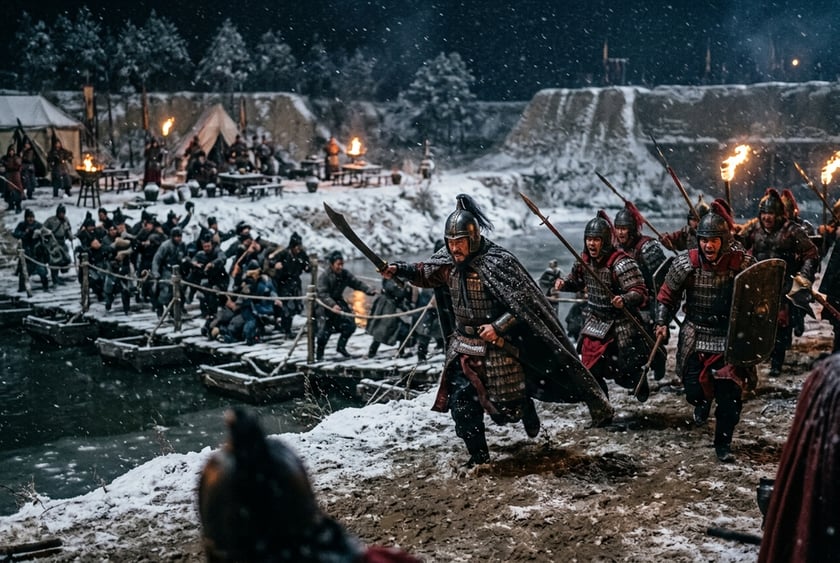
Strategic Background
The Battle of Xingshi was the first large-scale external military stress test Shuhan faced after Zhuge Liang's death, and it was also an attempt by the Caowei faction led by Cao Shuang to establish military prestige through a "conquer Shuhan" strategy. From a modern military-history perspective, the campaign had three layers of background. First, Cao Shuang had held real power since Cao Fang's accession and urgently needed a large-scale expedition to establish his own military reputation and press down the elder-statesmen faction represented by Sima Yi — it was a "politically driven military action" whose connection to the strategic rationality of the war itself was tenuous. Second, after Zhuge Liang's death, Shuhan was governed by Jiang Wan and Fei Yi and had entered a phase of strategic contraction; Hanzhong's defense had shifted from Zhuge Liang's "advance to hold the passes" to a "layered gate defense", though the specific tactical arrangements had not yet been finalized. Third, there had been no major battle on the Wei-Shu border since Zhuge Liang's death — roughly ten years — and the response capability of both armies to actual battlefield conditions had atrophied. This campaign was in effect a mutual inspection of the two sides' states of readiness.
Disposition of Forces
Caowei's deployment followed a "concentrate heavy forces on one axis, break through in a single thrust" approach — Cao Shuang and Xiahou Xuan led more than 100,000 troops south through the Lugu Valley, aiming directly at Hanzhong. The biggest problem with this deployment lay in logistics: the Lugu road was the most precipitous of the several routes from the Guanzhong plain into Shu, flanked by towering mountains and deep valleys; the rate of draft-animal attrition along the supply line was enormous. Cao Shuang had plainly underestimated this, treating the campaign as a rapid-win political performance rather than preparing a sustained logistics system for a prolonged standoff.
On the Shuhan side, the Hanzhong garrison council was divided. The majority of commanders advocated "hold firm in the Han and Le fortresses and let the enemy in" — meaning: allow the Wei army to enter the Hanzhong basin, then counterattack once the relief force from Chengdu (the Fu army) arrived. The weakness of this posture was that once the Wei force had penetrated into the Hanzhong interior, Shuhan's strategic depth would be compressed, and the civilian population and grain stores would be exposed to direct threat. Wang Ping's plan was "first seize Xingshi and hold the rear" — block the Wei force outside the Hanzhong basin, at the mountain stronghold of Xingshishan, preventing the enemy from deploying its superior numbers, while buying time for the Fu army to arrive as reinforcement. This approach represented the maximum exploitation of Shuhan's topographic advantage by substituting a mountain stronghold for strategic depth.
Key Decision Points
The campaign had three key decision points. The first was Wang Ping's overruling of the majority opinion and insistence on seizing Xingshi. Wang Ping's authority as General Who Stabilizes the North ensured this decision could be implemented, but more important was his judgment: he understood clearly that once the Hanzhong basin fell, Shuhan would have no defensible ground left. "If the enemy takes the pass, disaster follows" — a single sentence that reveals his deep understanding of the geography. The second was that护军 Liu Min concurred with Wang Ping and immediately executed the plan, showing that Shuhan's middle-ranking military officers retained responsive decision-making capability and had not become paralyzed by Zhuge Liang's death. The third was Fei Yi's personal arrival from Chengdu at the head of the Fu army. As the regent following Jiang Wan, Fei Yi's presence at the front demonstrated the central government's intense concern for the Hanzhong defense line. This tradition of "the highest civil-military official of the government personally leading the vanguard campaign" had continued from Zhuge Liang's time and was one of the core elements that allowed Shuhan to maintain efficient military mobilization.
Results and Reverberations
The immediate result was that the Wei army retreated of its own accord when its supply lines collapsed, and Shuhan achieved its defensive objective at minimal cost. But the deeper reverberations were threefold. First, Wang Ping — as the key frontier commander of the post-Zhuge Liang Shuhan — had his prestige firmly established by this campaign; he continued to garrison Hanzhong until his death. The border configuration of "Wang Ping holds Hanzhong, Deng Zhi anchors the east, Ma Zhong anchors the south" that took shape in the middle-to-late period of Shuhan bought the regime nearly twenty more years of life. Second, Cao Shuang's prestige collapsed. A military expedition that "returned without result, mobilizing a hundred thousand men only to be stopped at a mountain pass" cost the Cao Shuang faction its claim to military authority within Caowei. Sima Yi's relative advantage at court widened further; in the Gaopinglingzhibian five years later, Cao Shuang was unable to mobilize sufficient military support — the root cause lay precisely in the political credit squandered by the Xingshi failure. Third, this campaign became a classic case in the study of "substituting mountain strongholds for strategic depth" by later military thinkers — Deng Ai, Jiang Wei, and Zhong Hui all drew on the Xingshi experience when designing their campaigns in the Hanzhong-Jiange corridor.
Counterfactual Analysis
What would have happened if Wang Ping had adopted the majority plan of "hold firm in the Han and Le fortresses"? The most probable outcome: Cao Shuang's 100,000-strong force would have entered the Hanzhong basin, seized outlying strongpoints, and settled into a standoff with the Han and Le fortresses; the local population and material resources of Shuhan's interior would have come under immediate pressure; when the Fu army arrived it would have had to launch an open-field counterattack, with casualties on both sides multiplying several times over. Even if Shuhan ultimately drove the Wei army back, the Hanzhong region's economy and population would have been severely undermined, threatening the very foundation of Shuhan's northern defense. A second, more aggressive counterfactual: if Cao Shuang had been willing to make adequate logistical preparations for the long march through the Lugu Valley, converting the campaign from a rapid-victory operation into a war of attrition, the outcome might not have been the fall of Xingshishan — the terrain there truly favors defenders — but Shuhan would have been forced into sustained wartime mobilization, and its internal contradictions (the power-sharing friction between Jiang Wan and Fei Yi, the conflict between Jiang Wei's pro-war faction and the locally rooted faction) might have been brought to a head ahead of schedule. Seen from this angle, the Battle of Xingshi was both a successful defensive engagement and a stroke of good fortune in which the opponent "exposed his own weaknesses": Cao Shuang's political hunger for quick results allowed Shuhan to complete a textbook strategic defense at the lowest possible cost.