Strategic Context
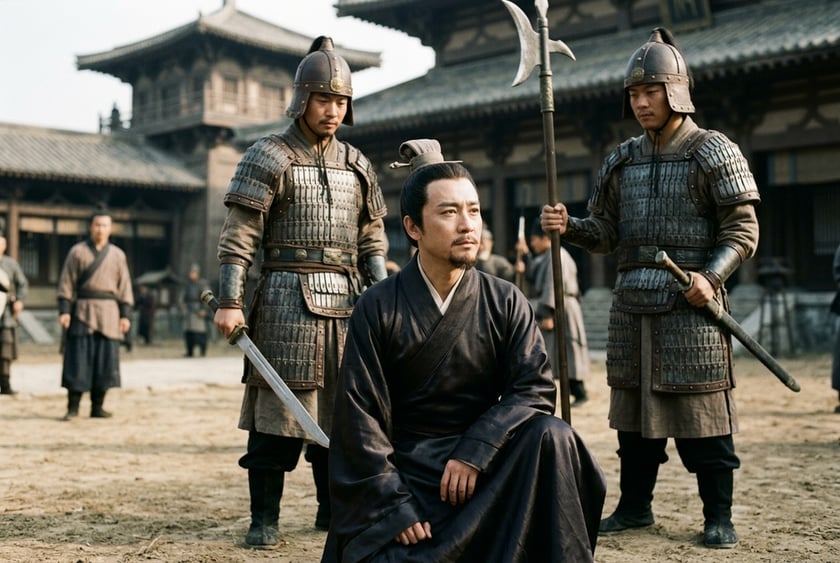
The Battle of Jiangxia in the spring of Jianan year 13 was the concluding chapter of the Jiangdong clique's sixteen-year fixation on "avenging a father's death," and also the first large-scale external military campaign in which Sun Quan appeared as an absolute proponent of war after taking sole charge of his domain [c:17211]. Historically, Sun Jian was shot and killed by an archer under Huang Zu while attacking Liu Biao during Chuping year 4 (192); from that moment forward, the house of Wu and the Jiangxia Huang Zu bore a blood feud. During Sun Ce's era, two attempts to exact that revenge were left unfinished; after Sun Quan's succession, two more expeditions were launched in Jianan years 8 and 12, both returning without result, and Jiangxia had become a thorn in the heart of the Eastern Wu. Geographically, Jiangxia Commandery was positioned at the middle stretch of the Yangtze — touching Jiangling to the west, Wuchang to the east, opening northward to Jing and Xiang, and controlling the Dongting region to the south — a strategic chokepoint commanding mid-Yangtze shipping. Militarily, Huang Zu was renowned throughout Jingzhou for his armored warships and powerful crossbowmen; he was the only local power along the middle Yangtze with actual water-combat experience [c:17211]. Placed within the larger strategic picture on the eve of Chibi, the Battle of Jiangxia took place on the night before Cao Cao had pacified the north and was about to march south on Jingzhou. Sun Quan's choice to commit his full force to eliminating Huang Zu at this precise moment was driven both by the desire to avenge a private blood debt and by the need to remove the destabilizing factor on Jiangdong's western flank — clearing strategic space for the far larger confrontation with Jingzhou and with Cao Cao that was approaching.
Deployment of Forces
The core of Sun Quan's deployment was "specialized division of labor in water warfare": Zhou Yu served as Grand Commander of both water and land forces; Lv Meng functioned as forward vanguard responsible for breaking the defensive line; Dong Xi and Gan Ning served as deputies to support the flanks; Ling Tong, Pan Zhang, and other core commanders were assigned respectively to the tasks of support and pursuit; and Sun Quan personally led one hundred thousand troops, pressing the advance under the political banner of "avenging a father" [c:17211]. This deployment was the mature product of two generations — Sun Ce and Sun Quan — building Jiangdong's naval forces; every commander had a precisely defined tactical role, no longer dependent on the personal command of a single supreme general. On Huang Zu's side, the deployment looked formidable: Su Fei as chief commander, with Chen Jiu and Deng Long as vanguards; large armored warships were "fitted with more than a thousand powerful bows and crossbows and lashed by great cables across the river mouth at Miankou" [c:17211]. But the fatal flaw in this deployment was its "reliance on static defense" — the armored ships were locked in place by cables to form a wall across the water's surface; seemingly impregnable, yet once the cables were severed the defensive line would instantly collapse. Huang Zu's thinking was the old tactic from his confrontations with Sun Jian ten years earlier, reflecting how severely his understanding of Wu's tactical innovations had fallen behind.
Key Decision Points
The first decision point is Gan Ning's proposal to attack Jiangxia by capturing Huang Zu first. Gan Ning had originally served under Huang Zu but, having been long underutilized, transferred in anger to Wu; upon arriving he immediately proposed the strategy of "attacking Jiangxia, first taking Huang Zu," supplying the most critical inside intelligence for the entire campaign [c:17211]. The second decision point is Gan Ning's tactical maneuver of using a hundred small boats to sever the cables. Under the combined fire of the armored warship formation and its powerful crossbowmen, Gan Ning selected more than a hundred small boats, each carrying fifty men — twenty to row, thirty in armor with sword in hand — and without flinching from arrows and stones drove directly alongside the armored ships and used their swords to sever the lashing cables. This tactic converted the core difficulty of "breaking a giant formation" from "frontal assault" to "cut the link, dissolve the anchor" — a precisely designed tactical solution rarely seen in Chinese naval warfare history [c:17211]. The third decision point is Lv Meng's follow-up fire attack. Once the cables were cut and the armored ships swung broadside, fire attacks became possible; Lv Meng leapt from his small boat, personally took up an oar, rowed directly into the fleet, and set fires, also cutting down Chen Jiu with a blow to the chest — swiftly converting tactical success into campaign victory [c:17212]. The fourth decision point is Gan Ning's ambush of Huang Zu at the East Gate. Gan Ning judged that Huang Zu would certainly flee through the East Gate toward Jingzhou and stationed his ambush there in advance. When Huang Zu pleaded, "In the past I never treated you poorly," Gan Ning rebuffed him in a single line — referring to the shame of being treated as a river bandit — and shot Huang Zu from behind, knocking him from his horse, then beheaded him. This scene was the climax of personal vengeance while also serving as a moral gloss on "a man dies for one who truly appreciates him — but not for one who does not" [c:17213] [c:17214]. The fifth decision point is Sun Quan's post-war political management. On one hand, following Zhang Zhao's counsel that "an isolated city cannot be held," he abandoned Jiangxia and returned his forces, avoiding a prolonged direct confrontation with Liu Biao; on the other hand, acting on Gan Ning's request, he pardoned the captured Su Fei, because Su Fei had once done Gan Ning a kindness in Jiangxia — this style of "repaying kindness with kindness" represented a more politically mature face of Sun Quan than either his father or elder brother had shown [c:17215].
Outcome and Resonance
The Battle of Jiangxia achieved three strategic objectives in a single engagement: avenging the father (Huang Zu's head was presented before Sun Jian's spirit tablet); gaining a great general (Gan Ning was formally incorporated into the core Jiangdong commander roster, enfeoffed as commander); and shaking Jing and Xiang (depriving Liu Biao's clique of the Jiangxia gateway, planting the seed for the rapid collapse of Liu Biao's power half a year later at the time of Chibi). Looking deeper, this battle's resonance had at least four dimensions. First, it established Gan Ning's status among Jiangdong's "assault commanders"; in the subsequent battles of Chibi, Hefei, and Ruxu he was consistently deployed in the shock-trooper role. Second, Lv Meng's prominence through the fire-attack follow-up and his killing of Chen Jiu lifted him to a level where Zhou Yu and Lu Su began to see him as a man worth cultivating — he ultimately grew into the planner behind the Baiyidujiang surprise capture of Jingzhou. Third, by "breaking the East Gate of Jingzhou" Sun Quan drove Liu Biao's clique entirely onto the strategic defensive — half a year later Liu Biao died, Liu Cong surrendered, and the Battle of Jiangxia was effectively the trigger of that chain reaction. Fourth, the political management of "pardoning Su Fei to honor a debt of gratitude" built for Sun Quan the image of a lord who "holds righteousness and keeps faith," greatly increasing the personal loyalty of the Jiangdong warrior class to him. Viewed backward from the Battle of Chibi, without the Battle of Jiangxia, Sun Quan would have had neither "strategic room on the western flank" nor "real combat experience for Jiangdong's naval forces" — and the question of whether Chibi could unfold as the novel describes, with "thirty thousand defeating eight hundred thousand," would need to be reassessed entirely.
Counterfactual Analysis
The most imaginative counterfactual is: if Huang Zu had followed the counsel of a faction like Kuai Liang's (as depicted in the novel's earlier chapters) and chosen not to hold Jiangxia's armored-ship formation but instead proactively abandoned Jiangxia and pulled back to Xiangyang to combine forces with Liu Biao, Sun Quan's attack would have lost its clear target — with Huang Zu merging with Liu Biao's main force, the Wu army would have been facing not a single Jiangxia commandery but the entire Jingzhou military establishment, and the odds of victory would have fallen sharply. Second, if Gan Ning had not defected from Huang Zu to Sun Quan, Wu's army would have lacked the most critical inside intelligence about Jiangxia, and the tactical concept of "severing cables to break the armored ship formation" could hardly have taken shape — Gan Ning's defection was in essence a decisive case of "talent mobility determining battle outcome," standing in sharp contrast to other "defecting generals bring victory" cases of the San Guo period (Xu Shu going to Cao Cao, Zhang Liao serving Cao Cao, Jiang Wei joining Shuhan). A third scenario: if Sun Quan had not heeded Zhang Zhao's counsel to "abandon Jiangxia and return" and had instead insisted on stationing troops there, Jiangxia would have become a permanent Eastern Wu forward post on the mid-Yangtze — but this would simultaneously have compelled Liu Biao to concentrate his forces for a counterattack, potentially entangling Sun Quan in a prolonged attritional war with Liu Biao, tying him down before Cao Cao's southward march and completely altering the configuration of the Battle of Chibi. The reason the Battle of Jiangxia was a "clean victory" lies precisely in Sun Quan's decisiveness in withdrawing once the fighting was done — this "strike and withdraw" strategic restraint speaks more eloquently of Sun Quan's maturity as a ruler than the battle victory itself.