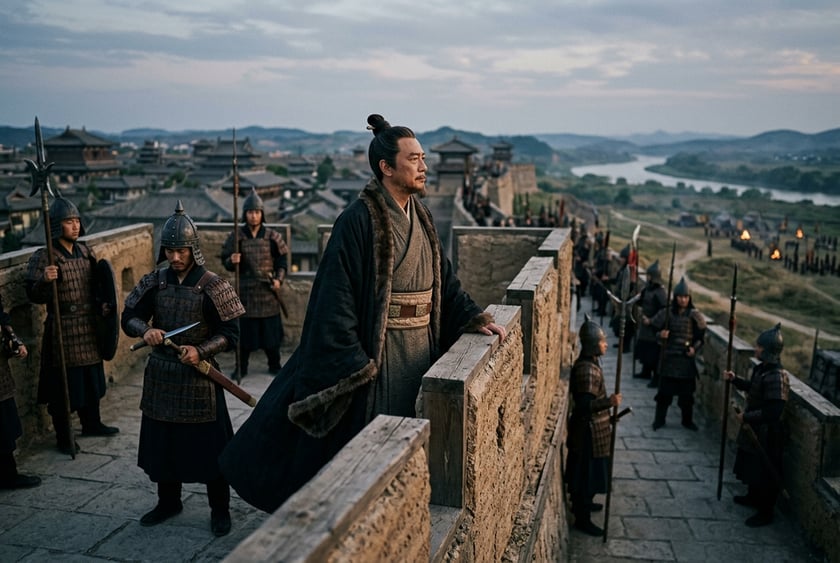
Strategic Background
Dongxizhangengpomengchong — Dong Xi's cutting of the mooring cables to breach the Mengchong warships — was the central tactical action of Sun Quan's third campaign against Jiangxia, and its strategic significance must be understood within the overall situation of the year preceding the Battle of Chibi. In the early spring of the thirteenth year of Jian'an, Sun Quan had already carried out two inconclusive Jiangxia campaigns: the first, in the eighth year of Jian'an, was forced into withdrawal by a rear-area rebellion of mountain peoples; the second, in the twelfth year of Jian'an, killed Huang Zu's subordinate commander Zhang Shuo but still failed to take Xiakou. In geographic terms, Jiangxia commanded the middle reaches of the Yangtze; controlling Xiakou opened a path northward to Xiangyang, westward into the interior of Jingzhou, and eastward to guard the gateway of Yangzhou — it was the most critical missing piece in Sun Quan's strategy of "controlling the full length of the Yangtze." On the personal level, his father Sun Jian had died in Jiangxia (killed by an arrow fired by one of Huang Zu's subordinates in 191), and this campaign was for Sun Quan both a strategic necessity and an emotional settling of scores across generations. Half a year later, Cao Cao would lead a great army south against Jingzhou; if Sun Quan had not managed to secure control of Jiangxia before that point, the entire deployment space for Wu's naval forces at the Battle of Chibi would have been severely compressed. Dong Xi's breakthrough in this campaign was, in essence, clearing strategic depth for the front lines of Chibi half a year later.
Disposition of Forces
Huang Zu's defensive dispositions were precise. Miankou — the junction of the Han River with the Yangtze — was topographically the throat of the inner river's outlet into the great river; Huang Zu deployed two large Mengchong warships to lock across the river mouth. The Mengchong was the main ship type of the late-Han navy: long and narrow, heavily armored, with a protective parapet, covered in ox-hide; crossbowmen could fire from inside the hull while remaining largely protected from return fire. Anchored with giant stones, the two ships formed a water fortification that could not be bypassed. More than a thousand crossbowmen and archers were positioned on either flank of the Mengchong ships, raining arrows down to cover the Yangtze's depth and providing immediate suppression against any small vessel the Wu forces might try to rush in. This disposition was tactically well-grounded: it upgraded the Jiangxia defense from a riverbank strongpoint defense to a "mid-river fortress defense," forcing the attacking side to neutralize the water-borne obstacles before it could mount a land assault. Sun Quan's dispositions presented the classic pattern of "commander holding the center, volunteer shock troops advancing first": Dong Xi and Ling Tong led a commando unit forward under incoming fire, with the main fleet pressing behind and awaiting the appearance of a breach. The key to this disposition was the outcome of the commando unit — once the commandos completed their unlocking action, the tactical deployment of the main force had a starting point.
Key Decision Points
Three key decision points shaped this battle. The first was Sun Quan's choice of where to strike. Rather than using a flanking overland approach to bypass the water-borne obstacles, he attacked directly at the strongest link in the Jiangxia defensive line — the Mengchong warships themselves. The consideration behind this decision was the time window: the Jiangxia campaign had to be completed before the spring flood season, and an overland flanking route would drag out the campaign; moreover, once the spring flood raised the Yangtze's water level it would become harder to control the positions of the Mengchong ships precisely. The second was Dong Xi's tactical choice — rather than the conventional options of archery or fire attack, he personally led the commando unit forward under incoming fire, cutting the mooring cables himself. The logic of this choice: the Mengchong's ox-hide armor had some resistance to fire attack, and an archery duel could not suppress shooters positioned behind the armored portions of the ship; cutting the anchor ropes to let the Mengchong drift from their stations was the fastest way to break the blockade. This was an extremely high-risk, high-reward tactical improvisation. The third was the exploitation immediately following the cutting of the cables — once the Mengchong ships had drifted from position, the Wu main force immediately rushed into Miankou, surrounded Xiakou, and ultimately captured and beheaded Huang Zu. The seamless linkage of these consecutive actions reflects the discipline and coordination capacity of Sun Quan's naval forces.
Outcome and Reverberations
The campaign's result was Sun Quan taking full control of Jiangxia and capturing and beheading Huang Zu. At the tactical level, this cable-cutting action became a textbook case of "dare-to-die assault" for the Wu navy; Dong Xi thereby joined the ranks later called "the tigers of Jiangbiao," alongside Ling Tong, Gan Ning, and Pan Zhang as representative mid-level commanders of the most aggressive character during the Sun Quan era. At the strategic level, the complete transfer of Jiangxia's control gave Sun Quan three direct benefits: first, it eliminated the last Jingzhou-based strongpoint on the western flank, making the entire middle Yangtze reach Wu's strategic backyard; second, Xiakou and Miankou became the forward base for Wu's naval forces at the Battle of Chibi half a year later — the thirty thousand naval troops commanded by Zhou Yu and Cheng Pu were able to advance directly from Xiakou to intercept Cao Cao's forces, saving enormous logistical and maneuvering costs; third, capturing and killing Huang Zu completed the reckoning across two generations — Sun Ce and Sun Quan — with their father's mortal enemy, consolidating Sun Quan's family prestige within the core Jiangdong leadership group. On a longer time scale, the Jiangxia campaign also established the standard operational model of Wu's navy in the middle Yangtze — use heavy armored ships to blockade the river mouth, use dare-to-die assault to break the blockade, use the main fleet to complete the depth penetration — a model that recurred in subsequent campaigns at Chibi, Ruxu, Yiling, and elsewhere; it is one of the core legacies of Eastern Wu's military culture.
Counterfactual Analysis
If Dong Xi had failed to sever the Mengchong's mooring cables and Sun Quan's third Jiangxia campaign had again returned empty-handed, the course of the Battle of Chibi would have been significantly altered. First possibility: Jiangxia remains under Huang Zu's control (or his successor); half a year later when Cao Cao drives south against Jingzhou, Cao Cao's forces can advance along the Xiangyang-Wan-Jiangxia-lower-Qishui axis and directly threaten the deployment of Wu's northern naval forces. Zhou Yu's navy would have been forced to set up defenses at a position further east — Chaisang or Wankou — with less depth and less room to maneuver, making it far harder to seize the optimal moment to execute the fire attack. Second possibility: after Liu Biao's death, Jiangxia passes to his son Liu Qi (the historical record does show that Liu Qi served as Governor of Jiangxia); when Cao Cao pressed down, Liu Qi might have linked up with Liu Bei, but his military ability was far inferior to Huang Zu's and he might not have been able to provide the Sun-Liu alliance with an equivalent strategic anchor. Without the Xiakou forward position, Eastern Wu's justification for joining Liu Bei in alliance would have declined sharply, and the Battle of Chibi might not have formed the pattern of "dual-line pressuring of Cao Cao's forces" that it presents in the historical record. In short, Dong Xi's cable-cutting — a tactical action that at first glance seems momentary — actually erected the most critical strategic scaffolding for the Battle of Chibi, which would change Chinese history half a year later. Without the Miankou breakthrough, there could have been no rendezvous at Xiakou, and therefore no effective resistance by Zhou Yu against Cao Cao. This is a textbook case in San Guo military history of "small action, large consequence."