Strategic Background
In the Romance of the Three Kingdoms, the Battle of Cangting is positioned as the "sequel" to and conclusion of the Battle of Guandu. Although Yuan Shao's main force was routed at Guandu, he still held the four provinces of Ji, Qing, You, and Bing, and was able to regather some two to three hundred thousand troops and horses for a comeback, encamping at Cangting [c:16135]. For Cao Cao this was the crucial window to utterly destroy the Yuan clan's war potential before the enemy could recover its vitality. Geographically, the Cangting ford lay at a Yellow River crossing, and its terrain—fighting with one's back to the water—provided a natural stage for the decisive battle to come. The novel designs this engagement as a campaign of "pressing a victory to annihilation," its strategic intent clear: to give the Hebei faction no time to catch its breath and rebuild.
Dispositions of the Two Sides
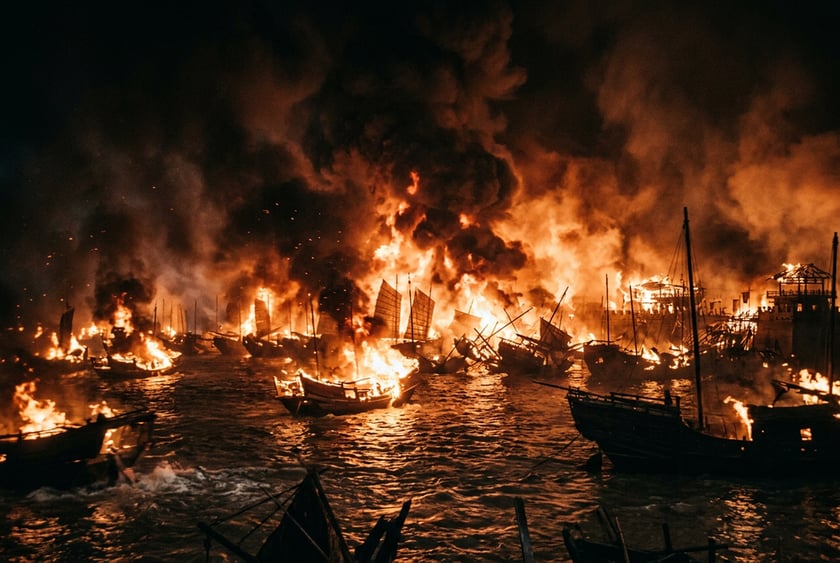
Cao Cao's disposition is the centerpiece of the whole chapter. Cheng Yu offered the "Ten-Sided Ambush" stratagem, dividing the Cao army into five squads of ambush troops on each flank—on the left Xiahou Dun, Zhang Liao, Li Dian, Yue Jin, and Xiahou Yuan; on the right Cao Hong, Zhang He, Xu Huang, Yu Jin, and Gao Lan—with Xu Chu as vanguard of the central army [c:16136]. This was a carefully choreographed deep ambush array to lure the enemy: first Xu Chu would feign a raid on the camp, then a false defeat and withdrawal would draw out the men of Yuan Shao's five camps all at once, luring them all the way to the bank of the Yellow River and into the dire strait of "no road ahead" [c:16136]. Yuan Shao's side, by contrast, had almost no tactical design worth the name; Yuan Shang brandished his blade in displays of valor before the lines, which served mainly to underscore his bravado without strategy, and the whole great army, once lured out, was wholly exposed within the ambush net [c:16135].
Key Decision Point
The key to victory lay in Cao Cao's daring to place his own forces in the perilous position of "backs to the water" to spur a fight to the death. When the Yuan army pursued to the river and the Cao army had no road of retreat, Cao Cao cried out, "There is no road ahead—why do the troops not fight to the death?", and the whole army turned and fought furiously, Xu Chu galloping to the fore and cutting down more than a dozen generals in a row, reversing the battle in an instant [c:16136]. The ingenuity of this decision was that the true killing stroke of the Ten-Sided Ambush was not the number of ambush troops but the use of a feigned defeat to drag the enemy into a preset dead ground, then forcing out one's own army's fighting strength through that very desperation. Yuan Shao's fatal error was blind pursuit—in a situation where, freshly defeated at Guandu, he ought to have been cautious, he was still led by the nose by the bait, burying his regathered forces in the ambush ring at a single stroke.
Outcome and Resonance
The Yuan army fell into chaos; Cao Hong and Xiahou Dun cut off the line of retreat, Yuan Xi and Gao Gan were struck by arrows, their army and horses almost entirely destroyed, and Yuan Shao led only his three sons in a breakout [c:16137]. The most symbolic scene is Yuan Shao embracing his three sons and weeping bitterly, vomiting blood without cease, lamenting, "It is Heaven that destroys me" [c:16137]. This stroke is both a turning point in the character's fate and a declaration that the Hebei faction would never recover from then on: Yuan Shao withdrew to Jizhou to recuperate and handed military affairs to Yuan Shang along with Shen Pei and Feng Ji, sowing the seeds for the later internal strife among his sons and Cao Cao's piecemeal conquest of Hebei [c:16137]. In the novel's structure, the Battle of Cangting is a foundational engagement in the grand process of "Cao Cao's Pacification of Hebei."
Counterfactual Speculation
It must be noted that the Battle of Cangting has no record in the official histories of a "decisive battle" on a scale matching the novel's, and the "Ten-Sided Ambush" is all the more a dramatized tactic the Romance constructs to reinforce Cao Cao's image as a strategist. Reasoning within the novel's premises: had Yuan Shao remained cautious in this engagement and not rashly pursued the bait, holding the line across the river with the strength of his four provinces, Cao Cao might not have won quickly; Hebei's manpower and resources could have sustained a prolonged war of attrition. But the core the novel means to convey is precisely Yuan Shao's tragedy of character—"at his wits' and strength's end" yet obstinate and avid for victory—and it was just this character that led him, even after Guandu, to stake his last remaining capital on a doomed defeat, and that greatly accelerated Cao Cao's process of unifying the north.