Strategic Background
The Romance of the Three Kingdoms places the Five-Route Invasion of Shu right after Liu Bei's crushing defeat at Yiling and his death from illness at Baidicheng—precisely Shu Han's most vulnerable window. Cao Pi concluded that "Liu Bei is dead; I have nothing to worry about," and intended to swallow Shu in one stroke while its new ruler was young and hearts were unsettled [c:16131]. This conception itself accorded with the basic logic of wars of annexation— launching an all-out assault while the opponent's regime is in transition and its military strength is damaged. But the novel also voices the opposing view through Jia Xu: Liu Bei would surely entrust his heir to Zhuge Liang, and Zhuge Liang, grateful for the recognition he had received, would do his utmost to support him, so a hasty invasion of Shu might not succeed [c:16131]. Cao Pi did not adopt this prudent judgment but was instead drawn to Sima Yi's more aggressive plan, setting the keynote for a campaign "grand in momentum yet hollow at the foundation."
Dispositions of the Two Sides
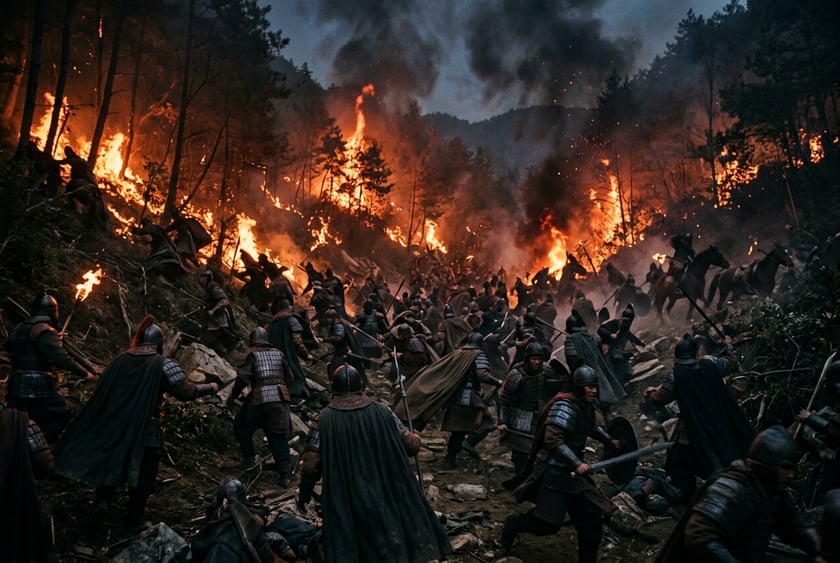
Sima Yi's "five-route" design showed considerable layering: luring the Liaodong Xianbei chieftain Kebineng out through Xiping Pass with gold and silk; driving the southern Man leader Meng Huo to attack the four commanderies of Yi Province with official patents and rewards; drawing Sun Quan of Eastern Wu to take Fucheng with the promise of ceded land; turning the surrendered general Meng Da to march out from Shangyong through old friendship; and finally having Cao Zhen lead the regular force as the main assault through Yangping Pass—five hundred thousand troops closing in from four sides, the aim being to leave Zhuge Liang unable to protect head and tail at once [c:16132]. This was a textbook approach of "multi-line containment and dispersed defense." Zhuge Liang's response was to dismantle it route by route: sending Ma Chao, long stationed in Xiliang and a terror to the Qiang and Hu, to hold Xiping Pass; using Wei Yan's decoy troops to bewilder the southern Man; having Zhao Yun hold the perilous road at Yangping; for Meng Da's route, reckoning that a man so fickle would surely refuse to fight to the death; and only the Eastern Wu route, which could not be barred by force, required defusing through diplomacy [c:16134]. The merit of the two dispositions came down to this: Sima Yi was betting on "simultaneous pressure," while Zhuge Liang was calculating "the true mettle of each route."
Key Decision Point
The most delicate gambit took place with Eastern Wu. Faced with the Wei envoy's courtship and the lure of ceded land, Sun Quan wavered for a time, and Lu Xun's judgment became decisive: Cao Pi, holding the Central Plains, was hard to challenge in haste, and to openly refuse Wei now would surely breed enmity— better to assent on the surface while watching covertly, deciding his course once the results of the four routes became clear: if the four routes won, exploit the chaos to take Chengdu first; if they failed, deliberate anew [c:16133]. This was a cool-headed opportunism: Eastern Wu always placed its own interests above both Wei and Shu and would by no means serve as Cao Pi's free hired blade. Zhuge Liang understood this thoroughly, and so sent Deng Zhi as envoy to Wu, using diplomacy to draw away entirely this most difficult route to defend. The deciding move lay precisely in Zhuge Liang accurately dismantling a five-route military crisis into a four-route military problem plus a one-route diplomatic problem.
Outcome and Resonance
In the end all five routes came to nothing: the western tribes withdrew without a fight at the sight of Ma Chao, Meng Huo was driven back into his caves by Wei Yan's decoy troops, Meng Da "fell ill" midway and held his troops still, Cao Zhen was blocked at the Xie Valley and returned without gain, and Sun Quan, on Lu Xun's advice, never sent a single soldier [c:16134]. Sun Quan afterward sighed, "Lu Boyan truly reckons like a god," glad he had not rashly acted to earn the enmity of Western Shu [c:16134]. In the novel's narrative this campaign is the shining moment of "Zhuge Liang Repels the Five Armies," used to shape his image of composure in crisis and mastery of strategy from within the command tent, and to lead naturally into the subsequent main thread of Deng Zhi's mission to Wu and the renewed Wu–Shu alliance.
Counterfactual Speculation
It must be emphasized that the Five-Route Invasion of Shu has no corresponding unified campaign on record in the official histories; it is a highly structured fictional episode the novel constructs to highlight Zhuge Liang's talent and strategy. Even reasoning within the novel's own premises: had Sun Quan believed the Wei envoy and actually raised a hundred thousand troops to take Fucheng, with Shu Han bearing the pressure of five routes at once, the situation would have been far more perilous—the Eastern Wu route was the only force capable of striking Shu Han's heartland. It is precisely for this reason that Zhuge Liang's priority of placing diplomacy ahead of military action appears so crucial. Conversely, the fundamental flaw in Cao Pi's plan was its overreliance on "borrowing strength" from allies and foreign peoples, forces that each harbored their own designs and were not truly at his command; once the core adhesive (Eastern Wu's cooperation) came loose, the five-hundred-thousand-strong host crumbled of itself like a sandcastle.