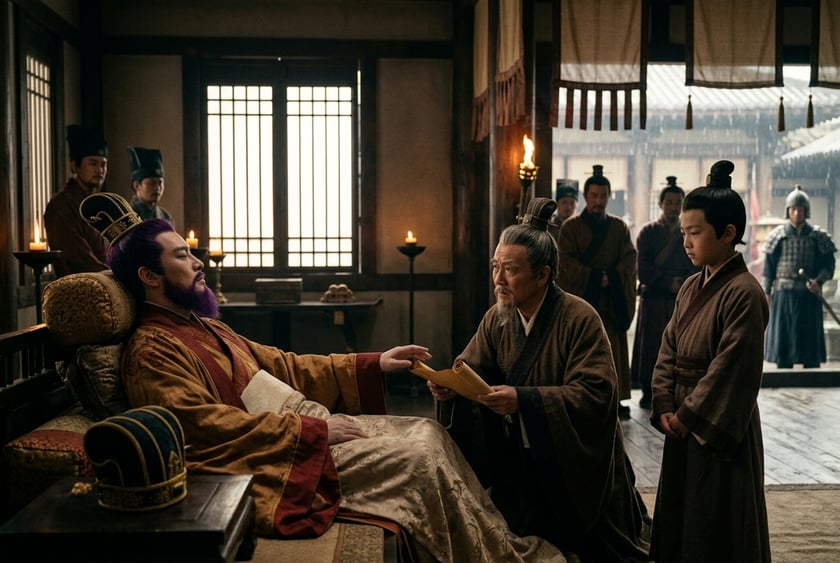
Strategic Background
Wancheng (present-day Nanyang) sits at the center of the Nanyang basin, a strategic communications hub for descending south from the Central Plains into the Jianghan region and controlling Jingxiang to the west. In the second year of Jian'an, Cao Cao had only recently welcomed Emperor Xian of Han and relocated the capital to Xu Chang; on his western flank he was incorporating Zhang Xiu into his sphere, making him a buffer protecting the southwestern gateway of Xudou. Zhang Xiu, originally a nephew of Zhang Ji and a continuation of Dong Zhuo's remnant forces, was in a relationship of mutual dependence with Liu Biao, and the ties between the two sides were not stable. Cao Cao's southward march on Wancheng was primarily intended as a political accommodation backed by military pressure, bringing Zhang Xiu into the outer ring of the Xu Chang regime. But upon arriving at Wancheng Cao Cao took Zhang Xiu's widowed aunt, Lady Zou, as his own — Zhang Xiu used "my uncle's widow has been taken" as cause to rebel again without warning, and the Wancheng campaign thus became a compound event: two defeats, a standoff, and a final reconciliation.
Deployments
When Cao's forces first entered Wancheng they were on "surrender-reception protocol," with inadequate defensive precautions; the main camp was arranged too loosely; and though Dian Wei commanded the personal guard for the night watch, his weapons had been stolen beforehand by Zhang Xiu's personal attendant Hu Cheer — a narrativized detail that in substance reflects Cao Cao's excess of trust in newly surrendered generals at this early stage [c:16856]. In the second assault on Wancheng the approach was a direct frontal attack: Xu Chu took the field and cut down Zhang Xiu's general Zhang Xian within three bouts [c:16857]; then followed three days of sustained siege, moving earth to fill the moat, stacking firewood, erecting scaling towers to observe the city, and finally choosing to concentrate the breakthrough at a pile of firewood stacked in the corner of the west gate [c:16858]. Under Jia Xu's masterminding, the Zhang side used a "turning the tables" response — observing Cao Cao's direction of attack and actively using a corresponding approach to lure the enemy into a trap [c:16859] — which is the key reason the Wancheng standoff could sustain multiple rounds.
Key Decision Points
This series of engagements had three key decision points. The first was Cao Cao's private act of taking Lady Zou during the submission phase — it transformed what could have been a smoothly managed pacification operation into the fuse that triggered the opposing side's armed rebellion. The deaths of Cao Ang, Cao Anmin, and Dian Wei were the direct price of this mistake; in the novel's subsequent narrative Cao Cao repeatedly agonizes over it — a rare instance in his portrayal as a "supreme warlord" where he acknowledges that a private act caused strategic loss. The second was Jia Xu's functional position within the Zhang Xiu camp — Jia Xu could correctly calculate that upon Zhang Xiu's surrender to Cao Cao "he will certainly treat my wife and children generously," and could equally calculate the rhythm of "if we now pursue the newly retreating Cao forces we will either certainly win or certainly lose" [c:16859]; he was the true hidden commander-in-chief who actually determined victory and defeat in the Wancheng standoff. The third was Zhang Xiu's second surrender to Cao Cao on the eve of Guandu in the fourth year of Jian'an — though this does not belong to the Wancheng campaign itself, it is the "final resolution" of the Wancheng standoff: Jia Xu calculated "Cao Cao has heroic vision and will certainly welcome new surrenders to demonstrate his magnanimity to the world," and indeed after Zhang Xiu submitted on Jia Xu's advice he was well treated, receiving an earldom after Guandu.
Outcomes and Reverberations
The Battle of Wancheng ended militarily in a standoff; Zhang Xiu held Wancheng until his second surrender to Cao Cao in the fourth year of Jian'an. This prolonged grinding standoff had four levels of reverberation. First, Cao Ang's death had an enormous impact on Cao Cao's family and succession configuration — Cao Ang had been Cao Cao's eldest son and the preferred heir, and his death pushed the succession line back to Cao Pi and Cao Zhi, indirectly catalyzing the later succession struggle. Second, Dian Wei's death led Cao Cao in the novel to "have a shrine erected for a subordinate" for the first time, reinforcing his leader image of "inspiring subjects to die in his service." Third, Jia Xu was from this point recognized as the finest anticipatory strategist of the late Han; the Wancheng standoff was his landmark proving ground. Fourth, Cao Cao's ultimate generosity toward Zhang Xiu demonstrated his political composure of "accommodation first, private revenge second" — an approach he would repeatedly employ when facing surrendering opponents such as Zhang Lu and Liu Cong in later years.
Counterfactual Analysis
The counterfactual has two interesting branches. First, if Cao Cao had not taken Lady Zou during the initial submission phase, would Zhang Xiu have remained in long-term allegiance? Almost certainly yes — Zhang Xiu's forces were no match for Cao Cao's, and Liu Biao's pressure limited his room to maneuver north or south; his strategic preference was naturally to "seek balance between large powers," and Cao Cao needed only moderate generosity to keep Zhang Xiu as a long-term southwestern buffer. In that scenario Cao Ang and Dian Wei would both have lived; the succession question would not have surfaced for a long time; and Caowei's succession trajectory could have been completely rewritten. Second, if Zhang Xiu had not surrendered for the second time to Cao Cao on the eve of Guandu but instead continued to maintain secret communications with Yuan Shao, Cao Cao's southwest flank would have harbored a Yuan Shao enclave, forcing Cao Cao to detach forces to defend it during the Guandu campaign and significantly reducing the defensive depth around Xudou. Under such circumstances the Wuchao night raid might not have succeeded, and the outcome of the Battle of Guandu might have been reversed. Taken together, the true significance of the Wancheng campaign lies in the political lessons it forced on Cao Cao all at once: "do not exploit surrenders for personal gratification," "a strategist who leaves nothing to chance is worth more than a single city," and "enemies can become the most stable of allies" — three lessons that recurred throughout his next twenty years of unification, and constitute some of the most important internal training in his evolution from "regional warlord" to "overlord of the Central Plains."