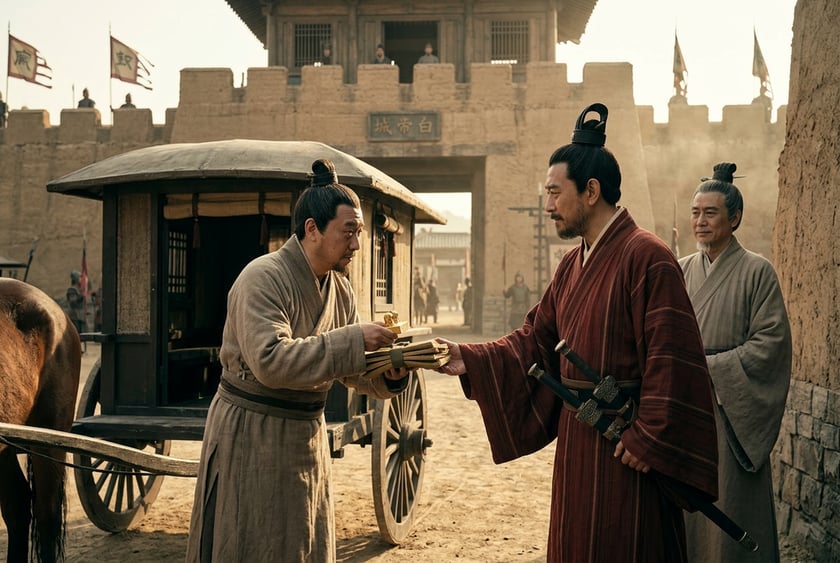
Background
After the Battle of Yiling and the Battle of Shiting, Sunwu entered a phase of relative territorial stability, and Sun Quan's attention shifted from external campaigns to internal reorganization of the bureaucratic system. Jiangdong's political structure contained a fundamental tension: the Sun clan's imperial authority depended on the support of the great Jiangdong lineages — the Gu, Lu, Zhu, and Zhang families — yet that same imperial authority had to constantly guard against those lineages growing too powerful to be controlled. During the Jiahe and Chiwu reign periods, local prefectural documents were piling up layer upon layer, and the authenticity of tax registers was increasingly difficult to verify. Sun Quan accordingly followed the precedent of Caowei's surveillance officials and installed within the Secretariat a "Surveillance Officer" (jiaoshi) post with authority to monitor all officials and audit accounts. It was in this position that Lv Yi acquired investigative power that reached across both the central government and the localities.
Key Figures
Lv Yi was a close attendant of the throne, not born of one of the great lineages, with no matrimonial ties to the four great Jiangdong clans; all his power derived from Sun Quan's personal trust — which was precisely what allowed him to go after the high-born with impunity. Arrayed against him was virtually the entire Jiangdong gentry coalition: Chancellor Gu Yong overseeing civil administration; Senior Commander-in-Chief Lu Xun overseeing military affairs; General of Chariots and Cavalry Bu Zhi as field commander in Jingzhou; General of Chariots and Cavalry Zhu Ju, who was Sun Quan's son-in-law and the moral authority of the court's principled faction; Grand Master of Ceremonies Pan Jun, who hailed from Jingzhou; and Crown Prince Sun Deng, who represented the future imperial succession. Lv Yi targeted them one by one, very nearly completing a comprehensive audit of Sunwu's entire upper-tier structure.
Core Issues
Lv Yi's methods can be broken down into three instruments. The first was "documentary entrapment" — seizing on procedural defects in specific official documents to press charges through creative interpretation. The second was "chain-of-guilt smearing" — using a single case to implicate the target's subordinates, personal retainers, and even staff advisors, thereby isolating the person under attack. The third was "private audience monopoly" — bypassing the normal deliberative processes of the Three Agencies and framing outcomes directly before Sun Quan. The political essence of this toolkit was the temporary conversion of the normal relationship of trust between the imperial throne and the bureaucratic system into a triangular surveillance structure of "emperor — surveillance officer — officials." The problem was that the surveillance office had no formal statutory authority; Lv Yi's personal clout far exceeded his official rank; and the arrangement eventually evolved into a gray zone of power in which "arrest, asset seizure, and dismissal" were exercised under the guise of oversight.
Political Consequences
The turning point in the Lv Yi affair was Grand Master of Ceremonies Pan Jun. Based in Jingzhou at the front, he was difficult to ensnare through the capital's machinations; using the occasion of a court audience, he confronted Sun Quan directly with the charges against Lv Yi, weeping as he presented his case. Lu Xun, Zhuge Jin, and others simultaneously submitted memorials laying bare how the surveillance system was corroding the state's architecture of trust. Sun Quan finally came to his senses, issued an edict executing Lv Yi and his partisans, and personally wrote handwritten letters of apology to Lu Xun, Zhuge Jin, and the other senior ministers, acknowledging that he had been a poor judge of character and had allowed surveillance to go too far. The price of this political storm was not small: Gu Yong's prestige was damaged, Zhu Ju was marginalized for several years, and a rift appeared in the relationship of trust between Lu Xun and Sun Quan — planting the seeds for Lu Xun's death in anguished frustration during the later "Two Palaces Dispute."
Counterfactual Analysis
Had Sun Quan not reined in Lv Yi in time and continued to let him operate unchecked, the estrangement of the four great Jiangdong clans would have surfaced ahead of schedule during the Chiwu years: figures such as Lu Xun, Zhu Ju, and Gu Tan might have collectively withdrawn from court affairs, leaving the Sunwu bureaucracy to run entirely on close attendants and imperial clansmen — tantamount to a large-scale political de-gentrify-ification. Conversely, had Sun Quan never deployed the surveillance apparatus in the first place, mid- and late-dynasty fiscal management and local oversight would have depended entirely on the traditional system of Chancellor, Prefectural Governor, and Regional Commander; Sunwu might have suffered fewer bouts of internal attrition, but the center's ability to check local strongmen would also have decayed. The true significance of the Lv Yi affair lies not in the rise and fall of a single harsh official, but in the fact that it forced Sunwu's imperial authority to expose its own limits in institutional terms for the first time — it could suppress the gentry in the short run, but could not govern over them indefinitely.