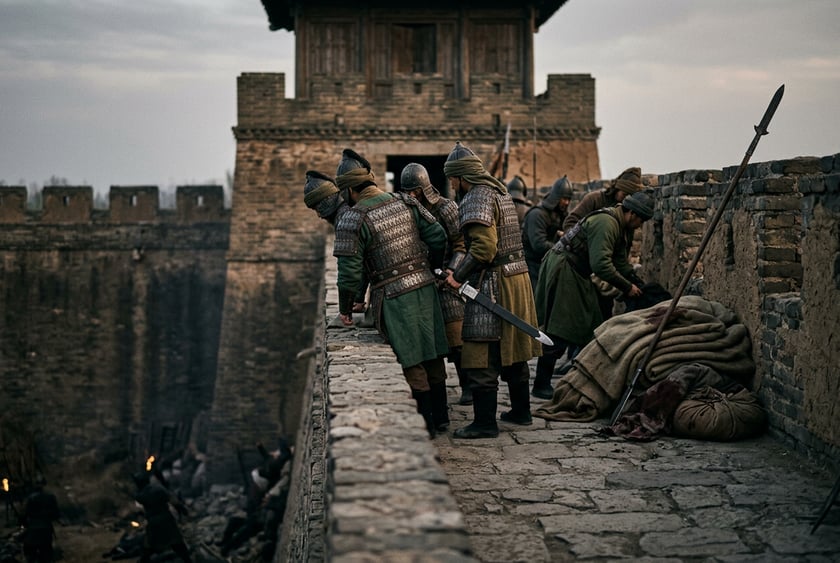
Background
In the second half of Jian'an year four, Yuan Shao — having destroyed Gongsun Zan — already held the four provinces of Ji, Qing, You, and Bing, with forces numbering in the hundreds of thousands. Cao Cao, though he served the emperor and issued commands in his name, controlled no more than a few commanderies in Yan and Yu, and faced threats on three sides: Liu Biao in the south, remnants of Yuan Shu's power in the east, and Ma Teng and Han Sui in the west. As Yuan Shao's posture of advancing south toward Xuzhou became increasingly apparent, the disagreement between the war faction and the avoidance faction within Cao Cao's secretariat grew sharper: Xun Yu argued for leveraging political legitimacy and institutional advantage in opposition; Jia Xu and others were more cautious. Guo Jia's "Discourse on Ten Advantages and Ten Disadvantages" was advanced at precisely this juncture — its primary function was not pure theoretical analysis but the construction of a persuasive framework for building strategic consensus within Cao Cao's camp.
Key Figures
Guo Jia held the post of Military Libationer of the Excellency of Works and was one of Cao Cao's most central strategic advisers. His method of argument was characteristic of the era: opening with the paradigm of Liu Bang, the Han Founder, defeating Xiang Yu "by outthinking superior force", he embedded the current Cao–Yuan contest within a classic historical template, making Yuan Shao's numerical advantage relative while bringing Cao Cao's institutional and personal advantages to the fore. Yuan Shao, as the subject of the analysis, was cast as a compound negative type: "outwardly generous, inwardly jealous," "many plans, few decisions," "high-minded rhetoric and courtesy-driven reputation-seeking." This characterization was not without foundation, but Guo Jia strung it together in the sharpest possible manner, constructing a narrative that could be weaponized. Xun Yu, though absent from these cited passages, was of one lineage with Guo Jia in his argumentative strategy; the two were the most important institutional strategists in Cao Cao's circle before and after Guandu.
Core Issues
The true depth of the "Ten Advantages and Ten Disadvantages" lies not in the specific claim of each advantage but in how it elevates the comparison from "who has more troops" to the level of "institutional culture." The first group — "Dao, righteousness, governance, method" — is a comparison on the institutional dimension, emphasizing the difference between lenient and strict political systems and the relative merits of talent-deployment mechanisms; the second group — "strategy, virtue, benevolence, discernment" — compares leadership style and moral posture, emphasizing decisiveness in decision-making and practical effectiveness in dealing with subordinates and the common people; the third group — "culture and martial valor" — returns to concrete capabilities in legal administration and military command. Through these three groups of ten criteria, Guo Jia reframed an imminent military confrontation as "a contest between two models of governance" — providing Cao Cao with psychological backbone while simultaneously seizing the moral high ground in political messaging. This is the same rhetorical strategy that continued in Cao Cao's signature edicts such as the "Edict on Ceding Commanderies and Explaining Personal Ambitions" and the "Edict on Recommending the Worthy Without Regard to Personal Conduct."
Political Consequences
In the short term, this analytical framework steadied the morale of Cao Cao's secretariat before Guandu, emboldening Cao Cao to meet Yuan Shao in battle despite being far outnumbered, and ultimately settling the contest with the single fire at Wuchao. In the medium term, it established Guo Jia's central position among Cao Cao's advisers — when Cao Cao later mourned Guo Jia's death with the words "Alas for Fengxiao! What pain for Fengxiao! How great a loss Fengxiao!" and explicitly stated "the one destined to accomplish my great enterprise was surely this man," this reflects the weight the discourse carried in Caowei's political memory. In the long term, the "Ten Advantages and Ten Disadvantages" became a standard template for later political debates and literary commentary — from Tang and Song historical critique to Ming and Qing military textbooks, the ten dimensions of "Dao, righteousness, governance, method, strategy, virtue, benevolence, discernment, culture, and martial valor" were repeatedly invoked to measure the relative merits of different rulers, making this discourse one of the important sources of classical Chinese political analysis.
Counterfactual Analysis
Had Guo Jia not advanced the "Ten Advantages and Ten Disadvantages," would Cao Cao still have chosen to fight it out at Guandu? From a purely military-logical standpoint the answer is probably still yes — when Cao Cao later wrote asking permission to withdraw, Xun Yu replied that "Yuan Shao's army is freshly assembled and cannot sustain prolonged preparation," arriving at the same strategic conclusion via a different analytical path. But absent the high-level institutional-cultural framing of the "Ten Advantages and Ten Disadvantages," Cao Cao's psychological trajectory in the months before battle would have been far less steady, with possibly several waverings affecting the decisiveness of the Wuchao action. A second counterfactual: Yuan Shao's advisers might have constructed a symmetrical "Yuan has ten advantages, Cao has ten disadvantages" — Tian Feng and Ju Shou certainly had the intellectual capacity to build a comparable argument — but Yuan Shao was poor at converting it into a decision-making tool through an institutionalized process, and the result was that his paper superiority never translated into battlefield execution. This is precisely the deepest insight the "Ten Advantages and Ten Disadvantages" leaves for modern political analysis: a comparative assessment of institutional-cultural strength and weakness is not abstract rhetoric but can, through organized deliberative procedures, be converted into real strategic judgment. That point is more important than any of the ten specific criteria themselves.