Background
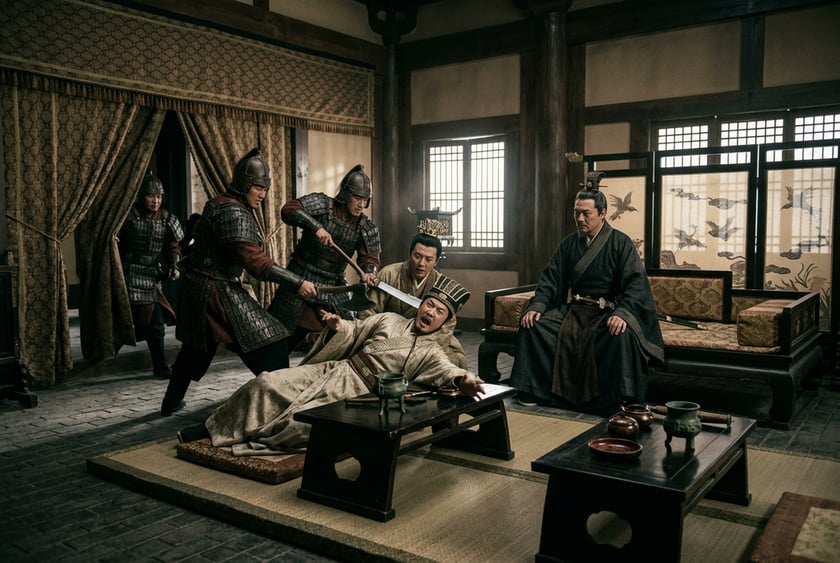
From the perspective of modern political history, Liu Cong's surrender to Cao Cao was not an isolated act of "faithlessness" but rather the full explosion of a decade-plus structural political imbalance within the Jingzhou bloc. Since Liu Biao's lone ride into Jingzhou in the first year of Chuping (190), he had relied on local magnate clans — represented by Kuai Yue and Cai Mao — to stabilize the region. Yet he never succeeded in reconciling two fundamentally opposing political forces: the "nativist accommodationist faction" led by the Cai and Kuai families, and the "anti-Cao resistance faction" represented by Yi Ji, Liu Qi, and incoming scholars from outside. This contradiction exploded around the question of succession — the eldest son Liu Qi was marginalized because his mother's clan held no leverage, while the younger son Liu Cong was pushed to the fore because his birth mother, Lady Cai, controlled the machinery of power [c:16370]. When Cao Cao personally led a great army south in the seventh month of 208, and Liu Biao happened to die at precisely that moment, Jingzhou in fact had no one capable of consolidating internal divisions and unifying a line of external resistance.
Key Figures
The core cast consists of Liu Cong, Fu Xun, Kuai Yue, Cai Mao, Wang Can, and Cao Cao. Fu Xun was the theoretician of the surrenderist faction: his three-tiered argument for persuading Liu Cong to submit — Cao Cao is powerful, Liu Bei cannot be relied upon, surrendering the province intact will preserve ranks and titles [c:16370] — succeeded precisely because it struck at every anxiety of an underage heir. Kuai Yue provided the political backing for the surrenderist line; he had old ties with Cao Cao, and the accommodationist course was most advantageous to his family. Cai Mao and Zhang Yun, as the military executors, controlled Jingzhou's naval forces and stripped any resistance of its armed foundation. Wang Can's position at this moment was ambiguous — as one of the "Seven Masters of Jian'an," his stance carried opinion-leader weight among Jingzhou's educated class, and his support for the surrenderists accelerated the formation of that consensus [c:16373][c:16374]. Cao Cao was the invisible director of it all: halting his forces at Nanyang, releasing Han Song from prison and elevating him to Grand Steward [c:16377] — these were a carefully choreographed set of "magnanimity signals" aimed specifically at transmitting a message to the scholars of Jingzhou.
Core Issues
On the surface the central question was "to surrender or not"; at the deeper level it was "on what terms to enter the new order." Fu Xun's plan for Liu Cong was to exchange the territory for ranks and titles, but Cao Cao's actual answer was to appoint Liu Cong as Governor of Qingzhou and then covertly order his assassination [c:16374][c:16375]. This handling is a specimen case for studying Cao Cao's policy toward those who surrender: the heads of enemy power blocs had to be relocated far away and eliminated at the root, to prevent them from forming a restoration force on their home ground; practical administrators and bureaucrats, by contrast, were given generous appointments and high posts to make them local agents of the new regime — Kuai Yue's appointment as Prefect of Jiangling and Wang Can's enfeoffment as Marquis Within the Passes are the execution of precisely this logic [c:16374]. Viewed through the lens of institutional history, this disposition — which favored bureaucrats over dynastic heirs — was in essence a binary classification of those who surrendered into "absorbable" versus "unabsorbable," a template that later dynasties would replicate when handling surrendered officials.
Political Consequences
The most immediate consequences unfolded on three levels. First, within less than a month Cao Cao took command of the most important political resources, manpower, and naval forces in the late-Han south — when Cao Cao settled into Xiangyang and declared "I am not pleased to have gained Jingzhou; I am pleased to have gained Yidu [Kuai Yue]" [c:16374], he revealed his true priorities: Jingzhou was valued first for its talent and bureaucratic system, and only second as territory. Second, Liu Bei lost every possibility of establishing himself in northern Jingzhou and was forced to retreat southward; tens of thousands of civilians wept and walked alongside him [c:16372]. Although this scene has been embellished by the Romance, strategically it did drive the Liu Bei bloc entirely toward the Jiangxia–Jiangdong corridor, creating objective conditions for the Sun–Liu alliance. Third, Cao Cao immediately "sent men across the river to Xiangyang to summon Liu Cong for an audience" and accelerated his southward march toward Jiangling [c:16373][c:16376]; his confident posture of expansion hastened his direct confrontation with the Sun Quan bloc — three months later the Battle of Chibi erupted, and this near-perfectly executed submission turned out to be the prelude to a far greater defeat.
Counterfactual Analysis
Had Liu Cong not surrendered, but instead followed Wang Wei's secret plan to "raise a specially trained force and strike Cao's army at a narrow pass" [c:16373], what would have happened? A realistic assessment is that the odds of success were nearly zero — the core of Jingzhou's naval forces was in Cai Mao's hands, Liu Cong had no personal prestige, and Xiangyang's defenses were insufficient to hold off the main Cao force — but even destruction would have cost Cao Cao far more and delayed his advance into Jiangling, giving Liu Bei's southward retreat a wider window and Sun Quan's decision-making window more time. Another more plausible counterfactual: had Liu Biao on his deathbed formally named his eldest son Liu Qi as successor, and had Liu Qi formed a unified anti-Cao front together with Liu Bei, the Jingzhou bloc could very possibly have organized resistance along the Jiangxia line. The Sun–Liu alliance might have coalesced months earlier, and both the location and structure of the Battle of Chibi would have changed. None of this came to pass — but understanding these possibilities reveals exactly how the seemingly one-sided surrender of the ninth month of 208, shaped by both contingency and structural forces, fixed the balance of power on the eve of Chibi.