Background
In the summer and autumn of the thirteenth year of Jian'an (208), Cao Cao personally led a great army southward; Liu Biao died, and the younger son Liu Cong — pressed by Cai Mao and others — surrendered Jingzhou entire to Cao Cao. Northern warlords had scattered one by one, and Liu Bei was retreating step by step southward along the line of Xinye, Fancheng, and Dangyang, having lost nearly all his base of operations. For Jiangdong, Cao Cao's absorption of Jingzhou meant the collapse of the shield upstream on the Yangtze; once his naval forces moved downstream with the current, Jianye would be left without defensible terrain. When Lu Su learned of Liu Biao's death, he immediately proposed to Sun Quan that a representative should be sent to Jingzhou to gauge the situation and, if necessary, join forces with Liu Bei to resist Cao Cao [c:18060]. This judgment was not a spur-of-the-moment improvisation; it grew from Lu Su's overall analysis of the upstream-downstream Yangtze configuration in his earlier "couch strategy" — "seize Jingzhou, then contend for all under heaven" was a main line already written into Jiangdong's strategic blueprint.
Principal Figures
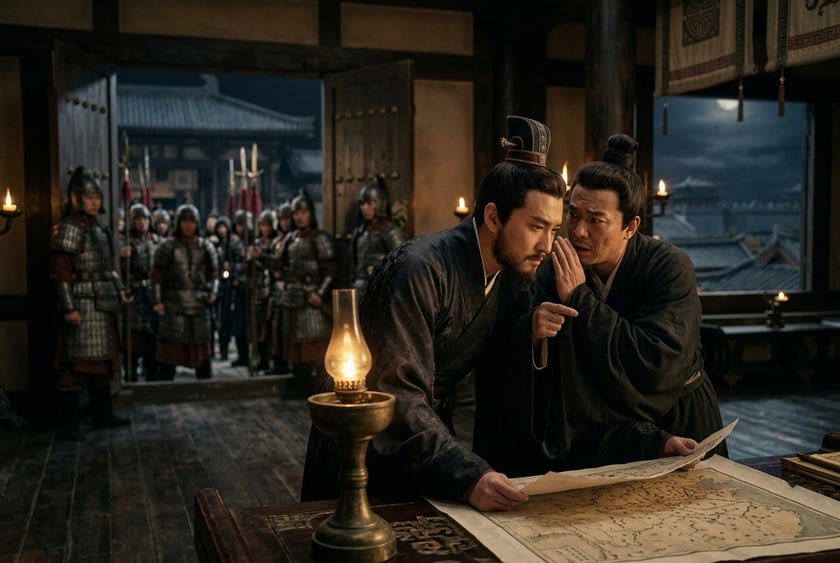
The three core figures at the meeting were not ordinary envoys. Lu Su at this point was Sun Quan's most trusted strategic counselor, capable both of speaking for Jiangdong and of making on-the-spot commitments with delegated authority. Liu Bei, though he had just suffered the crushing rout at Dangyangchangban, was still the nominal Left General and a kinsman of the Han imperial house — a political banner Jiangdong had to borrow. Zhuge Liang was a newly recruited advisor who had only recently joined Liu Bei's camp; Lu Su immediately told him on the spot, "I am a friend of your elder brother Zhuge Jin," establishing a personal connection at once [c:18060], and transforming a diplomatic meeting simultaneously into a liaison between the two sides' inner advisory circles. This dual structure of "high-level authorization plus advisor-level mutual recognition" allowed the alliance intention to be settled on the spot without requiring envoys to go back and forth repeatedly.
Central Issue
The surface topic was "whether Jiangdong was worth relying upon," but the actual substance was "whether Liu Bei could abandon the southward crossing and instead turn east to join forces with Sun Quan." Lu Su brought information on two levels: first, that Sun Quan commanded usable troops and a secure rear in Jiangdong and could serve as a reliable ally; second, that if Liu Bei crossed south to Cangwu or sought refuge with Sun Jian's old officer Wu Ju, he would not only disperse his strength but move far from the main theater, completely withdrawing from any role in shaping Central Plains dynamics [c:18060]. Lu Su's proposal adroitly repositioned Liu Bei from a refugee being pursued into the banner of an anti-Cao coalition — a revaluation of Liu Bei's political worth. After the meeting Liu Bei changed course and headed east toward Xiakou, merging with Liu Qi's Jiangxia forces, and immediately dispatched Zhuge Liang to accompany Lu Su and present himself before Sun Quan. This sequence of moves shows that the meeting produced its effect on strategic direction on the spot [c:18060].
Political Consequences
After the alliance intention was established at Dangyang, Jiangdong still had to pass through the intense debate between Zhou Yu and Zhang Zhao's faction before it could finally take root, but Lu Su's meeting gave the war faction a concrete fact to point to: "Liu Bei is willing to work with us." For Liu Bei, this meeting restored him from "fugitive" to "player at the table"; after Chibi he immediately occupied most of Jingzhou, which became the springboard for his eventual entry into Yizhou. For Sun Quan, the alliance pushed Jiangdong's defensive perimeter forward from the Yangtze to the Xiakou and Fankou line, sparing Jiangdong from bearing the full pressure of Cao Cao's forces alone. It can be said that the Battle of Chibi (Battle of Chibi) was possible precisely because this face-to-face meeting at Dangyang put Sun Quan's and Liu Bei's sides onto the same vessel [c:18060].
Counterfactual Analysis
If Lu Su had arrived a few days late and Liu Bei had already crossed the river southward and headed for Cangwu, the Sun-Liu alliance would have had no foundation: Liu Bei would have lost the geographic conditions for joining Jiangdong, and Sun Quan would have been hard pressed to face Cao Cao's million-strong force alone. If Lu Su had not immediately told Zhuge Liang on the spot "I am Zi Yu's friend" — making Jiangdong's personal acceptance of Zhuge Liang a visible gesture — Zhuge Liang might not have been able to open doors so quickly when he subsequently met Sun Quan at Chaisang [c:18060]. The San Guozhi also leaves a detail here worth noting: the account in Lu Su's biography and the account in the Shu biography of Zhuge Liang attribute the credit for the alliance proposal differently — the former ascribes primary agency to Lu Su, the latter attributes the "horizontal-alliance strategy" to Zhuge Liang; Pei Songzhi has already raised criticism on this point. The two accounts are not actually contradictory — Lu Su completed the "proposal" at Dangyang, Zhuge Liang completed the "consummation" at Chaisang; without either one, the allied Sun-Liu force would not have taken shape.