Background
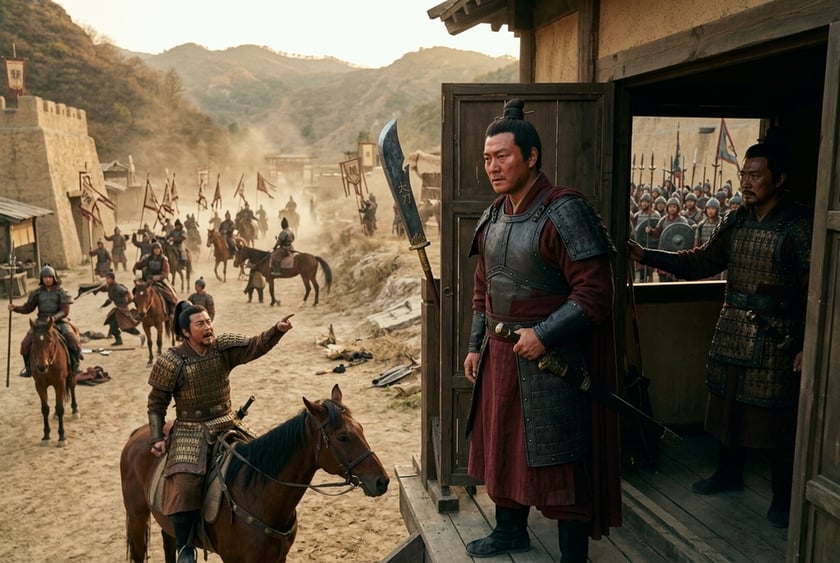
The Battle of Hanzhong in 219 was the pivotal turning point that elevated Liu Bei's faction from a "refugee warlord force" to one of the three poles of the realm. After defeating Cao Cao and forcing him to abandon Hanzhong, Liu Bei faced a new governance problem: Hanzhong, as the northern gateway of Yizhou, had to both guard against Cao Cao's return and preserve a forward base for future Northern Expeditions. The choice of a garrison commander for this sector was universally assumed — including by Zhang Fei himself — to be Zhang Fei. The reasoning was straightforward: Zhang Fei had the deepest seniority, the highest rank, and was the "tiger general" second only to Guan Yu; and since Guan Yu was already at Jingzhou, only Zhang Fei fit. But Liu Bei's decision overturned everyone's expectations.
Principal Figures
Wei Yan had been a yaomen general under Liu Bei, his seniority nowhere near that of Zhang Fei, Ma Chao, or Huang Zhong. His hallmark was a string of clean "small victories" since entering Yizhou — participating in the seizure of Luocheng, the attack on Chengdu, the pacification of Hanzhong — none of them the biggest achievement in any given campaign, but each one executed crisply. Liu Bei had personally observed Wei Yan's strict discipline, accurate enemy assessment, and rare offensive instinct. Zhang Fei played the "surpassed" role in this appointment — historical sources explicitly record that "Fei had inwardly expected the post for himself," showing that he had anticipated it, but he ultimately submitted without externalizing his dissatisfaction as Guan Yu might have done. The civil officials — Zhuge Liang, Fa Zheng, Dong He and others — were relatively reserved during this personnel decision, mostly observing Liu Bei's judgment without intervening directly.
Central Issue
The central issue of Wei Yan's appointment as Governor of Hanzhong was "replacing prestige-weight with tactical capability." In the conventional political-military system of the late Han, regional commanders typically came from prestigious veteran followers — both because prestige could keep subordinates in line and because name-recognition itself served as a deterrent to the enemy. Liu Bei overturned this convention: he judged that a "prestige-model commander" might not be effective against an active offensive force like Caowei, and that a "high-execution tactical commander" was what Hanzhong truly needed. Wei Yan's acceptance speech gave this thinking two-tiered expression: "If Cao Cao comes with all under heaven, I will hold him off; if a lesser general leads a hundred thousand men, I will swallow them." This compressed "tiered-response" thinking transformed Hanzhong's defense from "rely on a famous general to hold a pass" into a systems approach of "respond proportionally according to enemy strength."
Political Consequences
Wei Yan held Hanzhong for ten years, building the "layered gate" defense system that later military theorists held in high esteem: outposts and continuous fortifications deployed across all four Qin range routes — Ziwu Valley, Luogu Valley, Xie Valley, and the Chencang road — turning every possible rapid-advance route into a war of attrition through layered blocking. From 219 to 227, Caowei debated attacking Hanzhong multiple times but never found a breach — this was the material prerequisite that allowed Zhuge Liang to use Hanzhong as a base for counterattacking Longyou. Within Shuhan, this appointment also set a precedent: promotion of non-founding-cohort generals based on tactical execution. After Wei Yan, Wang Ping, Ma Zhong, Zhang Yi, and Deng Zhi — all "neither from Jingzhou, nor from the founding cohort, nor imperial relatives" — were successively given important roles by Zhuge Liang and Jiang Wan, allowing Shuhan's pool of military talent to be maintained. One could say that with a single appointment Liu Bei inscribed "judge personnel on merit, not origin" into the DNA of the Shuhan regime.
Counterfactual Analysis
What would have happened had Liu Bei followed popular expectation and appointed Zhang Fei as Governor of Hanzhong? The most direct consequence would have been Zhang Fei's character — given to drink, violent rages, and brutal treatment of subordinates — very likely inflaming internal tensions during a prolonged standoff, since Zhang Fei ultimately died at the hands of his own subordinates Fan Jiang and Zhang Da. The stability of the Hanzhong defense would have been significantly compromised, and any minor Wei offensive might have triggered a much larger internal crisis. Conversely, had Wei Yan never been promoted and remained a yaomen general, his potential as a "systemically offensive commander" would have had no arena in which to develop; the Ziwu Valley proposal he advanced during Zhuge Liang's first Northern Expedition in 229 might never have been proposed at all. Consider another variant: Liu Bei assigning Zhao Yun to the post. Zhao Yun had sufficient seniority and a steady temperament, but he leaned toward cautious defense and lacked the "tiered-counterattack" thinking Hanzhong required — Hanzhong might have held, but it could never have become a launching pad for the Northern Expeditions. Judging by outcomes, Wei Yan's decade as Governor of Hanzhong was the material foundation on which every Shuhan military posture rested — it transformed a natural barrier into a catapult ready to launch an offensive.