Strategic Background
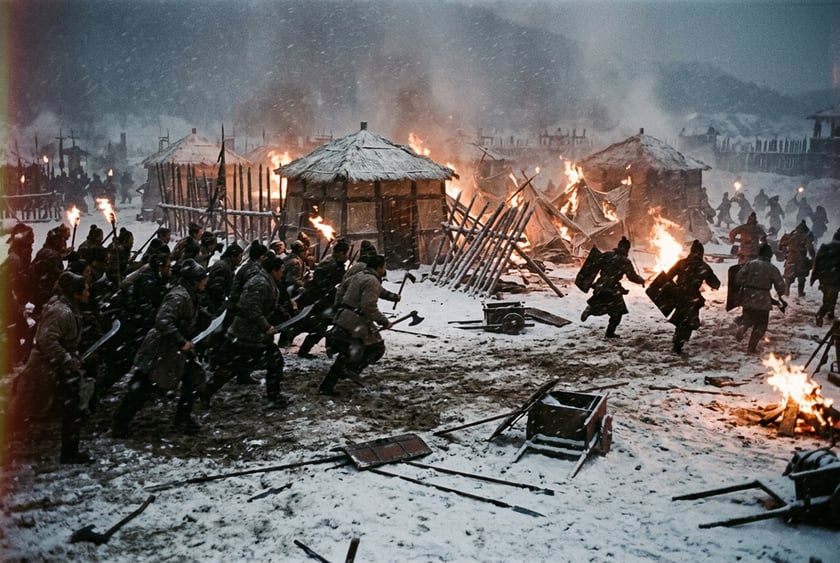
The Siege of Jicheng (Jichengzhiwei) was Ma Chao's last large-scale attempt to rebuild a political base in Liangzhou, and a classic case of structural pushback by the indigenous strongmen of the region against an externally imposed military force. At the strategic level, after the battle of Weinan in the sixteenth year of Jian'an (211), Ma Chao's main force had been crushed by Cao Cao and Han Sui rendered ineffective as a leader. Although Cao Cao could not remain in the west for long due to pressing affairs in the Central Plains, he left behind an instruction to his aide Yang Fu — "you shall hold this for me". Yang Fu thereby became Caowei's hidden asset in Liangzhou; his judgment that Ma Chao would inevitably rebel again and had to be guarded against was strikingly clear: "Ma Chao has the valor of Lv Bu and commands the deep affection of the Qiang people. If the Chancellor does not now take advantage of circumstances to exterminate him, his power will grow, and the commanderies north of the Long Mountains will no longer belong to the state". After lying low among the Qiang tribes for nearly two years, Ma Chao returned to the attack in the seventeenth year of Jian'an, taking most of the Liangzhou commanderies with barely a fight. Only Wei Kang at Jicheng held out. This pattern — "sweeping all before him, but stuck at one city" — gave Yang Fu the window he needed to set his counter-intelligence plan in motion.
Disposition of Forces
Ma Chao's deployment was a classic "use Qiang cavalry to dominate Han infantry" approach — his main force consisted of Qiang tribal cavalry he had cultivated, highly mobile but lacking siege engineering expertise and the endurance for sustained investment. The prolonged failure to take Jicheng perfectly exposed this natural weakness of the deployment: steppe-style armies are ill-suited to protracted siege warfare. Ma Chao's treatment of the Jicheng garrison after it surrendered also illustrates the two faces of his leadership: he executed more than forty officials on the grounds that their request to surrender "came only when the situation was desperate, not from genuine loyalty," yet kept Yang Fu because he judged him a man of "principled integrity" — a "reads people but misreads them" quality of judgment that was the root cause of Jicheng changing hands a second time.
Among the Jicheng defenders, Wei Kang as Administrator of Hanyang commandery should have been the anchor of resistance, but his strategic assessment was completely wrong: he equated "Xiahou Yuan has not come to relieve us" with "we must surrender," failing to see the political resources embedded in Yang Fu's persistent remonstrations. Wei Kang's opening of the city gates caused the entire resistance framework to collapse in an instant.
Yang Fu's counter-intelligence deployment was in fact the genuine core of this campaign. Step one: accept Ma Chao's appointment as an aide and gain his trust. Step two: recommend his own people, Zhao Qu and Yin Feng, for officer positions inside the army, laying the personnel groundwork for the counter-intelligence operation. Step three: leave under the pretext of a wife's funeral, secretly contact the local Liangzhou strongmen Jiang Xu, Yin Feng, and Zhao Ang, and — through his aunt, Jiang Xu's mother (a detail recorded more clearly in the San Guozhi biography) — stir up the will of the clan alliance. Step four: lure Ma Chao out of the city to give battle, while those inside reversed sides, barred the gates, and killed his family members to cut off his line of retreat. This plan fully instantiates a three-in-one counter-intelligence strategy of "internal agent + external support + psychological blow."
Key Decision Points
The campaign had three key decision points. The first was Yang Fu's decision not to die as a martyr of integrity but to remain and operate undercover over the long term. When Wei Kang opened the city gates to surrender, Yang Fu could have chosen to die in loyal protest; instead, after his remonstrations were rejected, he chose to stay. From the standpoint of Confucian ethics this choice was slightly imperfect, but in terms of political effectiveness it was correct: only while alive could he pursue revenge. Ma Chao's judgment that Yang Fu was "a man of principled integrity" was fundamentally wrong — he read Yang Fu's remonstrative gestures but failed to read the will for vengeance behind them. The second decision point was Yang Fu's departure under the pretext of a wife's mourning. This perfectly exploited the unquestionable force that Han Confucian ethics attached to filial mourning obligations, winning Yang Fu several months of freedom of movement while giving Ma Chao no grounds for suspicion. The third was the determination to kill Ma Chao's wife and children the instant the city's interior rose up. This was the most brutal step in the entire counter-intelligence chain — Zhao Qu and Yin Feng pushed Lady Yang and Ma Chao's three young children along with more than ten close relatives from the city walls, slaughtering them one by one — the goal being to deliver a psychological blow that would utterly destroy Ma Chao's will to fight, making it impossible for him to turn back and retake the city. This tactic of "using hostages to cut off the line of retreat" was not uncommon in ancient Chinese political and military affairs, but it was rarely executed so openly and to such an extreme.
Results and Reverberations
The immediate result was that Ma Chao was routed on three sides, fled as a fugitive to Zhang Lu, and from that point onward could never again establish a foothold in Liangzhou; all the commanderies north of the Long Mountains returned to Caowei control. The medium-term reverberations were threefold. First, Yang Fu thereby became the political symbol of Caowei in Liangzhou; he later became famous in the Caowei court for his frank remonstrations, and his clan remained prominent throughout the Wei-Jin period. Second, Ma Chao's Liangzhou political capital was completely exhausted. Although he subsequently surrendered to Liu Bei and became one of the "Five Tiger Generals," within Shuhan he was never again entrusted with an independent frontier command; his role was more that of a symbolic figurehead for winning over the Qiang tribes of the northwest, and he contributed no substantive breakthrough on the western flank of Shuhan's northern campaigns. Third, from the perspective of Liangzhou governance, the counter-intelligence success of Yang Fu, Jiang Xu, Yin Feng, and Zhao Ang — all indigenous strongmen — demonstrated the "power of insiders over outsiders" in mixed Han-barbarian borderlands: any externally imposed military force that cannot deeply embed itself within the local strongman network, however great its martial prowess, will find it difficult to maintain a lasting hold. This principle was repeatedly validated in the Sixteen Kingdoms of the Five Hu period and in the Tang dynasty's era of military commissioners.
Counterfactual Analysis
What would have happened if Wei Kang had heeded Yang Fu's urgent remonstrations and held Jicheng? The most probable outcome: Ma Chao, unable to take the city after a prolonged siege with supplies running out, would have been forced to withdraw; when Xiahou Yuan's relief force arrived it would have recovered the Liangzhou territory in due course; Yang Fu would not have needed to undertake the dangerous counter-intelligence gamble; and Ma Chao would not immediately have lost his family members. Ma Chao's Liangzhou base would nonetheless have crumbled under subsequent Caowei mopping-up operations — the process would simply have been longer. A second, more aggressive counterfactual: if Ma Chao had become immediately suspicious after Yang Fu's unannounced departure and preemptively killed Zhao Qu and Yin Feng, the inner reversal inside the city could not have occurred; he might have stabilized Jicheng and consolidated Liangzhou, forcing Caowei to pay a far higher price to recover the territory. The reason Ma Chao failed to take this precaution lies fundamentally in the fact that his sensitivity to "political reversal" was far lower than his sensitivity to "battlefield combat" — a textbook example of the divide between the pure warrior and the statesman. Viewed over the longer arc, the greatest lesson left by the Siege of Jicheng for the San Guo era is this: the survival of a geographically based regime depends not on military force but on whether it can integrate itself into the local power network. Ma Chao never understood this, and his entire political career paid the price.