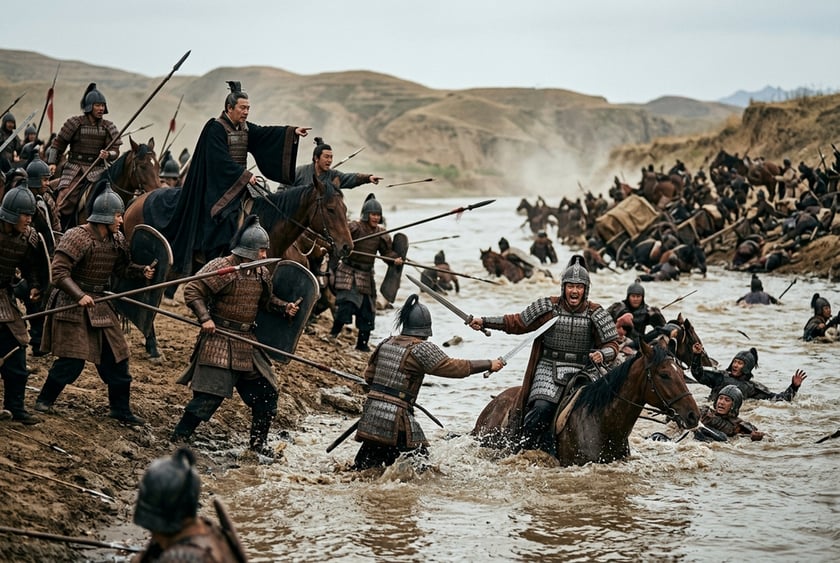
Strategic Background
In the autumn of the first year of Fenghuang (272), the Xiling Commander Bu Chan seized the city and defected to the Jin dynasty. Xiling sits at the eastern exit of the Three Gorges, commanding the upper gateway to Jingzhou; once received by Jin forces, a deep longitudinal rift would be torn in Wu's entire Yangtze River defense line from top to bottom. For Sun Hao's regime, losing Xiling was not merely the loss of a single city — it could lead to the entire middle Yangtze being severed in two. As Commander-in-Chief of Wu forces in Jingzhou with the title of Grand Marshal, Lu Kang had to accomplish two objectives in the shortest possible time: first, recapture the isolated city of Xiling; second, prevent the Jin main forces — Yang Hu's Nanyang army, Xu Yin's naval force, and Yang Zhao's Jingzhou army — from converging into a single thrust. The critical tension of the entire campaign lay in the fact that Lu Kang's forces were far inferior in numbers to the total Jin strength, and he had to reverse the situation by besieging without assaulting the city and making the interception of relief forces the primary battlefield.
Dispositions
Lu Kang's deployment embodied the classic thinking of "dispersing forces to hold key points, concentrating forces for the decisive battle": he ordered Zhang Xian to hold firm in the siege lines around Xiling, sealing Bu Chan inside the isolated city; he ordered Gongan Commander Sun Zun to patrol the southern bank and pin down Yang Hu's main force moving toward Xiangyang and Jiangling; the naval commander Liu Lv and the General Who Pacifies the West Zhu Wan were given sole responsibility for holding the Yangtze waterway to block Xu Yin; and he himself led the three main armies, deployed in formation outside the siege lines, facing Yang Zhao's relief force directly. This was an unconventional arrangement that placed "blocking the relief force" first and "attacking the city" second — in standard tactical examples, a besieging side always prioritizes eliminating the enemy inside the city. Lu Kang reversed this logic because he judged: as long as the relief force could not break through, the Xiling city would eventually fall on its own; conversely, if the relief force entered the city, the Wu army would be caught between two fires.
Critical Decision Points
At a midpoint in the campaign, General Zhu Qiao and Camp Commander Yu Zan defected to Yang Zhao at the front. Yu Zan had been a former official in Lu Kang's central army and knew the details of Wu's deployments inside and out. Lu Kang immediately made a critical judgment: Yu Zan will certainly tell Yang Zhao that the section held by the Yi troops is our weakest point, and Yang Zhao will certainly attack from there. That very night Lu Kang replaced the Yi troops in that sector with seasoned veteran regulars; the next day Yang Zhao attacked precisely at that point, met a fully prepared elite counterattack, and suffered heavy casualties under a rain of arrows and stones. This decision demonstrated two core command capabilities: first, rapid response to internal intelligence leaks — not purges, not punishments, but changing the very facts on which the enemy's plan was based; second, precise modeling of the enemy's decision pattern — anticipating that Yang Zhao, armed with the intelligence, would inevitably opt for the conventional approach of "avoiding strength and striking weakness." After more than a month of siege, Yang Zhao's options were exhausted and he fled under cover of night. Lu Kang, concerned that Bu Chan might make a comeback and having insufficient troops to split for pursuit, "had drums beaten as a battle signal as if about to pursue," using psychological intimidation to create the illusion of pursuit; Yang Zhao's army panicked and scattered, throwing down their armor; Lu Kang then sent light troops to follow and strike at their heels, inflicting a decisive defeat.
Outcome and Resonance
Lu Kang ultimately stormed and captured Xiling, executed Bu Chan together with the principal officers who had defected with him, and declared amnesty for the tens of thousands who had been coerced; after repairing the city's defenses he returned calmly to Lexxiang, "his expression showing no pride, humble and measured as always," earning the heartfelt respect of the entire army. The significance of this campaign in the military history of the late San Guo period has been severely underestimated: it proved that Wu's western front under Lu Kang's command still possessed the independent capacity to defeat a three-pronged Jin offensive, and directly pushed back the Western Jin's timetable for destroying Wu by approximately seven years — not until after Lu Kang's death (274) did the Jin court begin seriously planning the campaign against Wu. After the battle, Lu Kang and Yang Hu entered into the famous "Yang-Lu friendship" across the Han and Mian rivers: both sides restrained their soldiers from incursions into each other's territory, exchanged wine and medicine as gifts, and treated each other with the highest respect. This episode is repeatedly recorded in the Jinyang Qiu and Hanjin Chunqiu and became a rare case of "meeting virtue with virtue" between commanders of rival states during an era of division.
Counterfactual Analysis
If Lu Kang had used the conventional tactic of "first reduce the isolated city, then meet the relief force," the siege of Xiling would have needed at least forty days before it fell; in the meantime Yang Zhao would certainly have joined forces with Yang Hu, and the Jin army could have exploited the opportunity to take Jiangling, causing the entire upper Yangtze line of Wu to collapse. If Lu Kang had not adjusted the Yi troop sector promptly after Yu Zan's defection, Yang Zhao could have broken through in a single day, entered the city, and joined forces with Bu Chan, turning the Battle of Xiling into a battle of encirclement on Yang Zhao's terms. If Lu Kang had pursued without restraint and left himself vulnerable to a counterattack from Bu Chan, he might have lost on both fronts simultaneously. From a longer perspective, if Lu Kang had lost this battle, Sunwu might already have perished around 274, and the entire conclusion of the San Guo period would have come several years earlier — which from the reverse angle proves that Lu Kang as an individual truly played the role of "compensating for a national power deficit through personal ability" in the contest against the north's overwhelming aggregate strength. This was also the last true strategic victory of the later Wu state.