Background
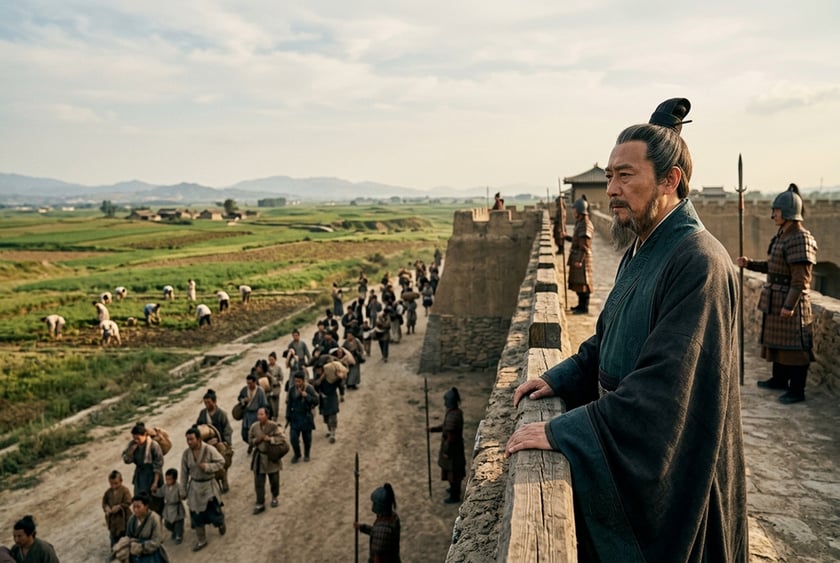
In the first year of Yuanxing (264), Sun Hao was enthroned through the recommendation of Chancellor Puyang Xing and General of the Left Zhang Bu and escorted by Ding Feng and others. In the early days of his reign, Sun Hao gave signs of an enlightened ruler: he reduced taxes and opened granaries for relief, and the whole of Jiangdong briefly placed high hopes in him. But within less than two years of accession, Sun Hao began to reveal his true nature of cruelty and violence — he launched ambitious palace construction, moved the capital to Wuchang, deployed harsh punishments and cruel officials, and had Puyang Xing and Zhang Bu, the very men who had enthroned him, put to death. By the first year of Baoding, the Sunwu court was facing two urgent problems: first, the Western Jin had already been established (Sima Yan received abdication in 265), and external pressure was growing daily; second, Sun Hao's tyrannical rule was rapidly eroding the internal support of the Jiangdong gentry. It was at this moment that Lu Kai's plot to dethrone him was put forward.
Key Figures
Lu Kai was from the Lu clan of Wujun — a nephew of Lu Xun and the highest court representative of the major eastern families during the middle and late Sunwu period, then serving as Left Chancellor. Ding Feng was a veteran military commander of Sunwu's older generation who had served through many campaigns since the time of Sun Quan, and was the leader of the current martial faction. Ding Gu was the Imperial Censor, in charge of the censorate. Liu Ping served as General of the Left and commanded the imperial guard. This combination of figures spanned the four axes of power — chancellor, military, censorate, and palace guard — and in theory possessed all the necessary components for a clean coup. The target for dethroning, Sun Hao, was at the apex of his personal rule, yet his degree of isolation was also at its highest.
Core Issue
The critical juncture of the entire conspiracy was the "emperor's visit to the ancestral temple" — one of the very rare windows when Sun Hao left the inner circle of the imperial guard and appeared in a public setting. The plan envisioned Ding Feng acting under the pretext of escorting the emperor, the Imperial Censor Ding Gu stepping forward on legal grounds to announce the deposition, and Lu Kai presiding over the enthronement of a new ruler. However, Sun Hao at the last moment substituted Liu Ping as the lead escort, leaving the original executors unable to approach the emperor. Lu Kai was forced to disclose the plan to Liu Ping, hoping Liu Ping would switch roles. Liu Ping and Ding Feng had long harbored mutual antagonism — the two veterans had once competed for merit and seniority at the front — and on top of that, Liu Ping's own assessment of the coup's risks ("if the matter fails, the nine clans will be exterminated") led him to respond with deliberately vague language and demur. This refusal — neither reporting the conspiracy nor joining it — was precisely what made the plot impossible to continue.
Political Consequences
The dethronement plot was never carried out; Lu Kai received no outward punishment — Sun Hao was unaware of it, or knew of it but could not move against Lu Kai's great clan background. But Lu Kai himself was thereafter consumed by grief and indignation, and died in office in the first year of Jianheng (269), still submitting memorials of frank remonstrance to Sun Hao on more than twenty matters on his deathbed. Ding Feng and Ding Gu in turn died of old age. The Sunwu court thereafter had no one with the capacity to organize effective checks on Sun Hao; imperial tyranny intensified without restraint, and by the time the Western Jin launched its campaign against Wu in the third year of Tianji (279), the Sunwu regime had completely lost internal cohesion. From the perspective of historical sources, the authenticity of this affair has long been disputed — Sima Guang in Zizhi Tongjian considered it hard to credit, reasoning that Lu Kai was a man of lofty integrity, Liu Ping was a mediocrity, the plot if successful would certainly have entailed extermination of nine clans, and Liu Ping could not have dared not to report it. Yet the Wu Records and Jiangbiao Zhuan cited in the San Guozhi annotations preserve the original account and should be treated as the internal version held by the Sunwu court's own historians.
Counterfactual Analysis
If Liu Ping had participated and the action succeeded, Sunwu would have accomplished in 266 a high-level coup analogous to Caowei's "Sima Yi eliminating Cao Shuang," enthroning one of Sun Xiu's sons as a child emperor. The combined governance of the Jiangdong great clans (Lu, Gu, Zhu, Zhang) with the military faction (Ding Feng's line) would, in theory, have given Sunwu a more coherent political rhythm during 263–280, enabling it to concentrate its forces against Western Jin — possibly even pushing back the timeline of Jin's conquest of Wu by several years. Conversely, however, a situation of a weak-boy emperor with a chancellor and a great general sharing power was extremely rarely sustainable for more than five years in the San Guo era; Sunwu would more likely have descended into factional infighting even more intense than Sun Hao's personal rule. The true historical value of the Lu Kai dethronement plot is that it allows later generations to see clearly: Sunwu's collapse was not the personal responsibility of any single emperor, but rather that the state lacked, at its final window, any institutionalized mechanism for error correction — a conspiracy aborted by the personal animosity between two old generals is the perfect footnote to the fragility of the entire system.