Background
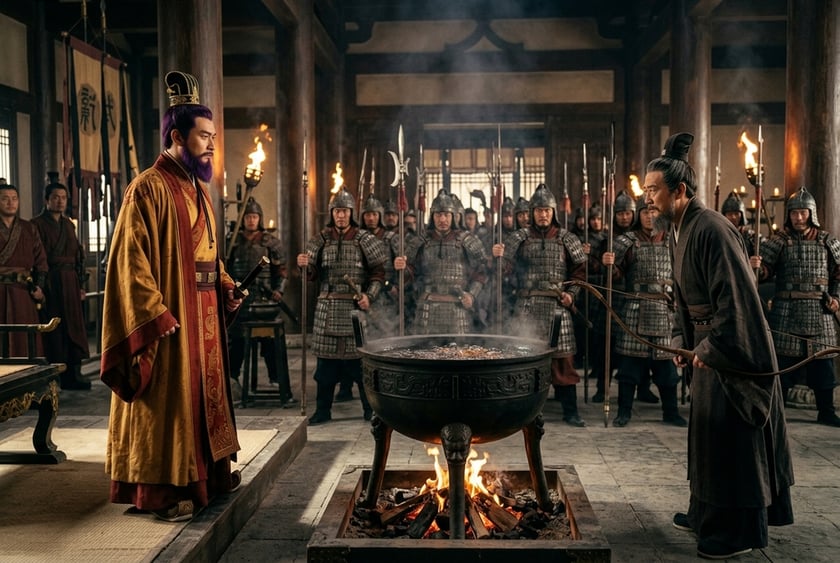
Around the first year of Jian'an, the political map of the late Han was in the midst of a critical redistribution of talent. After the killing of Dong Zhuo, the eastern warlords nominally recognized Yuan Shao as their alliance leader; the prestige of the Yuan clan's "four generations of the Three Excellencies" made Hebei the preferred destination for scholar-officials. At the same time, Cao Cao had just escorted the Han emperor to Xu and was beginning to take shape as the power behind the throne, though his headquarters remained far smaller in scale and talent than Yuan Shao's. The Yingchuan scholar bloc — represented by Xun Yu, Xun You, Guo Jia, and Zhong Yao — became the prize the two great factions were competing to win. These men were not merely strategists; they were also talent brokers within the society of classical norms: whoever secured the Yingchuan bloc would gain an unceasing supply of further scholar-officials. Guo Jia, a native of Yangzhai in Yingchuan, had from an early age "concealed his name, maintaining secret friendships with outstanding men," and his northward journey to call upon Yuan Shao represented in itself a trial probe by the Yingchuan bloc toward Yuan Shao [c:17943].
Key Figures
The central actors in this event were Guo Jia, Cao Cao, and Yuan Shao, with Xun Yu and Cheng Yu serving as pivotal nodes in the chain of recommendation. Guo Jia was the archetypal "principal strategist": skilled at strategic assessment and intelligence analysis of enemy positions, he was not suited to governing populations or handling administration. What he needed was a lord who "would both listen and could decide." Yuan Shao was precisely the negative example: outwardly deferential toward the worthy, affecting the manner of the Duke of Zhou, yet in practice "irresolute and incapable of decision" — an eight-character verdict that later became the universal consensus among northern scholar-officials on Yuan Shao [c:17943]. Cao Cao, by contrast, offered a point-for-point counterpart: a man of legalist-official background, quick to decide, willing to delegate authority, and able to tolerate frank counsel. Xun Yu was the critical node in the chain of recommendation — he had himself already left Yuan and joined Cao, then used his status as a Yingchuan fellow native to draw Cheng Yu, Guo Jia, Liu Ye, and others one after another into the headquarters, producing a "snowball" effect in the accumulation of talent around Cao Cao [c:17944].
Core Issue
The dialogue on "measuring one's lord" that Guo Jia left behind after his northern visit to Yuan Shao is one of the rare instances in late Han political history of a theory of lord-selection articulated by a scholar-official in his own voice [c:17943]. Its core proposition is that the wise man chooses his lord not by reputation but by "the manner in which he employs men" — specifically, by his decisiveness, his single-mindedness, and his ability to transform an advisor's counsel into action at the critical moment. This issue carries structural significance for the founding history of Caowei: it redefines "choosing one's lord" from a passive political alignment into the advisor's active professional choice. The fact that Guo Jia stayed only briefly at Yuan Shao's court before departing decisively was itself a demonstration of a new scholar-official style — one that used personal judgment rather than native-place ties or family lineage as the criterion for choosing a lord. This style was reenacted again and again in subsequent events such as Xun Yu's departure from Yuan, Zhang He's surrender to Cao, and Xu You's disclosure of intelligence, forming the internal logic that made talent concentrate around Caowei in its early period.
Political Consequences
The most immediate consequence was that Cao Cao's headquarters completed a full configuration of top-tier strategists in the four years between 196 and 200: Xun Yu presiding over internal affairs, Xun You over strategy, Guo Jia over decision, Cheng Yu over rear-area management, and Liu Ye over unorthodox initiatives — a lineup that played a decisive role at the Battle of Guandu [c:17944]. Over a longer time-frame, Guo Jia's entry consolidated Cao Cao's "Military Libationer" institution — a staff system in which advisors operated outside the administrative hierarchy and reported directly to the supreme commander — which was itself a significant innovation in late Han military-political structure. On Yuan Shao's side, the loss of these men produced chronic internecine strife among his advisors: Tian Feng, Ju Shou, Xu You, Guo Tu, and Xin Ping fell to mutual intrigue — the structural consequence of "too many plans and too little focus." In a sense, Guo Jia's career change tipped the scales of the Yuan-Cao contest far earlier than any single victory on the battlefield of Guandu.
Counterfactual Analysis
What if Guo Jia had remained in Yuan Shao's camp? One possibility is that he and Tian Feng and Ju Shou might have formed a coalition of the cautious, capable of steering Yuan Shao past his hesitation at crucial junctures — such as the stalemate at Guandu or the internal turmoil at Yecheng — and keeping the Yuanshaojituan viable for an additional three to five years. But given the structural character of Yuan Shao's personality ("irresolute and incapable of decision" being a matter of character rather than something that can be learned), the more likely outcome is that Guo Jia himself would have been sidelined or even executed — Tian Feng's fate is the cautionary example right before him. A second line of speculation: had Cao Cao failed to secure Guo Jia in 196 and been left with only Xun Yu and Xun You, the successive lightning decisions before Chibi — the raid on Wuchao, the absorption of Zhang Xiu, the pacification of Hebei, the campaign against the Wuhuan — would have been significantly impaired, and Caowei's timetable for unifying the north might have been delayed by five to ten years. This would in turn have opened wider development windows for the Sun clan of Jiangdong and Liu Biao of Jingzhou, and the San Guo configuration would have taken shape in a different set of proportions. Only by understanding this fork in the road can one appreciate the true weight, at a hinge-point of history, of what looked like an ordinary "change of employment."