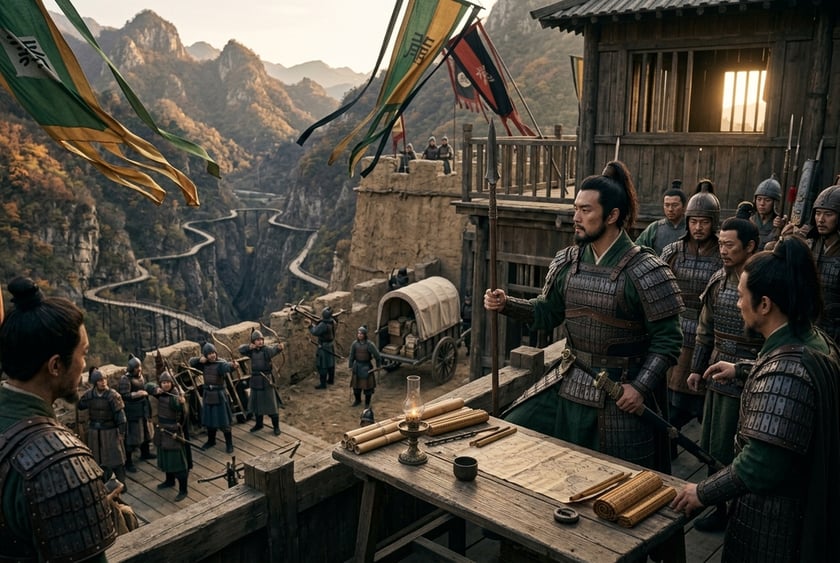
Background of the Meeting
After the Battle of Yiling, Liu Bei died of illness at Baidicheng, leaving Shuhan's national power gravely diminished. Sun Quan, though victorious in the campaign, had obtained Jingzhou at the cost of an open rupture with Shuhan — while the pressure from Caowei to the north had not diminished. Sun Quan had for a time submitted to Wei and accepted investiture as "King of Wu," but when Wei's Emperor Wen demanded a hostage — specifically that Sun Quan's heir apparent Sun Deng be sent to reside at court — Sun Quan realized that submission to Wei meant being gradually absorbed. Meanwhile, after Shuhan's return northward, Zhuge Liang immediately made "restoring the Wu-Shu alliance" his highest diplomatic priority; this provided the opening for Deng Zhi's mission to Wu. This meeting did not take place against a backdrop of goodwill; it was conducted in a tense moment when both sides harbored mutual suspicion and had only recently ended their enmity [c:17923].
The Dialogue
Sun Quan's reception of Deng Zhi was laden with deliberate menace: warriors were arrayed in front of the throne and a cauldron of oil was displayed, first probing the envoy's courage through an atmosphere of terror. Deng Zhi made a deep bow but did not prostrate himself; maintaining complete composure, he opened with the declaration that "an emissary of the superior state does not prostrate himself before the lord of a lesser kingdom" [c:17924], transforming a question of diplomatic protocol into an implicit contest over the political standing of both parties. Once the substantive conversation began, the core logic Deng Zhi laid out was admirably spare: if Shu and Wei were to realign, Wu would face encirclement from two sides — a fatal position; if Shu and Wu were to ally, each holding its own territory while checking the other, that was the only viable formula for sustaining the three-legged balance [c:17923]. The reason this argument was effective was not rhetorical brilliance but the fact that it placed before Sun Quan in the most direct possible terms the strategic dilemma he already knew perfectly well: "You already know the answer; I am merely giving it voice."
Decision Outcome
Sun Quan accepted Deng Zhi's recommendation, formally severed the vassal relationship with Wei, and restored the alliance with Shuhan. The following year Sun Quan dispatched Lieutenant-Colonel Zhang Wen on a return mission to Shu; Zhang Wen and the Shuhan scholar Qin Mi engaged in a court debate on topics such as "whether heaven can tip and collapse," using intellectual exchange to reinforce the cultural bonds between the two states [c:17925]. This dual structure of "envoy dialogue plus scholarly exchange" reflects a characteristic of Shuhan diplomacy under Zhuge Liang's direction: the goal was not merely to establish a pragmatic alliance of offense and defense, but to build a long-term, sustainable discursive consensus, ensuring that the alliance would not easily fracture over any single friction.
Historical Significance
The significance of Deng Zhi's mission to Wu within the San Guo configuration has been greatly underestimated. Its achievement was the establishment of a stable bilateral alliance lasting nearly forty years (223-263) — without parallel in the San Guo era: the relationships of Caowei with Wu and of Caowei with Shu each reversed repeatedly, yet between Wu and Shu, once the foundation laid by Deng Zhi, Zhuge Liang, and Sun Quan's generation had been set, no substantive hostility ever recurred. This stability sustained Zhuge Liang's five northern expeditions, the consolidating stewardship of Jiang Wan and Fei Yi, and Jiang Wei's continuous campaigns; the Eastern Wu side gained the strategic room to concentrate its forces against Caowei along the Huainan direction. From the perspective of institutional history, the model of "routinized diplomatic exchange" pioneered by the Deng Zhi and Zhang Wen generation of Wu-Shu envoys was itself unusual in ancient Chinese history: the two sides continuously dispatched missions and exchanged envoys, functioning almost like the resident representatives of modern states. For Deng Zhi personally, this mission established his irreplaceable position in the mid-to-late Shuhan diplomatic system; he subsequently made multiple additional missions to Wu, earning the title of true "guardian of the Wu-Shu relationship." Deng Zhi's mission to Wu can be said to have been the critical political node that preserved the San Guo configuration after Yiling, and the most important diplomatic realization of Zhuge Liang's Longzhong strategy during the post-war reconstruction period.