Background
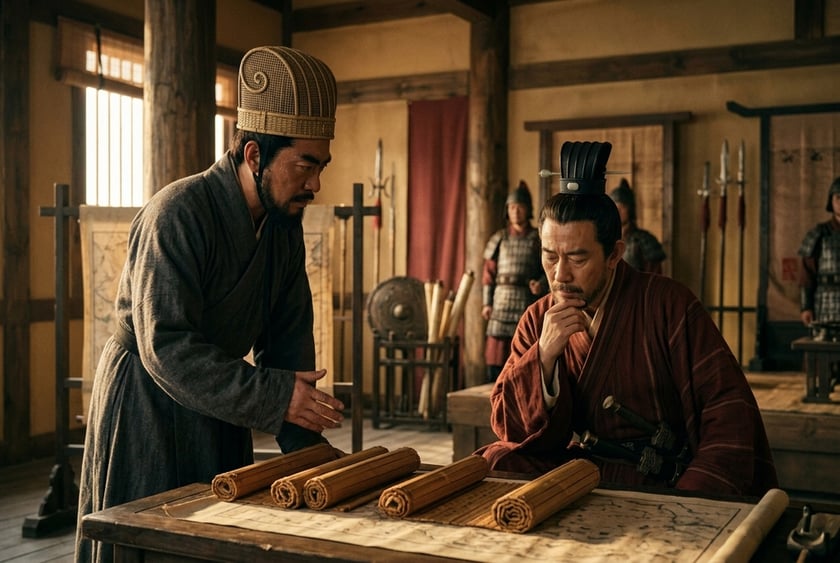
Guayinfengjin sits at the midpoint of the novel's continuous narrative of "the three conditions of surrender to Cao Cao — killing Yan Liang and Wen Chou — the thousand-li ride home alone." In the fifth year of Jian'an, Guan Yu, trapped on Earth Mountain, temporarily resided in Cao Cao's camp after agreeing to three conditions: "I surrender to Han, not to Cao Cao; the stipends of my two sisters-in-law remain unchanged; the moment I learn of Liu Bei's whereabouts I depart." During this period, Cao Cao treated Guan Yu with the highest possible honor — feasts every three days, grand feasts every five, gold upon mounting and silver upon dismounting, the rank of Marquis of Hanshou — all with the aim of gradually softening Guan Yu's resolve to return to Han. Yet Guan Yu's commitment to Liu Bei never wavered: while killing Yan Liang and Wen Chou and establishing merit in Cao Cao's service, he kept a constant watch for news of Liu Bei, and the moment he learned Liu Bei was at Yuan Shao's side he immediately set in motion the procedures for departing Cao Cao and returning to Han. This passage in the novel is the central narrative pillar for constructing Guan Yu's image of "loyalty and righteousness."
Key Figures
Guan Yu is the agent of the action. Throughout the entire process his words and deeds are perfectly consistent — from explicitly stating "my heart is with the Imperial Uncle" at the time of the three conditions, to "I would follow him beneath the ground" when Zhang Liao probed his feelings, to the material declaration of the sealed gold and surrendered seals, every step repeats the same core position. Cao Cao is the greatest obstacle to Guan Yu's departure, but the response he chose was not forcible detention — it was to "hang the avoidance plaque" — neither approving the farewell request nor resorting to force, intending to use emotional delay to change Guan Yu's mind. Zhang Liao, as an old acquaintance of Guan Yu and simultaneously a confidant of Cao Cao, served as the intermediary for multiple soundings of Guan Yu's true feelings. The two sisters-in-law, Gan Furen and Mi Furen, represent the family obligations Guan Yu must protect; their presence means Guan Yu's return to Han is not just a personal choice but a family duty.
Core Issue
The central issue of Guayinfengjin is "how to complete a change of allegiance without betraying the debt of gratitude." The dilemma Guan Yu faced was this: Cao Cao had given him the grace of saving his life, gracious treatment, and a noble title — by Han-era scholar-official ethics these forms of grace required reciprocation. But his sworn brotherhood with Liu Bei occupied a higher rank in his value system. His method of handling this was extraordinarily precise. First, establishing merit to repay grace: by killing Yan Liang and Wen Chou and relieving the siege at Baima, he explicitly told Cao Cao "the grace has been repaid." Second, leaving property and returning grace: he stored and returned every single reward received — gold, silver, beautiful women, servants, official seals — avoiding any possible accusation of "misappropriating Caowei resources." Third, leaving a farewell letter: he completed the proper ritual procedure in the form of a formal written document, leaving no stain of "departing without notice." This three-step combination gave Guan Yu's return to Han complete ethical legitimacy — he had repaid Cao Cao's grace and honored his oath to Liu Bei, and turned what was politically a defection into a leave-taking ceremony conforming to scholar-official norms.
Political Consequences
The immediate result of Guayinfengjin was Guan Yu's successful departure from Xudou, launching the journey home of "crossing five passes and slaying six generals". In the short term, Cao Cao lost a top-tier martial commander and the military configuration of Xudou developed a gap; but from the standpoint of political image, Cao Cao actually obtained an unexpected political asset — his publicly allowing Guan Yu to go was interpreted by later generations as a hallmark of "Cao Cao's love of talent," becoming a humane note within his "wily hero" label. From the Shuhan perspective, Guan Yu's return meant far more to Liu Bei's camp than its military value; it once again reinforced the bond of brotherhood among Liu Bei, Guan Yu, and Zhang Fei, providing the emotional foundation for all subsequent strategic deployments at Chibi, in Shu, and in holding Jingzhou. From the long-term perspective of the novel's cultural narrative, Guayinfengjin became an iconic symbol of the culture of loyalty and righteousness — the veneration of Guan Yu in later storytelling, drama, and folk temples was built to a large degree on the "honoring both grace and righteousness" posture displayed in this event.
Counterfactual Analysis
Had Guan Yu chosen to "keep most of the rewards and take only some away," this behavior would in hindsight have been read as "misappropriation," and Guan Yu's image would have descended from an icon of loyalty and righteousness to an ordinary returning general. Had Guan Yu left without notice and without even writing a farewell letter, he would have incurred the stain of "rudeness"; Cao Cao would have had every justification to dispatch troops in pursuit, and the opinion of the lords would also have leaned toward Cao Cao. Had Cao Cao chosen to forcibly detain Guan Yu — which was entirely within his military power — Caowei would have gained a general's body but permanently lost Guan Yu's true heart; even if Guan Yu served thereafter he would never have contributed a single plan or ounce of effort, analogous to Xu Shu's state while in Cao Cao's camp; at the same time Liu Bei's camp would have gained a powerful political accusation of "Cao Cao breaking faith and detaining him." Seen from this angle, the true value of Guayinfengjin lies not solely in Guan Yu personally — it was a "bloodless parting in which both sides preserved their dignity," leaving two camps that would repeatedly face each other in the future without having accumulated irreconcilable moral debts against each other. This "preservation of propriety in an age of chaos" is precisely the most precious element of late Han scholar-official culture. Historiographically, the official record contains a brief account of Guan Yu's departure from Cao Cao to return to Liu Bei, but the detail of "sealing the gold and surrendering the seals without taking a single thing" is the novel's elaboration — it carries a strong literary sensibility and is an important source for the construction of later loyalty-and-righteousness narratives.