Cause
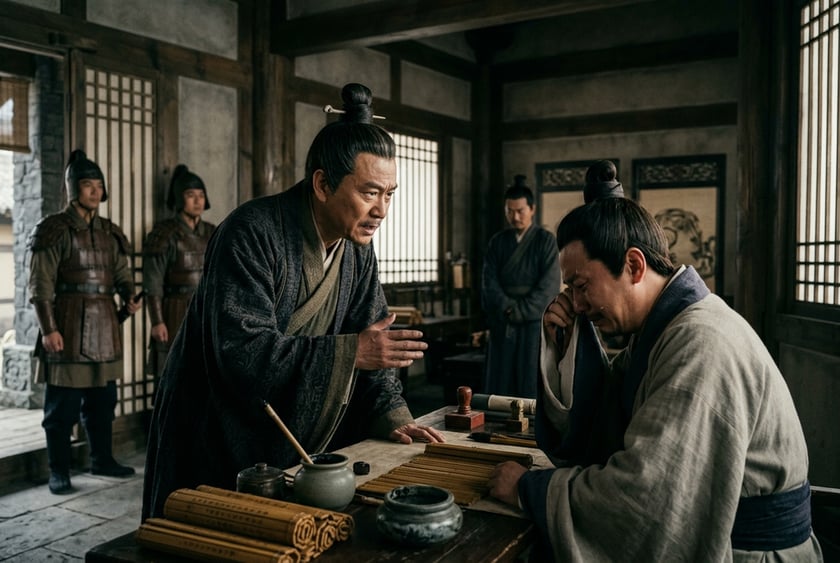
As a modern military historian evaluating this brief, brutal, and doomed coup, it must be placed in the sharp political turn of the twenty-first and twenty-second years of Jian'an (216–217). Cao Cao advanced to the title of King of Wei in the twenty-first year; in the twenty-second year he designated Cao Pi as heir apparent. The entire Wei timetable for dynastic replacement had quietly accelerated. The "Han loyalists" still surrounding Emperor Xian — men of the stripe of Geng Ji, Wei Huang, Jin Yi, and the Ji brothers — realized their time was running out. Geng Ji had originally served in the chancery staff, Wei Huang held the post of Superintendent of Justice; both held respectable rank in the court but had no military authority, and "seeing Cao Cao advance to the title of King and adopt the carriages and dress of the Son of Heaven in going out and returning, their hearts were greatly displeased" [c:17504]. This is the classic state of "holding office but having lost one's value alignment" — not supposed to take desperate action, yet having no other path.
Participating Forces
The five core conspirators each held a distinct motive for opposing Cao Cao. Geng Ji and Wei Huang came from the middle and lower ranks of the Han bureaucratic system and harbored the traditional literati ideal of "purging the emperor's side" [c:17504]; Jin Yi was a descendant of Han Chancellor Jin Rizi, a family of hereditary Han ministers — "how could I follow traitors?" [c:17505]; Ji Miao and Ji Mu were sons of the imperial physician Ji Ping who had been executed by Cao Cao in the Yidaizhao affair, bearing both private grievance and public outrage together [c:17506]. Collectively these five commanded only about a thousand household retainers and private soldiers; their sole point of access to the center of power was that Jin Yi had a close personal relationship with Wang Bi, the officer in charge of security at Xudou. But they had no external support whatsoever. What should have been the critical variable — the Guan Yu coalition — was at this very moment making an active northward push from the Jingzhou direction and about to launch the Xiangfan campaign, but the Xudou uprising and Guanyubeifa had no effective coordination whatsoever.
Key Turning Points
The turning points of the coup almost all occurred on the night of the Lantern Festival. The plan itself had points of merit: choosing the Lantern Festival, when the city was ablaze with lights and vigilance was at its most relaxed; launching on two fronts simultaneously, one force inside the city attacking Wang Bi's camp and one outside setting fire as a signal; and a clear objective — escort the emperor to the Wufeng Tower to "summon all officials and personally pronounce an edict to suppress the traitors" [c:17506]. But three fatal flaws were exposed in execution. First, Wang Bi, though hit by an arrow, escaped by luck and ran to Jin Yi's front gate seeking help — Jin Yi, thinking it was a fellow conspirator arriving, opened the door, thereby exposing his identity [c:17507]. Second, Xiahou Dun, commanding a patrol outside the city with thirty thousand regular troops camped only five li from Xudou, entered the city the instant the fires were lit, "dispatching a unit of troops into the city to assist" [c:17508]. Third, the conspirators had failed to mobilize the city's population — the people on Lantern Festival night only watched the lights; there was no general response to the call to "kill the national traitors." Of the three flaws the second was the most fatal: the closeness of Xiahou Dun's camp showed that Cao Cao's security arrangements for Xudou were already extremely tight, and the supposed "window of minimum vigilance on Lantern Festival night" had never really existed.
Suppression and Outcome
Once Xiahou Dun entered the city, Cao Xiu led the mopping-up; by daybreak Jin Yi and the Ji brothers were all dead, and when Geng Ji and Wei Huang broke out through the south gate they were encircled and captured alive by Xiahou Dun's main force [c:17508]. Cao Cao's response was mercilessly severe: the entire extended families of Geng, Wei, and the others were executed in the marketplace, and "all officials of the court large and small were arrested and sent to Yecheng to await sentencing" [c:17508]. This combined "clan collective punishment and full-court purge" was Cao Cao's standard treatment of potential political rivals — eliminating the actors while completely reshaping the political ecology of the court. Geng Ji's shout at the execution ground — "Cao Aman, in life I could not kill you; in death I shall become a vengeful ghost to strike down the traitor!" — has been called the final eruption of the Jian'an literati spirit [c:17509]; Wei Huang's pressing his face to the ground and grinding his teeth until they shattered before dying also became a canonical image in later loyalty-and-righteousness narratives. But the spiritual heights these two men reached in their final moments only threw into sharper relief how inadequate their operational preparation had been.
Historical Echoes
The Geng Ji–Wei Huang uprising resonates on four historical levels. First, it was the last "organized Han loyalist resistance to Cao Cao" during the Jian'an years. Before it: Dong Cheng's Yidaizhao affair (200), Ma Teng and his son's plot to assassinate Cao Cao (212), Empress Fu's conspiracy (214), and now this — almost all ended in failure and clan extermination. After this, neither Xudou nor Yecheng saw organized Han loyalist resistance of any scale again. Second, Cao Cao used the suppression to complete a purge of any remaining Han loyalists in the court; the operation of "sending all officials to Yecheng" left Emperor Xian with almost no one he could trust, and the timetable for dynastic replacement became in substance irreversible. Third, it proved from the negative side the necessity of establishing Cao Pi as heir apparent — the succession struggle had just ended a year earlier, the Wei upper stratum had already oriented toward the new dynasty, and the political space left for Han ministers had been compressed to zero. Fourth, the failure of this episode reminded later generations: a coup in an urban setting, without the cooperation of regular troops and broad popular mobilization, relying only on "inside contacts plus aristocratic household soldiers," is nowhere near enough — a pattern confirmed repeatedly in Chinese political history.
Counterfactual Analysis
The first counterfactual: had Guanyubeifa been coordinated in timing with the Xudou uprising. In the twenty-fourth year of Jian'an, when Guan Yu flooded the Seven Armies and "shook Huaxia," Cao Cao genuinely considered relocating the capital to avoid the edge of his advance; if combined with a political coup inside Xudou, the Caowei ruling center might have experienced a temporary vacuum, giving Emperor Xian a non-zero chance of being escorted out. But this would have required the conspirators to establish long-range communication with Guan Yu's side — virtually impossible under the communication conditions of early 218. The second counterfactual: had Xiahou Dun not been on patrol outside Xudou that night. The very fact that Cao Cao stationed this foremost clansman general outside the capital was itself a final safeguard against remnant Han loyalists — it shows that Cao Cao had a clear-eyed read of the latent risks in Xudou. The third counterfactual: had one of the five principal conspirators held military authority — for example, had one of them been able to turn a unit of the palace guard. This is the greatest gap between the Geng Ji–Wei Huang affair and both the "Empress Fu conspiracy" of the same era and the later "Gaopinglingzhibian" by Sima Yi — the latter two either avoided direct armed confrontation or mobilized regular troops, while this coup relied entirely on private soldiers and passion. This failure thus became a specimen of "idealism confronting the machinery of state" — worthy of respect, but impossible to win.