Strategic Background
As a modern military historian, the Battle of Dierciruxukou must be read on the map of the long-running Cao–Sun strategic contest. In the seventeenth year of Jian'an, Sun Quan adopted Lv Meng's proposal to build a fortified position at Ruxukou, effectively sealing the Chaohu–Yangtze corridor; in the eighteenth year, Cao Cao made his first southern push and failed to break through. Three years later, in 216–217, Cao Cao advanced to the title of King of Wei and urgently needed a breakthrough beyond the Hanzhong front in order to push back Sunwu's "Huai-Jiang defense line." This southern campaign was simultaneously a political statement — the newly titled King of Wei had to demonstrate military action — and a strategic repair: as long as the Hefei–Ruxu–Jianye depth problem remained unsolved, Wei's southeastern flank would forever have the live risk of "Wu forces pushing north across the Huai." The novel records Zhang Liao reporting to Cao Cao that "Sun Quan is at Ruxu intending to launch an offensive; I fear our forces at Hefei are too few to resist," whereupon Cao Cao, still on the Hanzhong front, held a special discussion on whether to return and shore up the eastern line.
Deployments
On the Wei side, Cao Cao commanded in person with his core generals — Zhang Liao, Li Dian, Le Jin, Xu Chu, Pang De, Cao Xiu, and others — massing from Hefei southward, the force officially numbered in the hundreds of thousands. On the Wu side, Sun Quan went personally to the front. The principal commanders were Lv Meng holding the main camp, Ling Tong engaging Zhang Liao head-on, and Gan Ning specializing in surprise night raids; Chen Wu, Pan Zhang, Zhou Tai, and Han Dang covered the riverbank depth defense; Xu Sheng and Dong Xi served as reserves; Lu Xun — as the son-in-law of Sun Ce — led one hundred thousand troops landing from the opposite bank in reinforcement. In terms of terrain, Ruxukou controlled the inlet from Chaohu to the Yangtze; for the Wei forces to advance they first had to mass their infantry in a waterway-laced landscape and then break through the water stockade fortified with chain booms and stakes, which dragged the battlefield into the mode of warfare Wu excelled at: "amphibious operations combined with small-unit night raids."
Key Decision Points
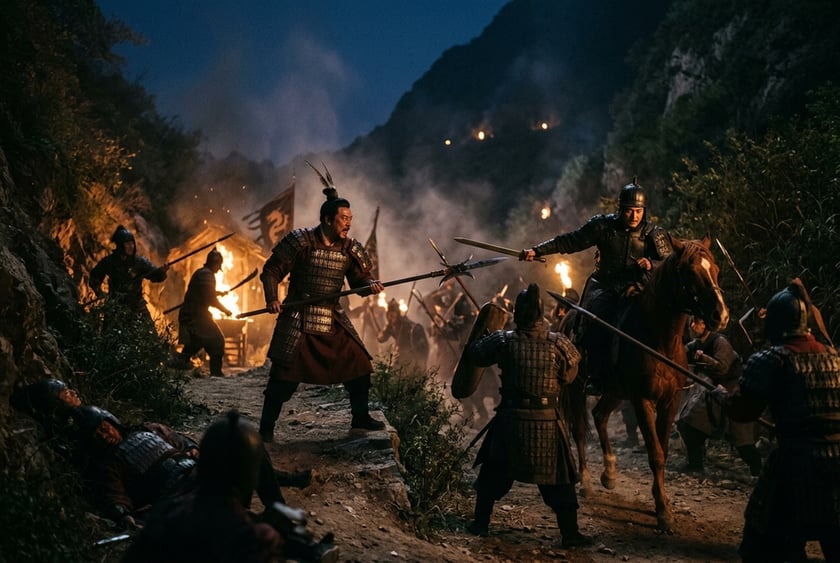
Gan Ning's night raid on the Wei camp was the signature event of this battle. He personally requested to lead a hundred cavalry into the Wei camp by night, and before departing he had all hundred men sit in a circle to drink, making explicit their readiness to die, pledging to "exert their utmost in death" before riding out. This passage reads as high drama but is tactically sound: during a phase in which both sides' main forces were in silent standoff, small-scale surprise raids to destroy the enemy's morale were a pattern Wu forces repeatedly employed at the Huai-Jiang front — "striking daylight with darkness." The second key decision came when Ling Tong and Zhang Liao fought fifty bouts to a draw; at that point Cao Xiu "secretly loosed an arrow from concealment" that brought down Ling Tong's horse, while Gan Ning shot Le Jin through the face and rescued Ling Tong. This exchange not only left Le Jin seriously wounded but also resolved the longstanding blood feud between Ling Tong and Gan Ning, the two becoming "brothers in life and death" — the repair of relations among Wu's frontline commanders had significant long-term value for the stability of the Huai-Jiang defense line in subsequent years.
The third decision came at the strategic close. After more than a month of standoff, Zhang Zhao and Gu Yong advocated seeking a negotiated settlement; Sun Quan concurred, sending Bu Zhi to the Wei camp to arrange terms, "pledging annual tribute". Cao Cao, "seeing that he could not quickly take the Jiangnan region," was glad of the pretext to disengage. This mutual restraint — "fight to stalemate, then settle" — was the shared political rhythm of all three Ruxukou engagements.
Outcome and Echoes
The battle concluded with Wu making the formal overture for peace while in reality Cao Cao's forces proved unable to cross the Yangtze. Chen Wu's death in battle was the most visible Wu loss, but Lu Xun's reinforcement of one hundred thousand crossing from the opposite shore drove the Wei forces back to the bank, and overall Wu casualties remained manageable. On the Wei side, Le Jin, Dong Xi, and others suffered significant losses, and most critically, the Ruxukou defensive line held and the Yangtze barrier remained in Wu's possession. Three lasting echoes followed from this battle. First, Wu consolidated the three-layer defense system of "Ruxu stockade — riverbank depth — amphibious mobile force," and did not face a major northern offensive again until 222. Second, Cao Cao's three failed southern campaigns in person shifted his southern strategy toward "pressure without conquest," redeploying more forces to Hanzhong and the western front. Third, the reconciliation of Ling Tong and Gan Ning and the sacrifice of Chen Wu increased the cohesion of the Wu core commander group, preparing the personnel conditions for Lv Meng's later seizure of Jingzhou.
Counterfactual Analysis
Had Cao Cao's side not loosed that arrow during the Ling Tong–Zhang Liao duel — or had Le Jin not been shot by Gan Ning and been able to fight on — the probability of a Wei victory in that engagement would have risen noticeably, and Wu frontline morale would have taken a blow. But even so, Wei would still have faced two structural obstacles to actually crossing the Yangtze: the Ruxukou fortifications and the naval disparity. The more plausible counterfactual is therefore this: had Cao Cao not launched this campaign in 216–217 and instead concentrated that portion of his forces on Hanzhong, Liu Bei's Battle of Hanzhong would very likely have been pushed back by one or two years, or might even have failed to reach completion by 219. From this perspective, the true significance of the second Ruxukou campaign lies not in how much Wu won, but in how thoroughly it pinned Caowei's attention to the eastern front, indirectly creating the strategic vacuum in which Shuhan seized Hanzhong. Jiangnan unconquered, Hanzhong lost — the two great late-life military regrets of Cao Cao were in fact two faces of the same coin.