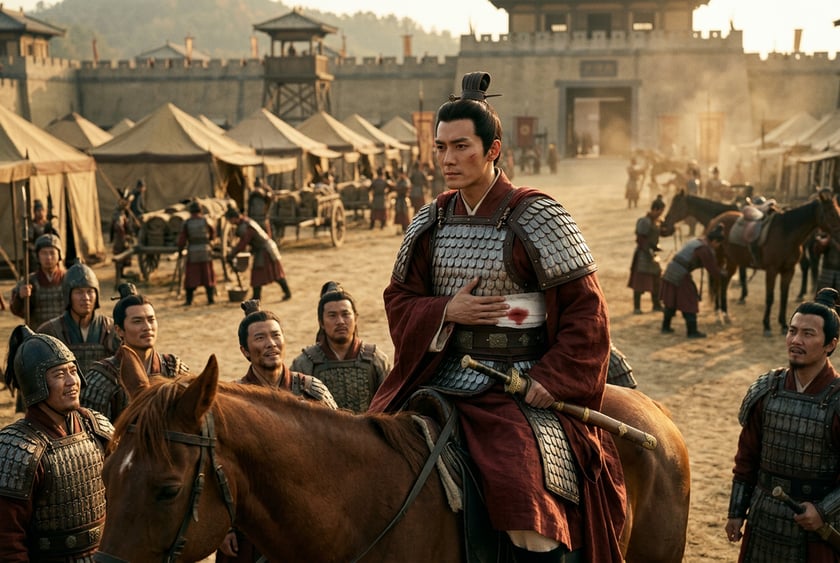
Strategic Background
From the perspective of modern military history analysis, the Battle of Didao marks the critical inflection point at which Shuhan's northern campaigns shifted from a "use offense as defense" strategy toward a "gamble for decisive victory" strategy. In early Zhengyuan 2 (255), Caowei's Grand General Sima Shi died on campaign at Xu Chang after suppressing the Huai-nan rebellion of Guan Qiujian and Wen Qin; Sima Zhao had just taken over and had yet to consolidate his authority, leaving the Wei court in a temporary vacuum. Jiang Wei perceived this window of opportunity and resolved to launch a northern campaign on a scale surpassing any of his previous efforts: commanding Zhang Yi, Xiahou Ba, Liao Hua, and other senior generals in separate columns, with the main force aimed directly at Longxi. His strategic objective was no longer harassment-style strikes or the seizure of individual fortresses, but rather exploiting the geographical features of the Taoxi Pingyuan to seek the annihilation of Liangzhou's main Wei forces in open battle, thereby creating conditions for the long-term occupation of Longright.
Disposition of Forces
On the Shu side, Jiang Wei made Taoxi the main theater, pushing the main force along the western bank of the Tao River; Xiahou Ba engaged Chen Tai's relief forces while Zhang Yi handled siege operations. This three-line deployment of "main force field battle + detached column siege + detached column blocking" was risky in terms of manpower — a total force of tens of thousands split across three axes, leaving none with a decisive advantage. On the Wei side, Yanzhou Governor Wang Jing was garrisoned at Didao in defense and committed a critical error: instead of holding Didao per Chen Tai's orders, he led his troops out and advanced to Taoxi to engage Jiang Wei proactively. This rash advance exposed the command weaknesses of Wei's Liangzhou system — Wang Jing was insufficiently experienced and drastically underestimated Jiang Wei's effectiveness in open battle. Chen Tai marched south from Shanggui while Deng Ai advanced from an adjacent direction to combine forces; this relief plan was itself well designed, its critical variable being the tempo of the march and the psychological pressure it could exert.
Critical Decision Points
The first decision point was Wang Jing's sortie from Didao to engage. By military logic, Didao had sound fortifications; Wang Jing's correct choice was to seal the gates and wait for Chen Tai's relief force. Instead he chose to attack, exposing Wei's main Liangzhou forces to the open-battle environment in which Jiang Wei excelled. The result was that Shu forces completed the encirclement on the western bank of the Tao River, with "those among Jing's troops who died in the Tao River numbering in the tens of thousands" — the highest single-engagement tally of the entire Shuhan northern campaign sequence. The second decision point came after Jiang Wei's field victory, when Zhang Yi immediately remonstrated: "This is enough; we should not advance further. Advancing risks destroying this great achievement", urging that the gains be secured and the Taoxi position consolidated. Jiang Wei chose to continue besieging Didao, hoping to convert the field victory into the capture of a city. This decision effectively committed the reverse of the sunk-cost fallacy — he wanted to use his earlier victory to purchase a larger one, and in doing so mired Shu forces in a siege for an extended period and surrendered their maneuverability advantage. The third decision point came at the moment of choosing to withdraw when Chen Tai and Deng Ai combined their relief forces. Jiang Wei suffered a cognitive bias in gauging the scale of the relief effort — the novel attributes this to Deng Ai's stratagem of feigned troops and a surprise move; but even setting aside the novel's embellishments, the real question Jiang Wei faced at that moment was: gamble on a final assault to take Didao before the relief force arrived, or accept defeat and withdraw to preserve the main body. He ultimately chose withdrawal, which was the prudent call from a purely military standpoint, but also meant that the window for converting the Taoxi victory into political capital was definitively closed.
Outcome and Reverberations
The most immediate outcome was Jiang Wei's retreat to Zhongdi, with the Taoxi gains failing to translate into territorial occupation. From Shuhan's strategic perspective, this was a textbook case of "tactical great victory, strategic draw." Chen Tai and Deng Ai returned to Didao to comfort and commend Wang Jing, then reported their achievements to Cao Mao; Deng Ai was as a result appointed General Who Pacifies the West and concurrently held the position of Protector of the Eastern Qiang — his political standing on Wei's western front was definitively established by this battle, paving the way for him to eventually succeed Chen Tai as the primary manager of Liangzhou military affairs. The deeper reverberations operate on three levels: first, Wei drew from this battle the lesson that "Liangzhou cannot again be entrusted to generals lacking military experience," with Deng Ai, Chen Tai, and Guo Huai's network becoming the western front's core, such that Shuhan's northern campaigns thereafter never again replicated the Taoxi-scale field victory; second, Jiang Wei already faced criticism at court for aggressive northern campaigning, and the Didao outcome of "turning great victory into nothing" deepened Shuhan's internal doubts about his strategy, with the sustained support of veteran ministers Zhang Yi, Liao Hua, and others steadily declining; third, Deng Ai's post-battle prediction to Chen Tai that "Shu forces will certainly march out five times", while partly the novel's embellishment, also reveals that Wei's western front senior leadership had already fully internalized the pattern of Jiangweibeifa, and from that point the two sides entered a "matched standoff" phase of mutual familiarity in the Longright region.
Counterfactual Analysis
What if Jiang Wei had heeded Zhang Yi's counsel of "do not advance further," and instead of hammering at Didao had immediately pushed westward after the Taoxi victory to besiege Nan'an, Tianshui, and other cities? A realistic assessment is that this course might have allowed Shu forces to seize two or three mid-tier cities on the momentum of Taoxi casualties and thereby fully take a stretch of Longright, providing at minimum a stable forward base for future northern campaigns. The cost would have been abandoning encirclement of Wang Jing's remnants, with Wei still able to reconstitute its Liangzhou forces from Guanzhong over the long run. The other fork is the scenario where Jiang Wei chose to act fast — throwing the entire force at Didao before Chen Tai's relief arrived, betting on "trading losses for territory." Had this succeeded it would have changed the Longright configuration; failure would have meant the destruction of Shuhan's main force and the bearing of personal political responsibility by Jiang Wei. The most thought-provoking point is this: the Taoxi victory itself was already the strategic peak of what Shuhan's national power could sustain, and the psychology of wanting to convert one victory into two overestimated the strategic depth that Shu possessed. Understanding this rhythmic loss of control is precisely the way to understand why the 255 campaign — seemingly brilliant yet in reality spinning its wheels — became the true turning point of Shuhan's national fortunes.