Origin
When Minister of Works Wang Yun and Lv Bu killed Dong Zhuo in the fourth month of the third year of Chuping (192), it should have been the moment of Eastern Han's revival — the people of Changan celebrated, and many believed the Han house might yet be restored. Yet Wang Yun's policy for managing the aftermath rapidly exposed a grave flaw: he took a hard line of "neither amnesty nor pacification" toward the Liangzhou military. When Li Jue, Guo Si, Zhang Ji, and Fan Chou — Dong Zhuo's four core subordinate generals — fled back to Liangzhou and sent men to memorialize for pardon, Wang Yun's answer was: "Though a general amnesty has been declared for the realm, these four men alone are excluded". The political cost of this decision was enormous — it backed tens of thousands of Liangzhou troops into a corner where "they had to rebel or die." Jia Xu intervened at this moment and offered his famous advice to march on Changan: rather than each man fleeing separately to be seized by some local headman, they should rally the Liangzhou troops and "in the name of the state punish the traitor"; simultaneously he used the rumor that "Wang Yun intends to sweep clean all the people of this region" to rouse the populace. This rhetoric simultaneously cloaked the rebellion in the legitimacy of "avenging Dong Zhuo" and converted the Liangzhou people's fear of Wang Yun into a mobilization force of over a hundred thousand — a classic case of "rumor mobilization" in Chinese political history.
Forces Involved
Li Jue, Guo Si, Zhang Ji, and Fan Chou constituted the core military strength, advancing in four columns toward Changan; along the road they encountered Dong Zhuo's son-in-law Niu Fu leading five thousand troops to join them and were assigned to spearhead the advance. On the capital's side, Wang Yun and Lv Bu were the main resistance, but Lv Bu's forces were limited and Li Su was defeated and killed by Niu Fu in the opening battle. Inside the city, the "internal agents" were Dong Zhuo remnants such as Li Meng and Wang Fang, who secretly opened the city gates — the direct cause of Changan's fall. Emperor Xian of Han occupied a completely passive position, used as a political symbol by all sides in turn. Ma Teng and Han Sui led the Xiliangjun in to reinforce and represented the external anti-Dong forces; but the household servants of the families inside Changan reported the plot, the three clans' young men of ability were executed, the internal agents neutralized, and the Xiliangjun ultimately withdrew in defeat. Cao Cao's move in the first year of Jian'an to escort the Son of Heaven eastward was the critical outside force that finally broke the deadlock.
Key Turning Points
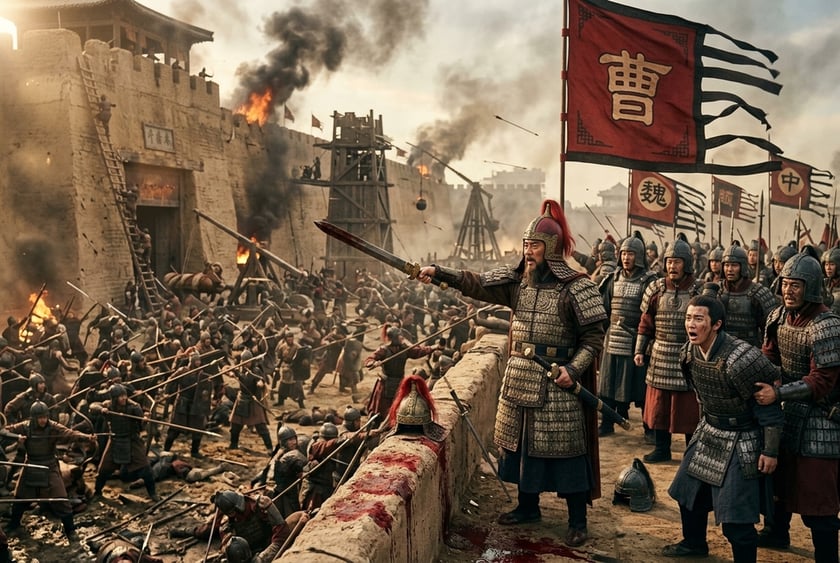
The Liguozhiluan falls into three distinct phases, each with a defining turning point. The first phase was the fall of Changan: four columns of Liangzhou troops, totaling over a hundred thousand, bypassed Lv Bu's main force, entered through the gates opened by Li Meng and Wang Fang — Wang Yun refused to flee and from the Xuanping Gate jumped down, loudly announcing his identity, and was killed on the spot by Li Jue and Guo Si; this was the direct node at which Eastern Han's central authority collapsed. The second phase was the internal strife between Li Jue and Guo Si: after the four generals jointly seized power, Li Jue set a banquet to kill Fan Chou and Zhang Ji withdrew to protect Hongnong. The relationship between Li and Guo deteriorated rapidly; they fought over power every day for over fifty days — Li Jue seized the emperor and removed him to Meiwu, while Guo Si seized the court ministers, each using the Son of Heaven and the officials as hostages against the other. The metropolitan region suffered casualties beyond counting, and the state's central apparatus effectively ceased to exist. The third phase was Cao Cao's westward escort and the final reckoning: in the first year of Jian'an (196) Cao Cao advanced under imperial mandate; Xu Chu, Dian Wei, Xiahou Dun, Cao Ren, and other crack troops along multiple routes routed the Li-Guo combined army in the eastern outskirts of Changan; Xu Chu alone cut down Li Xian and Li Bie in battle; Li and Guo "fled westward in panic like stray dogs with nowhere to take shelter, with no choice but to become mountain bandits". They were ultimately killed by Duan Wei and Wu Xi.
Suppression and Outcome
At the military level, the suppression of the Liguozhiluan was not the result of a single battle but a combined effect of long resistance by multiple forces — tasks that Ma Teng and Han Sui had not accomplished, that Lv Bu had not accomplished, and that Wang Yun had not accomplished were ultimately completed in full by Cao Cao under the banner of the Son of Heaven. At the political level, the chaos produced several irreversible consequences. First, Changan was left in ruins; the western capital lost the capacity to serve again as the central capital, and the Eastern Han's political center of gravity shifted permanently eastward. Second, after the Liangzhou military bloc was shattered with Li and Guo's defeat, it never regained cohesion; Ma Teng, Han Sui, Zhang Ji, and others each managed their own localities, laying the groundwork for Cao Cao's later division-and-pacification approach to Guanzhong. Third, the political model of "holding the Son of Heaven hostage to command the lords" took definitive form in Cao Cao's hands — after the emperor's return east, he fell under Cao Cao's shadow, and Emperor Xian of Han spent the rest of his life there.
Historical Echoes
The Liguozhiluan has a textbook standing in Chinese political history. First, it is the model case of how "rumor mobilization" can transform a desperate military clique into a large-scale rebellion — Jia Xu's single utterance changed the course of history, cementing his label as "the toxic advisor." Second, it reveals the fatal flaw of the "neither amnesty nor pacification" approach when dealing with remnant forces of a defeated regime: Wang Yun's hard line may have appeared politically correct, but without the military strength to back it up it merely turned the opposing party into a mortal enemy. This lesson was repeatedly cited in later generations — from the post-conquest placement of Wu and Shu surrendered officials after Jin destroyed Wu, to the early Ming handling of Yuan remnant forces — always with "generosity as the foundation, severity as the supplement" as the basic principle. Third, the internal strife of the Liguozhiluan — the four generals killing each other, Li and Guo mutually seizing the Son of Heaven and the court ministers as hostages — is one of the most typical cases in Chinese political history of a "warlord coalition dissolving from within," providing a cautionary example for later warlord coalitions (from Dong Zhuo's remnants to the Simashi to the late Tang regional commanders): once a power bloc lacks a clear central arbitration mechanism, self-destruction is inevitable. From the perspective of grand history, the Liguozhiluan was the critical transition from the Dongzhuozhiluan to the San Guo tripartite equilibrium — it completely destroyed the last possibility of a Han restoration and created irreplaceable political opportunities for Cao Cao's rise.