Background
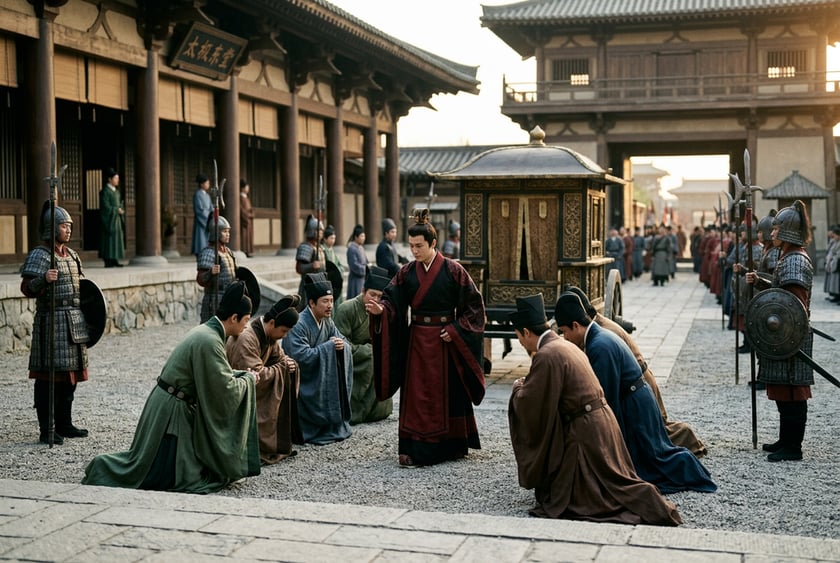
Since Emperor Xian Liu Xie was seized by Dong Zhuo and forcibly relocated to Changan in the first year of Chuping (190), his personal safety and political standing had depended entirely on the Xiliangjun warlords who controlled the central armies. After Dong Zhuo's death, commanders such as Li Jue and Guo Si took over Changan, only to quickly fall into factional infighting — Li Jue held the emperor hostage while Guo Si held the court ministers, turning Changan into an active battlefield between the two forces. The imperial palace was repeatedly plundered, court officials were held captive by rival factions, and the machinery of government was nearly paralyzed. By the second year of Xingping (195), Emperor Xian could no longer remain in Changan: the food supply had been cut off and the imperial retinue had dwindled to almost nothing, and as long as he remained in the hands of Li Jue and Guo Si, the eastern warlords had every reason to ignore the central court's commands. "The Eastern Return" became the only way out for Emperor Xian and his surviving ministers under these circumstances.
Key Figures
The driving force behind the Eastern Return was not Emperor Xian himself but rather several factions with sharply different interests. First came the court civil officials — Yang Biao, Yang Qi, Dong Cheng, and others who, through lobbying, conspiracy, and coalition-building, translated the political goal of "leaving the pass and returning east" into an actionable plan. Second were the Xiliangjun-affiliated commanders Yang Feng and Xu Huang, who had already parted ways with Li Jue and escorted the imperial carriage along the route under the banner of "serving the king". Third were the Bopo Army commanders Han Xian, Li Le, and Hu Cai — former Yellow Turban remnants who were urgently summoned as the last line of defense at the critical moment when the imperial carriage came under pursuit by the combined forces of Li Jue and Guo Si. Zhang Yang, Governor of Henei, and Wang Yi, Governor of Hedong, provided material assistance along the way, preventing the imperial party from starving to death during the famine year.
Core Issues
The true nature of this Eastern Return was not "the emperor going home" but rather a series of transactions between political authority and armed protection. Each time the imperial carriage was taken over by a particular force, that force gained partial control over the nominal authority of the Son of Heaven. The scene described in the novel of Li Le slashing off the fingers of those scrambling to board boats during the river crossing, and the subsequent mass appointment of officers at Anyi by carving titles with an awl because no proper seals were on hand — both reveal that "receiving and escorting the Son of Heaven" was a political asset that could be cashed in immediately: whoever held the emperor could use the imperial seal to distribute official titles wholesale to their troops and legitimize their own military authority. The real consequence of the Eastern Return was not the restoration of court order but the triggering of a broader competition among the eastern warlords for this "political asset."
Political Consequences
When the imperial carriage returned to Luoyang, the old capital had been burned to the ground by Dong Zhuo; palaces lay in ruins, markets stood empty, and court officials had to pay their respects while standing amid brambles. This situation — where "the emperor bore the name but the court could not even feed itself" — created the perfect opportunity for Cao Cao to intervene: he marched south to defeat the Runan Yellow Turbans, then immediately turned north and dispatched Cao Hong and Xiahou Dun and others to meet the imperial party, before personally leading his main force to relocate the imperial carriage to Xudou. From that point on, Cao Cao possessed the banner of "holding the emperor to command the warlords" — while Yuan Shao, Liu Biao, Sun Ce, and the other eastern warlords lost the political leverage to resist Cao Cao even nominally. Equally critical was the fate of those Xiliangjun- and Bopo-affiliated commanders who had escorted the emperor along the way — Yang Feng and Han Xian quickly became unable to tolerate Cao Cao's monopoly on the glory and fled east to Daliang, where they were soon destroyed.
Counterfactual Analysis
Had Emperor Xian not launched the Eastern Return in 195 and instead remained stranded in Changan: the internal conflict between Li Jue and Guo Si would have continued until they exhausted each other, and Cao Cao might have been forced to march directly into the Guanzhong region to escort the emperor — which would have shifted the axis of Cao Cao's expansion away from the Central Plains–Hebei corridor toward Guanzhong and Liangzhou, bringing his inevitable conflict with Ma Teng and Han Sui forward by more than a decade. Alternatively, had the Eastern Return succeeded but been intercepted first by Yuan Shao or Liu Biao rather than Cao Cao, then it would have been another man who "held the emperor," and the political axis of the entire San Guo configuration might have been anchored at Yecheng or Xiangyang — Cao Cao might have spent his entire career as a mere warlord confined to a corner of Henan. The Eastern Return matters precisely because it put the ownership of the "Han court" brand up for negotiation one final time, and Cao Cao was the greatest beneficiary of that transaction.