Background
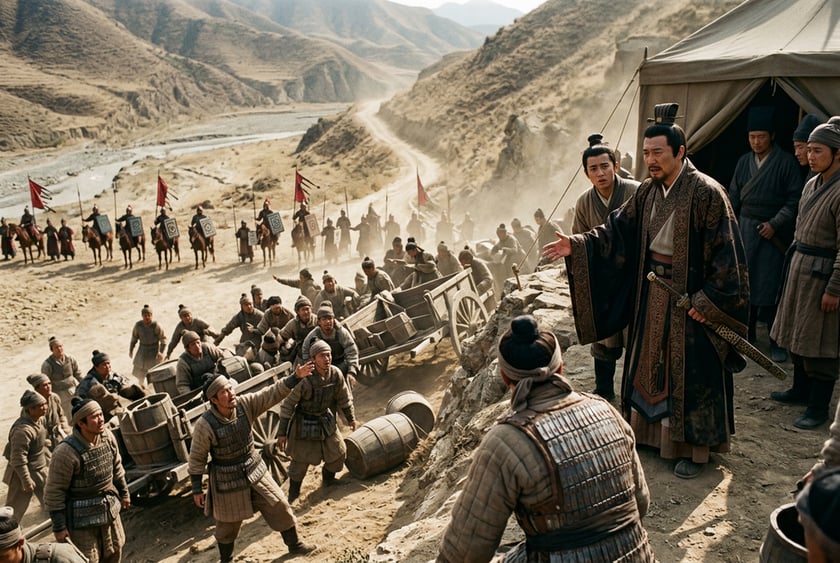
The armed conflict of Li Jue and Guo Si was the climax of the "Turmoil of Li Jue and Guo Si" and a naked portrait of the collapse of central power at the end of the Eastern Han. After Dong Zhuo's death, his old subordinates Li Jue and Guo Si stormed into Chang'an, killed Wang Yun, drove out Lü Bu, and seized Emperor Xian of Han to control the court—Li Jue made himself Grand Marshal and Guo Si made himself General-in-Chief, running rampant without restraint while no one at court dared speak [c:16150]. This arrangement of "two villains jointly holding the Son of Heaven" was inherently fragile: both held military power, both wished to monopolize the reins of court, and their mutual suspicion was only a matter of time. The Grand Commandant Yang Biao and the Grand Minister of Agriculture Zhu Jun saw precisely this fissure, and offered Emperor Xian the estrangement plan of "first making the two villains destroy each other, then summoning outside support to sweep them clean" [c:16150].
Principal Figures
Li Jue and Guo Si were the dual protagonists of this internal strife, both Liang-Province warlords, brave but lacking in scheme, greedy and full of suspicion. Yang Biao was the planner behind the scenes; perceiving the jealous nature of Guo Si's wife, he instructed his own wife to enter Guo's household and spread rumors that Guo Si was having an affair with Li Jue's wife, and used the matter of a poisoned dog at a banquet Li Jue had sent over to confirm the suspicion, pushing the two step by step toward rupture [c:16151][c:16152]. Throughout the storm Emperor Xian was a bargaining chip fought over, with no autonomy to speak of. Jia Xu showed his diplomatic dexterity at the crucial moment—he secretly advised Emperor Xian to use offers of high rank to break up Li Jue's already scattered followers [c:16158]; and Huangfu Li, on imperial order, shuttled between the two camps to persuade them, also attempting to reproach them on grounds of righteousness over the gravity of their acts [c:16157]. In the end it was Zhang Ji, leading a great army in from Shaanxi to mediate and suppress, who at last brought both sides to lay down arms and escort Emperor Xian eastward.
Core Issues
On the surface this conflict was the private grudge of two warlords, but in essence it was an armed contest over "who could monopolize the political capital of the Son of Heaven." When Guo Si was convinced he had been poisoned, he declared, "Li Jue and I planned great affairs together, and now he seeks for no reason to murder me," and so struck preemptively [c:16153]; Li Jue then raised troops first and abducted Emperor Xian into his camp, turning the emperor into the legitimizing signboard of his own "protecting the imperial carriage" [c:16156]. The most absurd scene was the two cursing each other before their lines—Li Jue calling himself "protector of the carriage," Guo Si denouncing him as "abductor of the carriage"—each wanting to monopolize control of the Son of Heaven [c:16155]. The core issue thus became clear: in an age of chaos with central authority collapsed, the Son of Heaven had become the most valuable and also the most helpless political prop in the warlords' armed struggles.
Political Consequences
The direct consequence of the conflict was another catastrophe for Chang'an: chaotic battle beneath the walls and the plundering of the inhabitants, Li Xian abducting the Son of Heaven, Guo Si carrying off the palace ladies and burning the palaces, with countless palace folk shot dead by stray arrows [c:16154]. The last shred of the Han court's dignity was wiped away. The strife also drained the strength of the Liang-Province warlords—Yang Feng, discontented with Li Jue's unfair distribution of rewards and punishments, defected and rose in revolt, and Li Jue's military fortunes gradually waned [c:16158]. At last, through Jia Xu's divisions and Zhang Ji's mediation, Emperor Xian was able to journey east to Hongnong, taking the first step in breaking free of Chang'an. This chain of reactions sowed the distant cause for Cao Cao's later "upholding the Son of Heaven to command the unsubmissive" and welcoming Emperor Xian to Xu.
Counterfactual Speculation
Suppose Li Jue and Guo Si had not fallen for the estrangement and had continued to hold Emperor Xian in concert—what then? The answer is likely another disaster: two greedy, brutal warlords firmly controlling the Son of Heaven, no hope of Emperor Xian's journey east, and Guanzhong long mired under high-handed warlord rule. From this angle, though Yang Biao's estrangement scheme came at the price of Chang'an's people being put to the slaughter, it objectively broke the monolith of the Liang-Province warlords and created a crack through which the Son of Heaven could escape. The deeper lesson of the Li Jue–Guo Si conflict is this: a power structure sustained by the "joint rule" of several strongmen with inconsistent interests is inherently lacking in stability, and from outside a single lever (one rumor) suffices to detonate its internal zero-sum struggle. And the one who truly laughs last is often not any party to the conflict, but the third party who waits patiently and finally takes over the Son of Heaven—Cao Cao.