Background
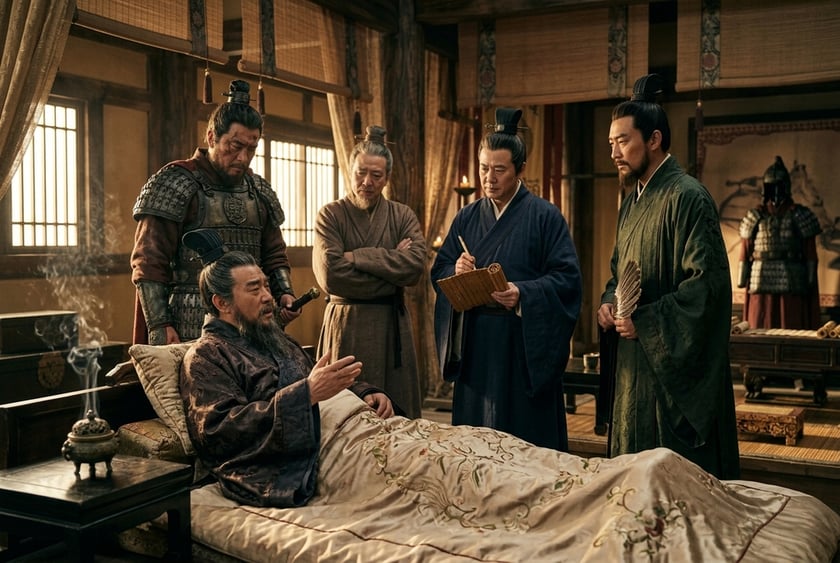
In the first year of Zhengshi (240), Emperor Ming Cao Rui died, leaving behind an adopted son of barely eight years, Cao Fang, to succeed to the throne. The two figures entrusted with the regency in Emperor Ming's final moments were Cao Zhen's son Cao Shuang, a senior representative of the imperial clan, and Sima Yi, a minister who had served through four reigns — representing the two political axes of the Cao bloodline and the meritorious outsider families respectively. The Romance places this configuration at the opening of chapter 106: Sima Yi and Cao Shuang "assist the crown prince Cao Fang in ascending to the imperial throne," honor Empress Dowager Guo as empress dowager, and change the reign name to Zhengshi [c:17068]. This arrangement essentially followed the precedent of "imperial clan plus meritorious minister" dual-track regency established since Emperor Wen, but unlike the balanced equilibrium of the "four regents" — Chen Qun, Sima Yi, Cao Zhen, and Cao Xiu — in Cao Pi's early reign, by the Emperor Ming era the imperial clan had withered; Cao Shuang was virtually the sole surviving representative of the Cao line in the central government, which meant the two-track system was naturally tilted from the outset, and power could easily tip entirely to one side with only a small shift in personnel.
Key Figures
Cao Shuang had frequented the inner palace from childhood and enjoyed the deep trust of Emperor Ming, but was not himself known for his abilities; his governance depended on a cohort of celebrated scholar-officials in his service [c:17068]. The so-called "Fanciful Elegants" — He Yan, Deng Yang, Ding Mi, Li Sheng, and Bi Gui as the core five, plus Grand Agriculturalist Huan Fan known as the "brain trust" — constituted Cao Shuang's think tank [c:17068]. Most of these men came from prominent families, admired refined discourse, had strong theoretical foundations but thin administrative experience, forming a sharp contrast to Sima Yi's decades of military-political seasoning. Sima Yi's side, while making a show of yielding, had his two sons Sima Shi and Sima Zhao "retire from office to leisure" [c:17069], building up a potential power in reserve. Pragmatic middle-ranking officials such as Fu Gu, Wei Zhen, Sun Li, and Wang Guan were in an awkward position — some holding remonstrance posts within the Cao Shuang faction, others eventually siding with the Sima clan in the later Gaopinglingzhibian.
Core Issues
The true issue at the start of the regency was: who would control military authority and the power of personnel appointment. He Yan stated it plainly: "Great authority must not be delegated to others, or trouble will arise later" [c:17068], and by bringing up the old grievance that Sima Yi, while resisting Shu during his earlier command, had repeatedly put Cao Zhen in a humiliating position until Cao Zhen died of grief and frustration, he stoked Cao Shuang's sense of clan enmity. Cao Shuang thereupon memorialized to honor Sima Yi with the title of Grand Tutor — superficially an elevation and honor, but in reality a stripping of real power, removing from his grasp the critical levers of the Secretariat directorship and command of the palace guard [c:17068]. Next came the reshuffling of the palace guard and central personnel: Cao Xi was made Commander of the Central Army, Cao Xun Commander of the Valiant Guard, Cao Yan Cavalier Attendant-in-Ordinary, each commanding three thousand palace troops; He Yan, Deng Yang, and Ding Mi took posts as Secretariat Ministers; Bi Gui became Inspector of Sili; Li Sheng became Prefect of Henei [c:17069]. This combination allowed the Cao Shuang faction to complete its takeover of all four critical nodes — "military force, administration, censorship, and the capital region."
Political Consequences
The side effects of this extreme concentration of power manifested quickly. The Romance dwells at length on the extravagance of Cao Shuang's lifestyle — clothing and utensils "indistinguishable from those of the court," rare curiosities "with the finest specimens taken first for himself," the mansion filled with beautiful women, the eunuch Zhang Dang even privately selecting former imperial concubines on his behalf, another thirty or forty girls of good families skilled in song and dance recruited as his household entertainers, and multi-story painted buildings under construction day and night [c:17069]. This portrayal carries a strongly critical tone, but its political import is clear: beneath the surface appearance of stability in the early Zhengshi court, the Cao Shuang faction rapidly descended into corruption and empty discourse, losing political self-restraint internally while suffering repeated setbacks in border affairs externally (such as the Luogu Valley invasion of Shu in 244). Sima Yi's "retirement due to illness" was a textbook-level strategic silence: he and his two sons endured in concealment for nearly ten years, biding their time for the one decisive strike that became the Gaopinglingzhibian of 249. It can be said that Caoshuangfuzheng was the necessary precondition for Simashiduoquan: structurally it completed the purging of the old Cao retainers and the isolation of the Fanciful Elegants, ensuring that the eventual coup would face not a coalition of the imperial clan but a small clique that had already lost the hearts of the people and the army.
Counterfactual Analysis
Had Cao Shuang adopted the counsel of pragmatists like Huan Fan rather than the aggressive line of He Yan and Deng Yang, would Wei have avoided the fate of dynastic replacement? The answer is almost certainly no, though the timing would have been significantly different. Even had Cao Shuang and Sima Yi maintained a surface dual-track arrangement, the structural problem of the imperial clan's decline would still have remained, and the Sima family's military roots had been accumulating steadily through the reigns of both Cao Pi and Cao Rui — they could not be easily uprooted. But had Cao Shuang not proactively stripped Sima Yi of real power, and had he not placed all palace guard forces under Cao family relatives, at least the timing of the coup could have been delayed, forcing Sima Yi to find some other opening before his natural death (251). Conversely, the fundamental dilemma of the Cao Shuang faction was "using refined scholars to command troops" — they could establish no genuine personnel loyalty within the Luoyang palace guards, yet refused to share power with meritorious veterans outside the Cao family. This structural defect meant that no tactical adjustment could fundamentally reverse the tide; the Gaopinglingzhibian of the tenth year of Zhengshi (249) looks more like a long-awaited reckoning than an accidental event.