Background
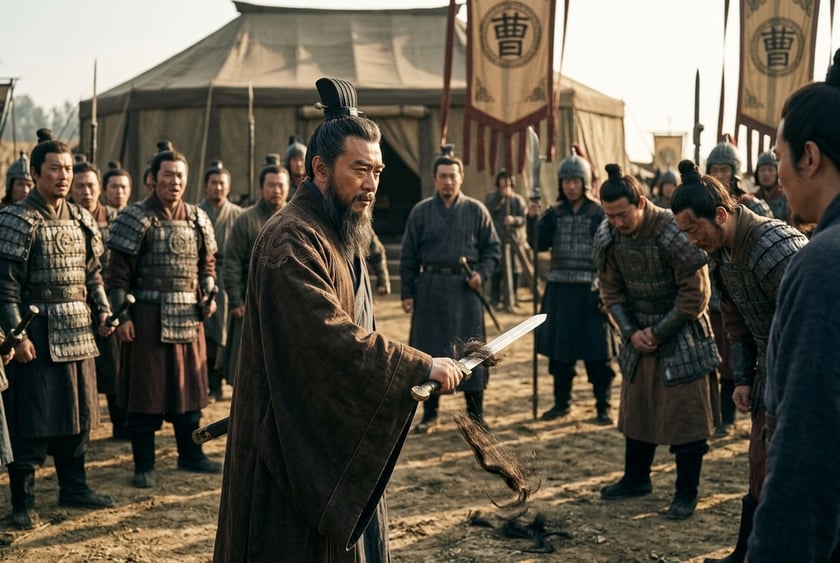
Luoyang at the end of the sixth year of Zhongping (189) and into the first year of Chuping (190) was in the throes of the political convulsion in which Dong Zhuo had deposed the young emperor, enthroned Emperor Xian, and was conducting widespread massacres. Cao Cao had been serving as Commandant of the Colonel Who Attacks the Enemy; he had attempted to assassinate Dong Zhuo in the hall under the pretense of presenting a sword, and after the attempt failed he fled from Luoyang. In the novel's narrative, he experienced two significant episodes during his flight: the first was being recognized by the Zhongmu county magistrate Chen Gong, who nonetheless released him; the second was the killing of the entire family of Lv Boshe, producing the moral declaration "I would rather I wrong others than that others wrong me" — transforming him in his own self-fashioning from a Han loyalist into a pragmatist who takes the age of chaos as his arena. These events form the psychological and moral backdrop for Cao Cao's raising of troops: he was no longer a "minister within the system set on restoring the Han," but a warlord of troubled times who needed to build his own armed force to survive and advance.
Key Figures
The personnel structure of the troop-raising phase displays the classic four-layer network of "clan — affines — local elite clans — men who came to join." The clan layer comprised the Xiahou and Cao families: Xiahou Dun and Xiahou Yuan each led a thousand strong men to rendezvous, while Cao Ren and Cao Hong each brought more than a thousand troops to assist — since Cao Song had originally been born a Xiahou and was given in adoption to the Cao family, the two clans jointly formed the blood-tie foundation of Cao Cao's troop-raising. The affine and elder generation layer comprised Cao Song and Wei Hong: Cao Song proposed that "dispersing the family fortune will not accomplish the matter; we must borrow the wealth of Wei Hong," and Wei Hong responded to the call by pledging his family property, saying "I have long had this intention but had yet to meet a hero of stature". The local elite clan layer comprised the men of Chenliu itself, who "answered the call like rain gathering together" — reflecting Chenliu's reserves of talent and materiel among the late-Han warlords. The layer of men who came to join comprised Le Jin and Li Dian: journeying from Yangping and Shanyang's Baolu for a thousand li to offer their services, they were the embryonic forms of what would later become the Five Good Generals. Although Xun Yu, Xun You, Cheng Yu, and Guo Jia are listed as participants in this event, most formally joined only at a somewhat later stage; nevertheless the troop-raising already created the organizational conditions for their eventual entry.
Core Issues
This troop-raising event revolves around three mutually nested political propositions. The first is the source of legitimacy: Cao Cao could not raise troops under a formal edict from the Han court; he chose to "first issue a forged edict and send it swiftly to all regions" — using a fabricated Son-of-Heaven edict as the banner to gather righteous forces, packaging a private armed force as an act of "loyalty and righteousness," with "Loyalty and Righteousness" written on the white recruitment banner. This "raising troops on a forged edict" was in the late Han a high-risk but high-reward strategy: it allowed Cao Cao to occupy the moral high ground, but it also meant that if the effort failed he would face the serious charge of "issuing a false edict." The second is the coupling of funding and personnel: Cao Cao's family fortune alone was insufficient to sustain large-scale recruitment; the resources of the local elite family of Wei Hong were indispensable; simultaneously, the speed with which Cao Cao's own clansmen — Xiahou Dun and the others — brought troops was far faster than the mobilization pace of other warlords, and this "clan-based army" became the source of Cao's core fighting power in subsequent years. The third is the self-fashioning of moral capital: Chen Gong's departure from Cao Cao after the "I would rather I wrong others" episode is the novel's earliest portrayal of Cao Cao's moral character. In this episode Cao Cao makes a definitive choice between "moral reputation" and "personal survival" — a choice that runs through the entirety of his subsequent political life.
Political Consequences
The immediate outcome of the troop-raising was that within a few months Cao Cao possessed an initial military force with clan officers as its backbone, local-elite family wealth as its financial support, and the banner of "loyalty and righteousness" as its source of legitimacy. In the medium and long term, the consequences have three layers. First, the coalition of Pass-East armies to suppress Dong Zhuo formally assembled in the first year of Chuping; Cao Cao participated as an independent warlord, standing alongside Yuan Shao, Yuan Shu, Sun Jian, and others — leaping from a minor Han official into the ranks of the lords. Second, the clan officer system established during this troop-raising (Xiahou Dun, Xiahou Yuan, Cao Ren, Cao Hong) became the command core that Cao Cao never altered throughout his life, forming a binary structure with non-clan generals (Le Jin, Li Dian, Yu Jin, with Zhang Liao and Xu Huang joining later) — the "Cao-Xiahou clans plus the Five Good Generals" — ensuring that supreme military authority always remained in clan hands. Third, "raising troops on a forged edict" as a political template gave Cao Cao a consistent strategic style when later using the Son-of-Heaven's name to command the lords — supplementing actual power with nominal legitimacy — ultimately developing into the complete strategy of "honoring the Son of Heaven in order to command the lords."
Counterfactual Analysis
Suppose that after fleeing to Chenliu, Cao Cao had failed to persuade Wei Hong to provide the funding: his initial armed force might have remained at the scale of several hundred men, unable to recruit heroes from all directions, and he would at most have been an inconsequential guest general within the coalition of Pass-East armies — the early San Guo configuration would have been completely different. Furthermore, had Chen Gong not abandoned Cao Cao after the "I would rather I wrong others" episode but remained as his early advisor, Cao Cao's counselor corps would have taken shape earlier than in actual history; but at the same time, constrained by Chen Gong, Cao Cao might have been unable to make certain "morally questionable but effective" critical decisions, and his political trajectory might have tilted more toward the path of "loyal Han minister." Finally, had Cao Cao chosen not to issue a forged edict but instead to raise troops in his own name, he would have lost the moral rallying power of the "loyalty and righteousness" banner and found it difficult to complete the mobilization to the scale of ten thousand men within a few months — the entire timetable of the late-Han warlords' rise would have been pushed back accordingly. The true significance of the troop-raising event therefore lies not in the scale of a few thousand men, but in establishing the three main lines of Cao Cao's lifelong political style: clan-based civil-military organization, legitimacy through forged imperial orders, and a pragmatic moral code.