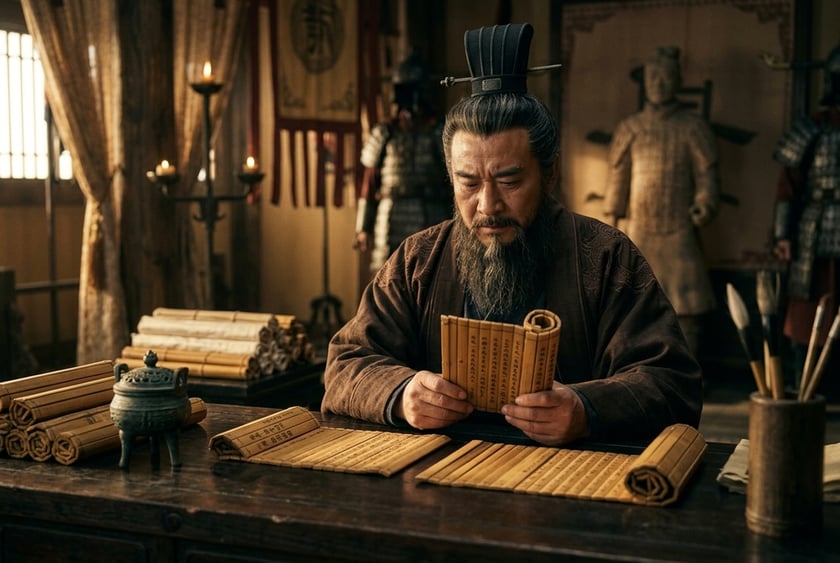
Strategic Background
The Central Plains situation of 193–194 was on the eve of the final stage of multi-polar warfare: Yuan Shao held Jizhou, Gongsun Zan held Youzhou, Yuan Shu held Huainan, Cao Cao held Yanzhou, and Tao Qian held Xuzhou — each party searching for room to expand. Cao Cao chose "vengeance" as the banner for launching the Xuzhou campaign, but his strategic intent went far beyond settling a personal score. Xuzhou lay to the southeast of Yanzhou, comprising the wealthy commanderies of Langye and Donghai and controlling the north-south Grand Canal route and the Huai-Si corridor, making it directly relevant to the security of the Yanzhou bloc. Although Tao Qian nominally held the title of a Han-appointed frontier administrator, Xuzhou's local elite clans were deeply rooted and his governing capacity was relatively weak, making him a target Cao Cao could legitimately absorb under the pretext of "punishment." Framing the campaign as a "military operation" rather than a purely political expedition allows a clearer view of its battlefield details and decision-making logic.
Deployments on Both Sides
The first phase of Cao's campaign was directed at the Langye–Donghai axis in northern Xuzhou, with Cao Cao personally leading the main force and vanguard commanders Xiahou Dun, Yu Jin, and Dian Wei clearing the way; the rear left Xun Yu and Cheng Yu holding the three core Yanzhou strongpoints of Juancheng, Fan County, and Dong'e. The second phase pushed further, with Cao Cao personally advancing to Donghai Commandery and clashing with Tao Qian's forces of Cao Bao and the client general Liu Bei in a blocking action near Tan on the return march. Tao Qian's dispositions relied primarily on city defense: Xuzhou proper was held firmly, with a detachment posted at ambush positions east of Tan, while external aid was sought from Mi Zhu and Chen Deng dispatched north to Beihai and Qingzhou to bring in relief forces from Kong Rong, Tian Kai, and Liu Bei. This pattern of "solid defense of the cities combined with multilateral external relief" was the classic response of a mid-tier warlord under attack from a stronger aggressor.
Critical Decision Points
The most critical decisions in the campaign occurred at three moments. The first was whether Cao Cao should extend the massacres: he chose to expand "punishing Tao Qian" into "slaughtering the subordinate population," a decision that tactically accelerated the submission of towns and cities but morally accumulated a heavy liability, singled out for criticism by the later historian Sun Sheng as going "too far." The second was Guo Jia's advice on how to respond to Liu Bei's letter: Liu Bei argued for "putting the court's crisis ahead of private enmity" to urge Cao Cao to pull back; Cao Cao initially wanted to execute the envoy and press the assault, but Guo Jia counseled "courtesy first, then force" — detaining the envoy with hospitality, relaxing the appearance of hostility on the surface while pressing the attack in reality — a stratagem reflecting the mature use of psychological warfare on Cao Cao's part. The third was Cao Cao's misjudgment of the security of Yanzhou's rear: he failed to detect that Zhang Miao and Chen Gong had developed a fundamental grievance against him, leaving the rear in the hands of only a few civil officials and a garrison; this gave Lv Bu the opening to strike Yanzhou, interrupting the entire eastern campaign.
Outcome and Aftermath
The campaign ended with Cao Cao forced to turn back, having failed to complete the annexation of Xuzhou. The direct battlefield gains were the capture of more than ten Xuzhou cities, but these were soon lost again once the Yanzhou crisis erupted. The indirect consequences were threefold: first, Tao Qian died not long afterward, and the Xuzhou local elite invited Liu Bei to take over as governor — Liu Bei thereby leaped from the status of a dependent client general to that of a warlord with territory and troops; second, "the massacre of Xuzhou" became the most controversial political stain of Cao Cao's early career, damaging his image among the scholar-gentry for years; third, the exposed vulnerability of Cao's rear made plain the limits of Cao Cao's early organizational capacity, compelling him after the campaign to restructure Yanzhou's governance, relying on Xun Yu, Mao Jie, and others to systematize administration — a rethinking that directly catalyzed the strategic pivot of "honoring the Son of Heaven in order to command the lords."
Counterfactual Analysis
Had Cao Cao adopted a restrained strategy — using "punishment of Zhang Kai" as a pretext for only a limited military action without mass slaughter — the local elite of Xuzhou would in all likelihood have pressured Tao Qian to surrender Zhang Kai's associates and compensate the Cao family for their losses, allowing Cao Cao to achieve both nominal and substantive victory without destroying Xuzhou's productive capacity. Furthermore, had Cao Cao simultaneously strengthened his cultivation of Yanzhou-based powers such as Zhang Miao and Chen Gong while committing his main force eastward, the event of Lv Bu striking Yanzhou might never have taken shape, and Cao Cao might even have completely absorbed Xuzhou before the end of 194 — completing the integration of the Central Plains ahead of schedule, which would also have moved forward the timetable for the decisive battle against Yuan Shao at Guandu. Finally, had Liu Bei been unable to exploit this opening to take over Xuzhou, his political starting point in the late Han warlord landscape would have been later and weaker, and the core narrative arc of San Guo would have been significantly reshuffled. The real significance of the Xuzhou campaign therefore lies not in "what was fought and how much was captured," but in how it unexpectedly exchanged strategic opportunities between Cao Cao and Liu Bei.