Background
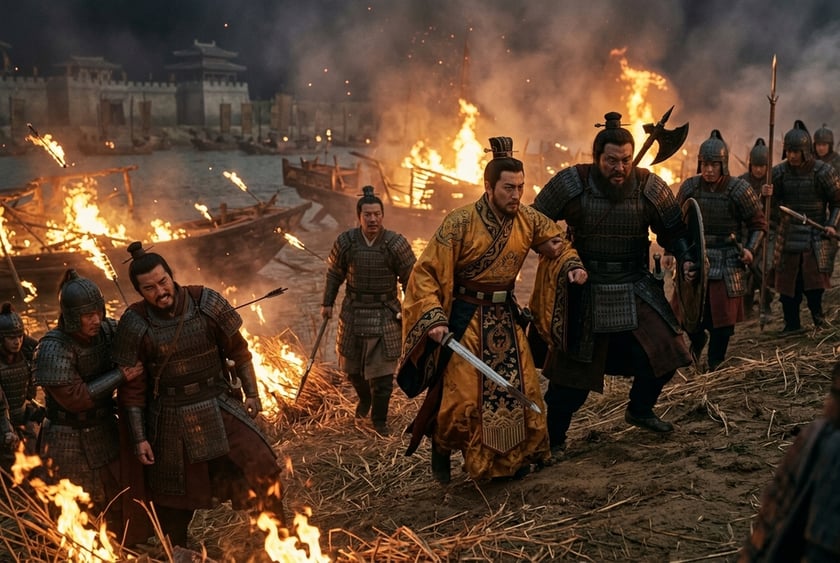
In the first year of Xingping (194), Cao Cao was at a pivotal stage of using Yanzhou as his base and projecting military force outward. The previous year he had achieved initial results in Xuzhou but had been compelled to withdraw for lack of winter provisions; entering the new year, he needed a decisive expedition to settle the Xuzhou question once and for all. Vengeance was the nominal banner: his father Cao Song had been killed by Zhang Kai, a commandant dispatched by Tao Qian, while journeying to Yanzhou to reunite with the family, in the area of Hua and Fei in Taishan; Zhang Kai subsequently fled south to Huainan with the plunder [c:17046]. The complication lay in the fact that whether Tao Qian himself had personally ordered the killing was never clear, but Cao Cao chose from a perspective of blame-assignment to hold Tao Qian directly responsible, binding private grievance tightly to political military action.
Key Figures
The command structure of this campaign reflects Cao Cao's early style of overall leadership: he served as commander-in-chief himself, leaving Xun Yu and Cheng Yu to hold Juancheng against threats to the rear, while overseeing the front personally, ensuring full control over the strategic objective [c:17046]. On Tao Qian's side, as Governor of Xuzhou he should have been coordinating from the center, but his command ability was clearly inferior to Cao Cao's in the field; Cao Bao and Liu Bei together garrisoned east of Tan, forming the core force opposing the Cao main army on Xuzhou's side. It is worth noting that at this time Liu Bei was still serving in the subordinate capacity of a client general under Tao Qian, but was already beginning to accumulate his own political capital through the process of resisting Cao Cao in Xuzhou. In this campaign, Sun Sheng — as a representative later historian — left behind the assessment that "punishing wrongdoers while offering comfort to the people is the noble tradition of antiquity; but attributing fault to Tao Qian and then slaughtering his subordinate population goes too far," introducing an outside scholarly perspective on the battle beyond the participants themselves [c:17046].
Core Issues
This expedition revolves around three intertwined propositions. The first is the assignment of responsibility: Zhang Kai was the direct perpetrator, but Cao Cao chose to extend responsibility to Tao Qian and the population of Xuzhou under his jurisdiction — this expansive imputation of blame is the crux of the controversy over the subsequent "massacre of Xuzhou." The second is the relationship between means and ends: the historical record states that "many were slaughtered wherever the army passed," meaning the objective of the expedition expanded from "taking Tao Qian's head" to "eliminating Xuzhou's capacity for resistance" — the result being that what had begun as simple vengeance became a political cleansing of an entire territory. The third is the vulnerability of Yanzhou's rear: even as Cao Cao's main force advanced east, the rear-guard, though capable, could not independently cope with the combined revolt of Zhang Miao, Chen Gong, and Lv Bu, and the Xuzhou campaign was forced into suspension precisely because the internal contradictions in the base territory had not been properly managed.
Political Consequences
Although Cao Cao captured five cities in succession and penetrated deep into Donghai, he did not achieve the ultimate goal of destroying Tao Qian's regime; instead he was thrust into a crisis at his base when Lv Bu struck Yanzhou, forcing him to turn back and deal with it. Tao Qian was able to catch his breath amid the fighting, but died of illness the very year the campaign ended; Xuzhou was then received by Liu Bei at the invitation of the local elite, giving Liu Bei his first formal standing as a lord in his own right. This chain reaction demonstrates that the political significance of the campaign lay not in the outcome on the battlefield, but in the fact that it inadvertently created a vacuum for Liu Bei to take over Xuzhou. On the moral level, Sun Sheng's criticism represents the mainstream view of later historians — elevating a private feud into a state-level punitive war might be defensible, but dragging civilians into it crossed the bottom line of Han-Wei civil-military ethics, and this shadow on Cao Cao's moral standing recurred repeatedly in later narratives of his "massacres."
Counterfactual Analysis
Suppose Cao Cao in the first year of Xingping had not personally campaigned against Xuzhou, but instead dispatched a secondary force to punish Zhang Kai and hold the direct perpetrators of Cao Song's death accountable — pressing Tao Qian to the position of publicly distancing himself from Zhang Kai. In that scenario Xuzhou might have reached a political settlement with Cao Cao through "delivering Zhang Kai's head, paying reparations, and maintaining tributary status," allowing Cao Cao to avoid the moral liability of the massacre and channel more resources into internal consolidation of Yanzhou; the Zhang Miao–Chen Gong revolt might then never have taken shape, since the leadership would not have left the home base. Furthermore, had the Xuzhou campaign not been interrupted and had Cao Cao ultimately taken the city, he would have faced the real difficulty of governing a population that deeply resented him; whether he could have replicated the Yanzhou model remains unknown. And had Xuzhou genuinely been incorporated into Cao Cao's sphere, Liu Bei would have lost the opportunity to take over Xuzhou, and the early character trajectories of the San Guo would have been significantly rewritten. Both lines of counterfactual reasoning converge on the same conclusion: Cao Cao's overreactive decision in 194 not only accumulated a moral liability for himself but also inadvertently cleared a critical opening for his adversary's rise.