Background
In the sixteenth year of Jian'an (211), the political landscape of the realm found Cao Cao freshly returned to Xudou in self-satisfied triumph after crushing Ma Chao at Tongguan, while Liu Bei held the four commanderies of Jingzhou and was urgently searching for a route westward. The governor of Yizhou, Liu Zhang, faced simultaneous pressure from two directions: to the north, Zhang Lu held Hanzhong and had long been hostile to Yizhou; to the east loomed the Sun-Liu alliance's potential ambition to push further west. Liu Zhang himself was timid and irresolute, and his court was divided among factions that favored aligning with Cao Cao, those that preferred cultivating ties with Liu Bei, and those that counseled sealing the borders and going it alone. Zhang Song, the chief aide of Yizhou, belonged to the "must seek outside help" camp, but he had already lost all faith in Liu Zhang's capabilities. His ostensible purpose in traveling as envoy to Xudou was not entirely above board — he secretly carried a detailed map of Sichuan's geography, intending to use the diplomatic mission to gauge outside powers' sincerity and stature and to find Yizhou a "new master."
Principal Figures
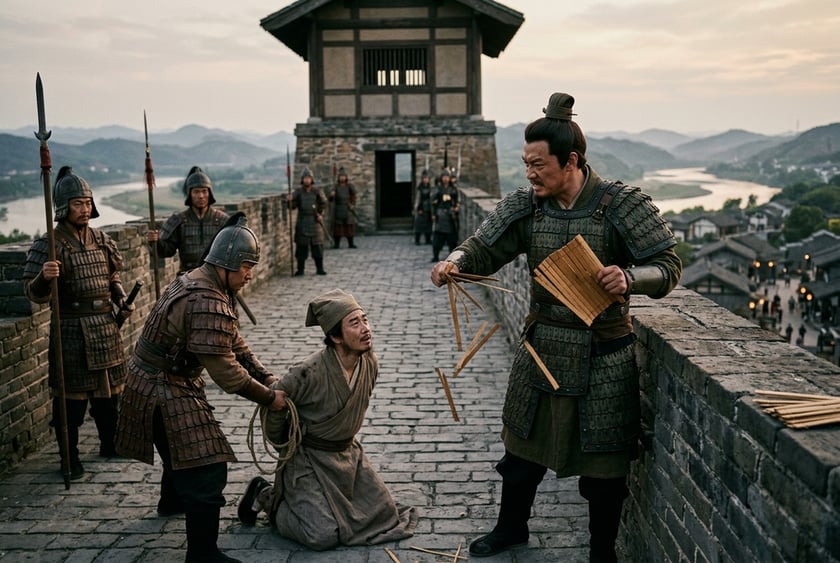
Zhang Song, as depicted in the romance, was a man whose "forehead jutted, head was pointed, nose flat, teeth protruding, and stature under five feet" — physically grotesque but sharp-tongued and possessed of a prodigious memory. This largely matches the historical record: Zhang Song is the archetype of the inner-agent strategist who compensates for appearance with talent. His elder brother Zhang Su was at this time the Grand Administrator of Guanghan, a conservative member of the old Yizhou gentry with a political stance diametrically opposed to Zhang Song's — a fraternal divergence that would ultimately seal Zhang Song's fate. On Cao Cao's side, Yang Xiu had vigorously praised Zhang Song's talent after witnessing him recite the Mengde Xinzao from memory; but Cao Cao dismissed him on account of his looks, was stung by Zhang Song's biting retort, and flew into a rage, ordering his men to drag him out and behead him — only the intercession of Yang Xiu and Xun Yu saved his life. Liu Bei's reception could not have been more different: he first dispatched Zhao Yun to welcome Zhang Song at the Yingzhou border, then personally led Zhuge Liang and Pang Tong to meet him outside the gates of Jingzhou. For three days Liu Bei feasted him "without once raising the topic of Sichuan," and finally, at a farewell banquet at the ten-li pavilion, he let Zhang Song himself broach the subject of "offering Shu."
Central Issue
The political science question at the heart of this episode is: how does one, in an age of upheaval, recruit an insider agent who comes bearing his own intelligence and his own networks? The answer lies in a three-point comparison — protocol, conversational skill, and investment of time. Cao Cao failed on all three counts: from his lofty station as Chancellor he treated a visitor from afar with cold contempt, and in conversation drove Zhang Song from potential ally into active opponent by likening him to a "rat." Liu Bei got all three right: he sent a general of flag rank to fetch him, kept sensitive topics off the table throughout the banquets, and spent three full days building genuine human trust. Most decisive of all was the behind-the-scenes role Zhuge Liang played as "intelligence coordinator" — Kongming had earlier sent agents to Xudou to gather information and was thoroughly apprised of Zhang Song's motives and schedule, enabling every move Liu Bei made to land precisely on Zhang Song's emotional rhythm. This political performance of "treating the worthy with deference" appeared gentle on its surface, yet in substance it was a precise execution of the highest-difficulty political operation: the transfer of an embedded asset.
Political Consequences
Upon returning to Yizhou, Zhang Song immediately conferred in secret with Fa Zheng and Meng Da; all three agreed to deliver Yizhou to Liu Bei. Zhang Song then counseled Liu Zhang, packaging the "invitation of Liu Bei into Shu as outside aid" as a double guarantee against both Zhang Lu and Cao Cao. Liu Zhang complied — and that was the political starting point for Liu Bei's entry into Shu. But Zhang Song's exposure was equally dramatic: late in the seventeenth year of Jian'an, upon hearing that Liu Bei intended to "return to Jingzhou," he urgently wrote a secret letter urging him to "advance quickly" — which was discovered by his elder brother Zhang Su, who happened to be visiting. Zhang Su, acting to protect the family, delivered the letter to Liu Zhang that very night. Liu Zhang "flew into a rage" and ordered the Zhang Song's entire household "put to death in the marketplace." This extermination of the family prematurely exposed Liu Bei's plot to seize Yizhou, forcing Liu Bei to switch abruptly from the mode of "pretended friendship" to open conquest — effectively activating the "middle plan" among Pang Tong's three-tiered strategies.
Counterfactual Analysis
Had Cao Cao not slighted the worthy and instead treated Zhang Song with courtesy — given Zhang Song's realistic and pragmatic character, he might very well have turned to present the Yizhou map to Cao Cao instead. If Cao Cao had obtained Yizhou, he would have completely severed Liu Bei's path westward and created a double envelopment of Sunwu, potentially precluding the formation of the San Guo balance of power altogether; Cao Cao might conceivably have achieved effective unification of the realm between 213 and 215. Conversely, had Zhang Song's secret letter never been discovered by Zhang Su, and had he continued as an inside agent facilitating Liu Bei's entry into Chengdu, the likelihood of Liu Zhang's early surrender would have increased substantially; the three sieges at Jiameng, Fucheng, and Luocheng might have been avoided, Pang Tong would not have had to die at Luocheng, and Shuhan's roster of talent would have been fuller than history recorded. The episode of Zhangsongxiantumoushu is therefore at once the logical starting point of Liu Bei's conquest of Shu and the classic illustration of how Cao Cao's arrogant triumphalism turned back against him. Later political historians have repeatedly cited this case to make a single point: in an age of upheaval, one piece of intelligence delivered to the right recipient is strategically worth more than one hundred thousand troops — provided the recipient understands the asymmetry between the cost and the return of treating the worthy with respect.